
Penny Dreadfuls, 1890 · page 176 of 271
Roxy Hastings — page 176: what you’re looking at
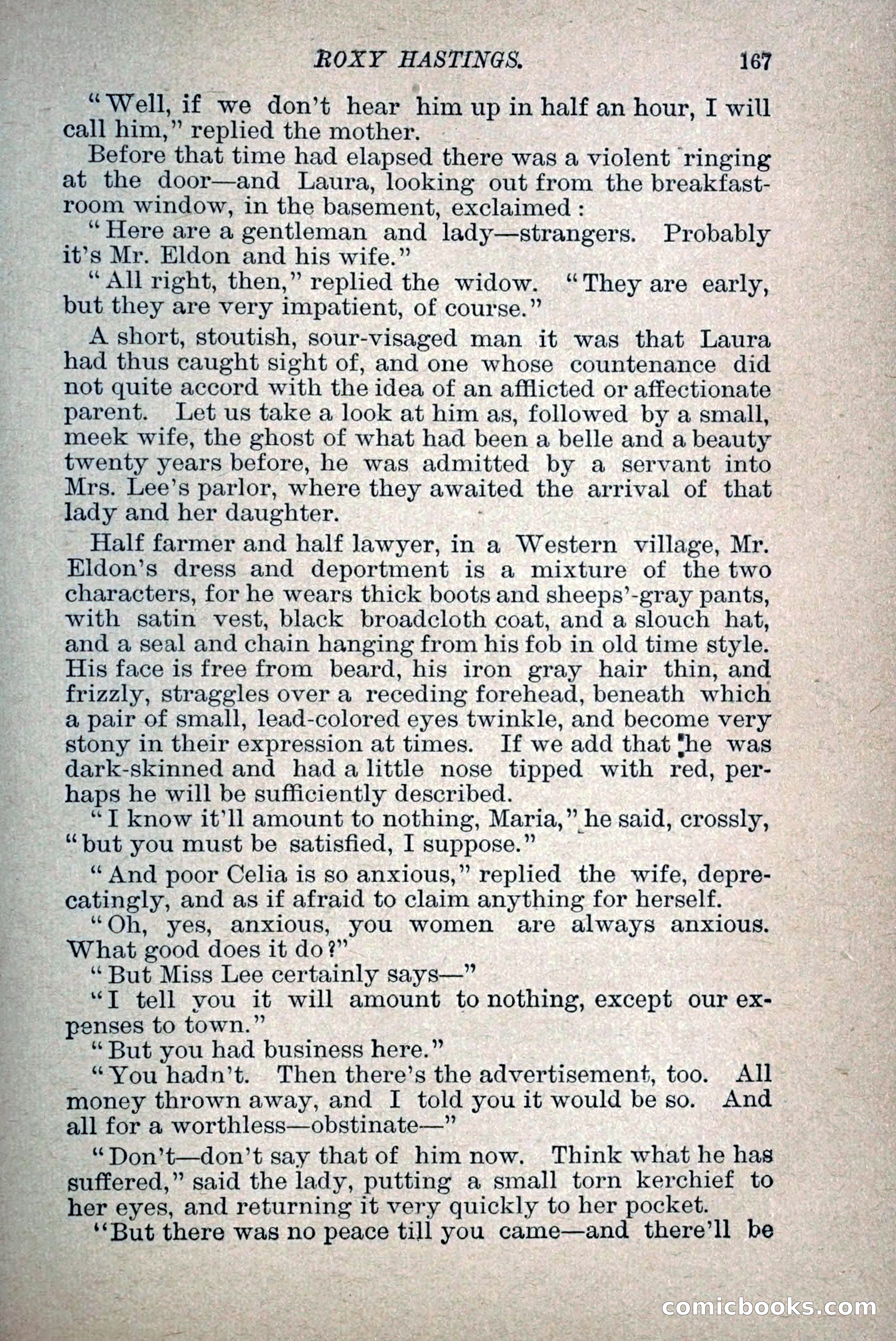
A restored page from Penny Dreadfuls, 1890. Page through the whole issue in the reader above.
📄 Transcribed text from this page (OCR, searchable)
Machine-transcribed from the original scan — historical spelling and the odd misread are preserved.
ROXY HASTINGS. 167 “ Well, if we don’t hear him up in half an hour, I will call him,” replied the mother. Before that time had elapsed there was a violent ringing at the door—and Laura, looking out from the breakfast- room window, in the basement, exclaimed : “ Here are a gentleman and lady—strangers. Probably it’s Mr. Eldon and his wife.” “All right, then,” replied the widow. “They are early, but they are very impatient, of course.” A short, stoutish, sour-visaged man it was that Laura had thus caught sight of, and one whose countenance did not quite accord with the idea of an afflicted or affectionate parent. Let us take a look at him as, followed by a small, meek wife, the ghost of what had been a belle and a beauty twenty years before, he was admitted by a servant into Mrs. Lee’s parlor, where they awaited the arrival of that lady and her daughter. ' Half farmer and half lawyer, in a Western village, Mr. Eldon’s dress and deportment is a mixture of the two characters, for he wears thick boots and sheeps’-gray pants, with satin vest, black broadcloth coat, and a slouch hat, and a seal and chain hanging from his fob in old time style. His face is free from beard, his iron gray hair thin, and frizzly, straggles over a receding forehead, beneath which a pair of small, lead-colored eyes twinkle, and become very stony in their expression at times. If we add that fhe was dark-skinned and had alittle nose tipped with red, per- haps he will be sufficiently described. “I know it'll amount to nothing, Maria,” he said, crossly, “but you must be satisfied, I suppose.” “ And poor Celia is so anxious,” replied the wife, depre- catingly, and as if afraid to claim anything for herself. “Oh, yes, anxious, you women are always anxious. What good does it do?” “But Miss Lee certainly says—” “T tell vou it will amount to nothing, except our ex- penses to town.” “But you had business here.” “You hadn’t. Then there’s the advertisement, too. All money thrown away, and I told youit would be so. And all for a worthless—obstinate—” “TDon’t—don’t say that of him now. Think what he has suffered,” said the lady, putting a small torn kerchief to her eyes, and returning it very quickly to her pocket. ‘‘But there was no peace till you came—and there’ll be GEomicboo! cS Go