
Penny Dreadfuls, 1890 · page 133 of 271
Roxy Hastings — page 133: what you’re looking at
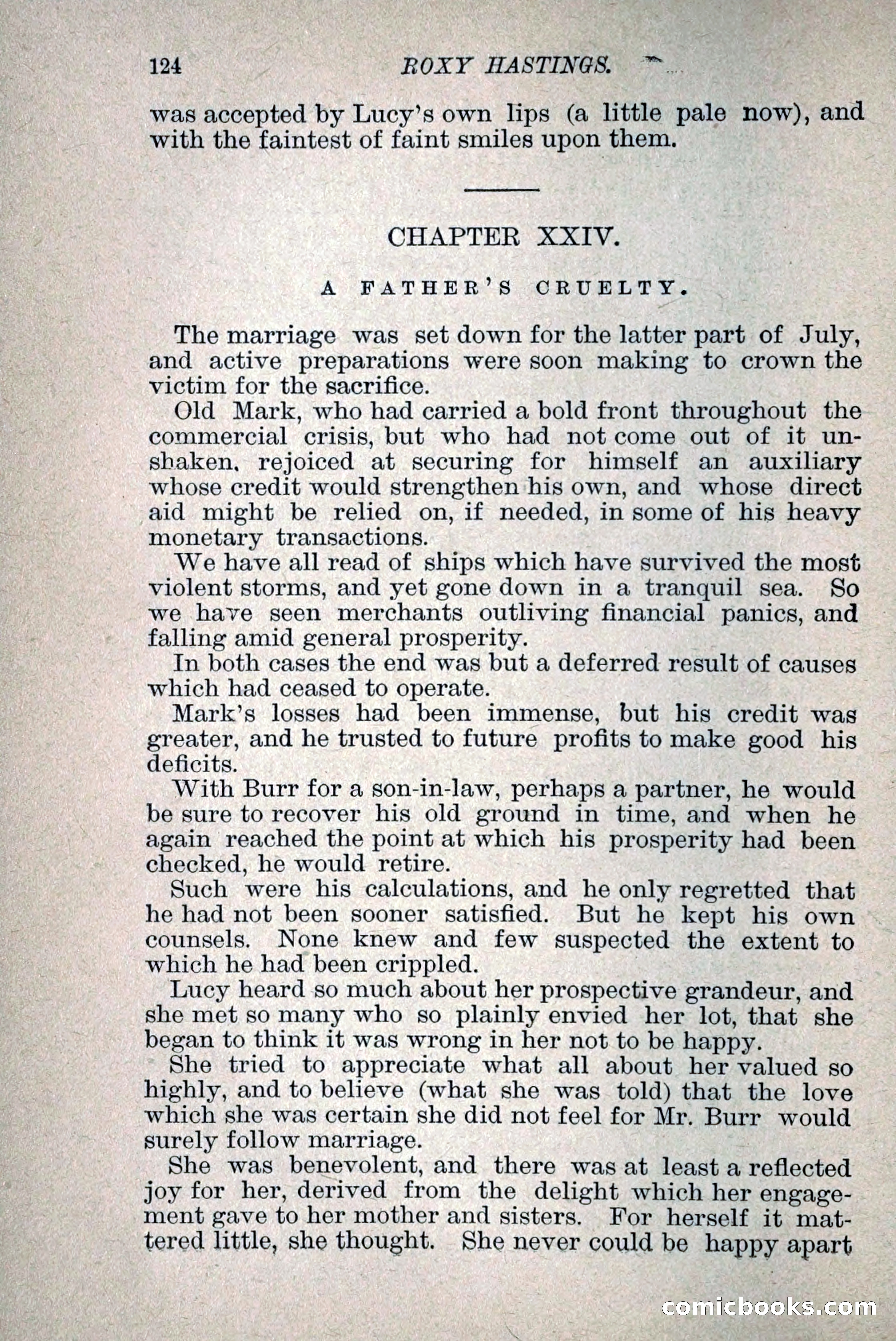
A restored page from Penny Dreadfuls, 1890. Page through the whole issue in the reader above.
📄 Transcribed text from this page (OCR, searchable)
Machine-transcribed from the original scan — historical spelling and the odd misread are preserved.
124 ROXY HASTINGS. ~™... was accepted by Lucy’s own lips (a little pale now), and with the faintest of faint smiles upon them. CHAPTER XXIV. A FATHER’S CRUELTY. The marriage was set down for the latter part of July, and active preparations were soon making to crown the victim for the sacrifice. Old Mark, who had carried a bold front throughout the commercial crisis, but who had not come out of it un- shaken, rejoiced at securing for himself an auxiliary whose credit would strengthen his own, and whose direct aid might be relied on, if needed, in some of his heavy monetary transactions. We have all read of ships which have survived the most violent storms, and yet gone down in a tranquil sea. So we have seen merchants outliving financial panics, and falling amid general prosperity. In both cases the end was but a deferred result of causes which had ceased to operate. Mark’s losses had been immense, but his credit was greater, and he trusted to future profits to make good his deficits. With Burr for a son-in-law, perhaps a partner, he would be sure to recover his old ground in time, and when he again reached the point at which his prosperity had been checked, he would retire. Such were his calculations, and he only regretted that he had not been sooner satisfied. But he kept his own counsels. None knew and few suspected the extent to which he had been crippled. Lucy heard so much about her prospective grandeur, and she met so many who so plainly envied her lot, that she began to think it was wrong in her not to be happy. She tried to appreciate what all about her valued so highly, and to believe (what she was told) that the love which she was certain she did not feel for Mr. Burr would surely follow marriage. She was benevolent, and there was at least a reflected joy for her, derived from the delight which her engage- ment gave to her mother and sisters. For herself it mat- tered little, she thought. She never could be happy apart Eomicbooks.co