
Penny Dreadfuls, 1890 · page 126 of 271
Roxy Hastings — page 126: what you’re looking at
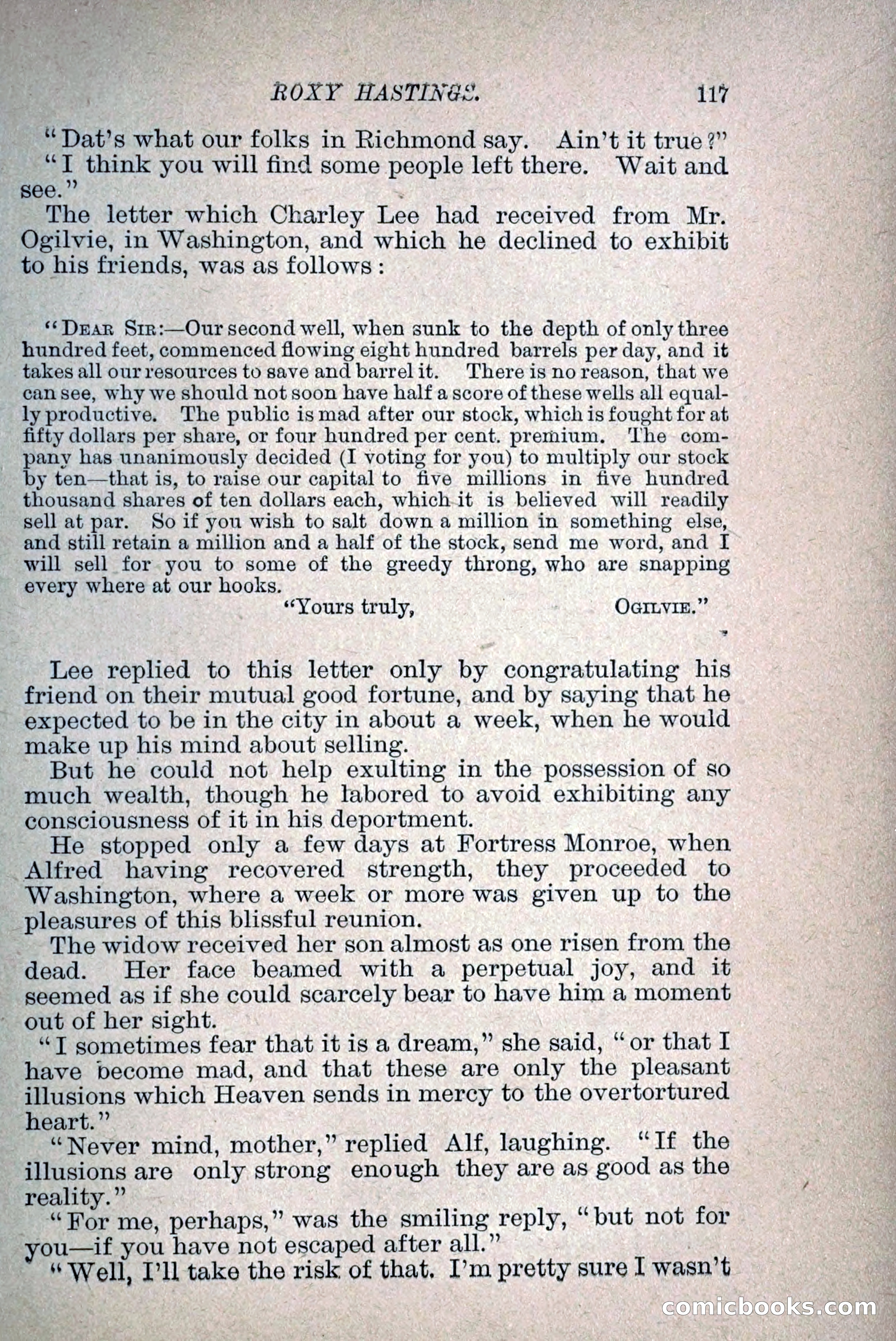
A restored page from Penny Dreadfuls, 1890. Page through the whole issue in the reader above.
📄 Transcribed text from this page (OCR, searchable)
Machine-transcribed from the original scan — historical spelling and the odd misread are preserved.
ROXY HASTINGS. 117 “Dat’s what our folks in Richmond say. Ain’t it true?” “TI think you will find some people left there. Wait and see.” The letter which Charley Lee had received from Mr. Ogilvie, in Washington, and which he declined to exhibit to his friends, was as follows: Dear Str:—Our second well, when sunk to the depth of only three hundred feet, commenced flowing eight hundred barrels per day, and it takes all our resources to save and barrelit. There is noreason, that we can see, why we should not soon have half a score of these wells all equal- ly productive. The public is mad after our stock, which is fought for at fifty dollars per share, or four hundred per cent. premium. ‘The com- pany has unanimously decided (I voting for you) to multiply our stock by ten—that is, to raise our capital to five millions in five hundred thousand shares of ten dollars each, which-it is believed will readily sell at par. So if you wish to salt down a million in something else, and still retain a million and a half of the stock, send me word, and I will sell for you to some of the greedy throng, who are snapping every where at our hooks. “Yours truly, | OGILVIE.” 7 Lee replied to this letter only by congratulating his friend on their mutual good fortune, and by saying that he expected to be in the city in about a week, when he would make up his mind about selling. But he could not help exulting in the possession of so much wealth, though he labored to avoid exhibiting any consciousness of it in his deportment. He stopped only a few days at Fortress Monroe, when Alfred having recovered strength, they proceeded to Washington, where a week or more was given up to the pleasures of this blissful reunion. The widow received her son almost as one risen from the dead. Her face beamed with a perpetual joy, and it seemed as if she could scarcely bear to have him a moment out of her sight. “T sometimes fear that it is a dream,” she said, “or that I have pecome mad, and that these are only the pleasant illusions which Heaven sends in mercy to the overtortured heart.”’ “Never mind, mother,” replied Alf, laughing. “If the illusions are only strong enough they are as good as the reality.” _ “For me, perhaps,” was the smiling reply, “but not for ‘ou—if you have not escaped after all.” “Well, I’ll take the risk of that, I’m pretty sure I wasn’t EOMIG JOO “S (e(6)