
Penny Dreadfuls, 1890 · page 103 of 271
Roxy Hastings — page 103: what you’re looking at
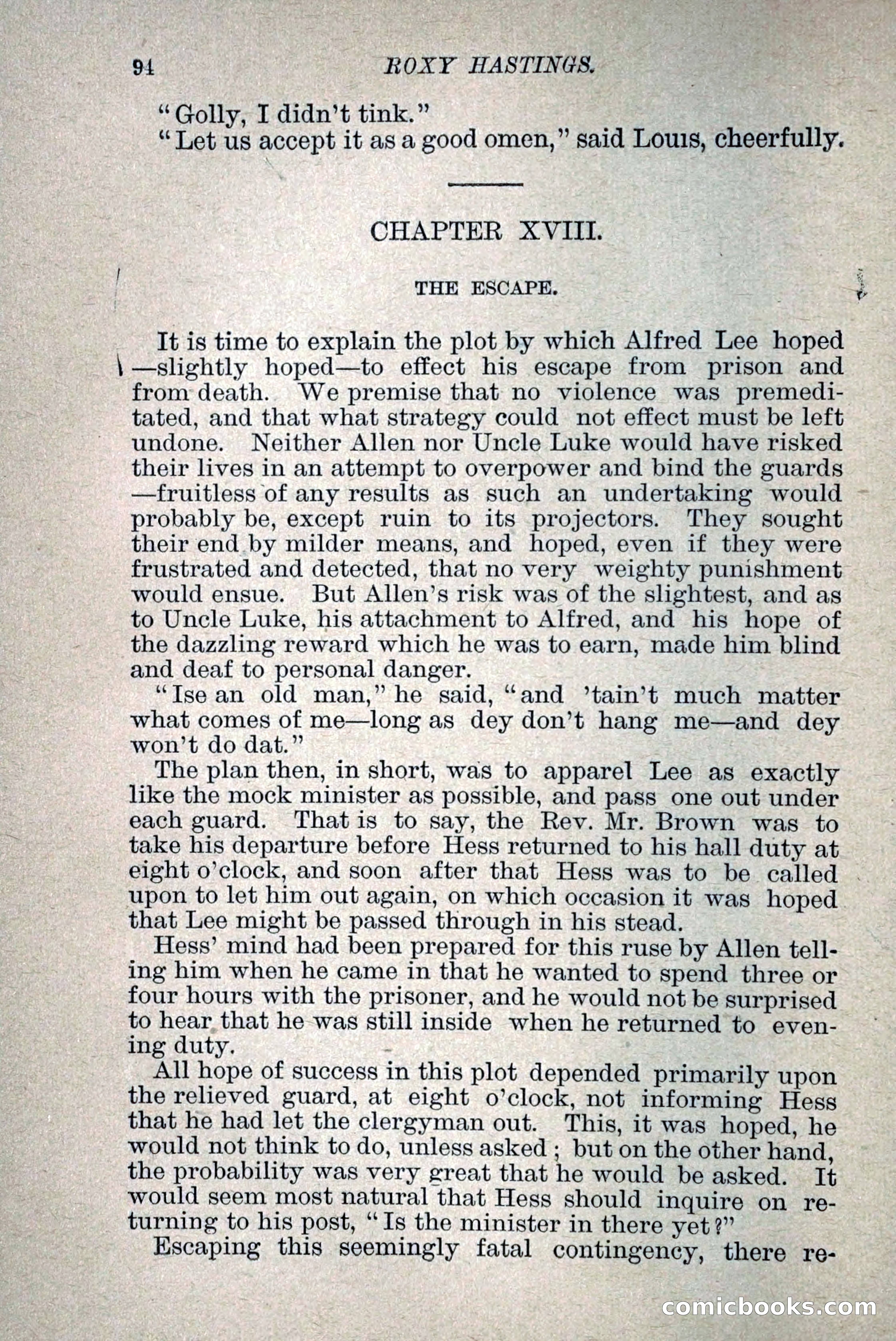
A restored page from Penny Dreadfuls, 1890. Page through the whole issue in the reader above.
📄 Transcribed text from this page (OCR, searchable)
Machine-transcribed from the original scan — historical spelling and the odd misread are preserved.
94 ROXY HASTINGS. “Golly, I didn’t tink.” “Let us accept it as a good omen,” said Louis, cheerfully. CHAPTER XVIII. THE ESCAPE. It is time to explain the plot by which Alfred Lee hoped \—slightly hoped—to effect his escape from prison and from death. We premise that no violence was premedi- tated, and that what strategy could not effect must be left undone. Neither Allen nor Uncle Luke would have risked their lives in an attempt to overpower and bind the guards —fruitless of any results as such an undertaking would - probably be, except ruin to its projectors. They sought their end by milder means, and hoped, even if they were frustrated and detected, that no very weighty punishment would ensue. But Allen’s risk was of the slightest, and as to Uncle Luke, his attachment to Alfred, and his hope of the dazzling reward which he was to earn, made him blind and deaf to personal danger. “Ise an old man,” he said, “and ’tain’t much matter what comes of me—long as dey don’t hang me—and dey won’t do dat.” The plan then, in short, was to apparel Lee as exactly like the mock minister as possible, and pass one out under each guard. Thatis to say, the Rev. Mr. Brown was to take his departure before Hess returned to his hall duty at eight o’clock, and soon after that Hess was to be called . upon to let him out again, on which occasion it was hoped. that Lee might be passed through in his stead. Hess’ mind had been prepared for this ruse by Allen tell- ing him when he came in that he wanted to spend three or four hours with the prisoner, and he would not be surprised to hear that he was still inside when he returned to even- ing duty. All hope of success in this plot depended primarily upon the relieved guard, at eight o’clock, not informing Hess that he had let the clergyman out. This, it was hoped, he would not think to do, unless asked ; but on the other hand, the probability was very great that he would be asked. Tt would seem most natural that Hess should inquire on re- turning to his post, “Is the minister in there yet?” Escaping this seemingly fatal contingency, there re- comicbooks:co