
Penny Dreadfuls, 1854 · page 99 of 400
Rosa Lambert — page 99: what you’re looking at
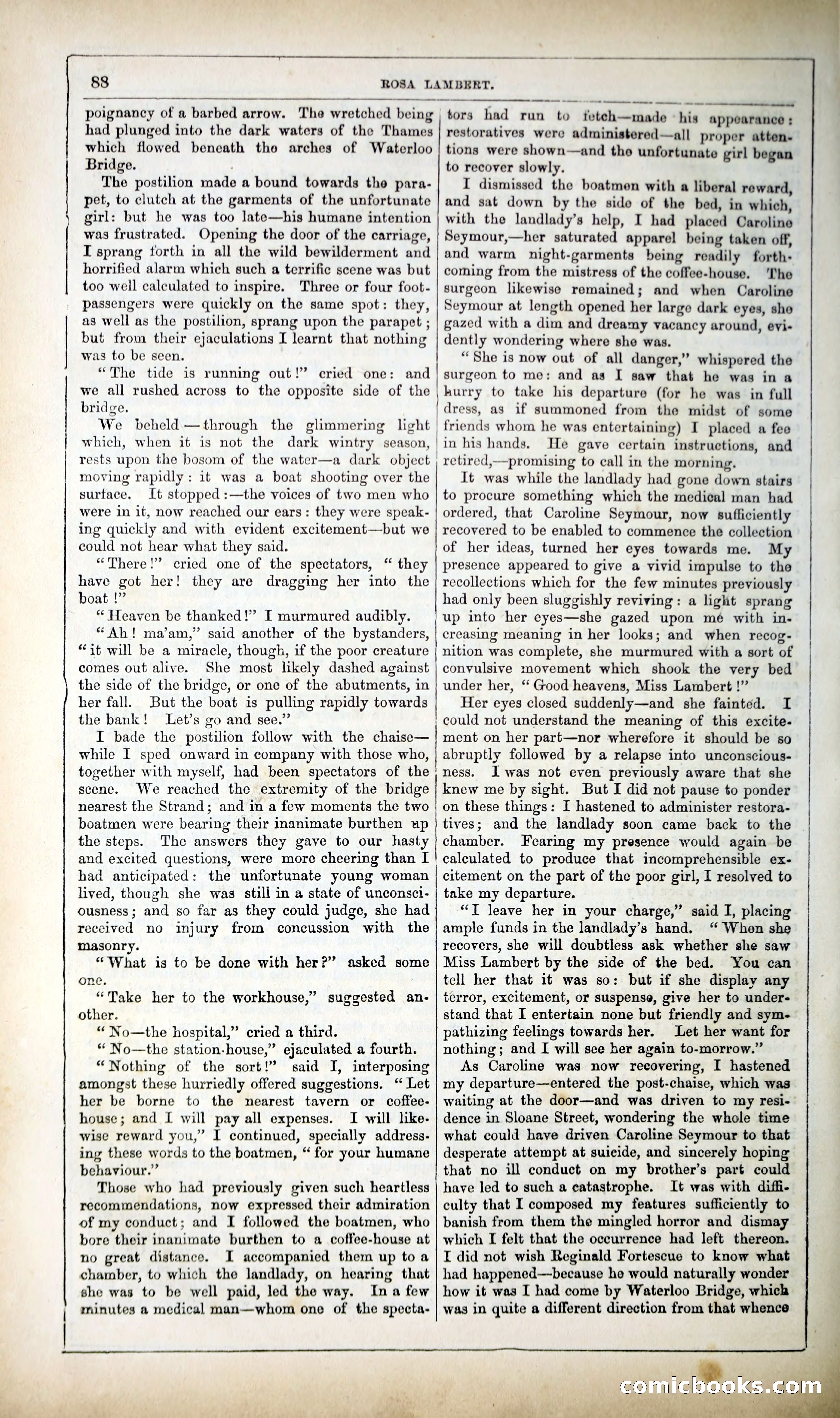
A restored page from Penny Dreadfuls, 1854. Page through the whole issue in the reader above.
📄 Transcribed text from this page (OCR, searchable)
Machine-transcribed from the original scan — historical spelling and the odd misread are preserved.
— ae poignancy of a barbed arrow. The wretched being had plunged into the dark waters of the Thames which flowed beneath the arches of Waterloo Bridge. | The postilion made a bound towards tho para- pet, to clutch at the garments of the unfortunate girl: but he was too late—his humane intention was frustrated. Opening the door of the carriage, I sprang forth in all the wild bewilderment and horrified alarm which such a terrific scene was but too well calculated to inspire. Three or four foot- passengers were quickly on the same spot: they, as well as the postilion, sprang upon the parapet ; but from their ejaculations I learnt that nothing was to be seen. “The tide is running out!” cried one: and we all rushed across to the opposite side of the bridge. We beheld —through the glimmering light which, when it is not the dark wintry season, rests upon the bosom of the water—a dark object moving rapidly: it was a boat shooting over the surtace. It stopped :—the voices of two men who were in it, now reached our ears: they were speak- ing quickly and with evident excitement—but we could not hear what they said. “There!” cried one of the spectators, “ they have got her! they are dragging her into the boat !” “ Heaven be thanked!” I murmured audibly. “Ah! ma’am,” said another of the bystanders, “it will be a miracle, though, if the poor creature comes out alive. She most likely dashed against the side of the bridge, or one of the abutments, in her fall. But the boat is pulling rapidly towards the bank! Let’s go and see.” I bade the postilion follow with the chaise— while I sped onward in company with those who, together with myself, had been spectators of the scene. We reached the extremity of the bridge nearest the Strand; and in a few moments the two boatmen were bearing their inanimate burthen up the steps. The answers they gave to our hasty and excited questions, were more cheering than I had anticipated: the unfortunate young woman lived, though she was still in a state of unconsci- ousness; and so far as they could judge, she had received no injury from concussion with the masonry. “What is to be done with her?” one. “Take her to the workhouse,” suggested an- other. “ No—the hospital,” cried a third. “ No—the station-house,” ejaculated a fourth. “Nothing of the sort! said I, interposing amongst these hurriedly offered suggestions. “ Let her be borne to the nearest tavern or coffee- house; and I will pay all expenses. I will like- wise reward you,” I continued, specially address- ing these words to the boatmen, “ for your humane behaviour.” Those who had previously given such heartless recommendations, now expressed their admiration of my conduct; and I followed the boatmen, who bore their inanimate burthen to a coffee-house at no great distance. I accompamied them up to a chamber, to which the landlady, on hearing that she was to be well paid, led the way. Ina few | minutes a medical man—whom one of the specta- asked some ROSA LAMBERT. ——- --— tors had run to fetech—made his appearance : restoratives were administered—all proper atten. tions were shown—and tho unfortunate girl began to recover slowly. I dismissed the boatmen with a liberal reward, and sat down by the side of the bed, in which, with the landlady’s help, I had placed Caroline Seymour,—her saturated apparel being taken off, and warm night-garments being readily forth- coming from the mistress of the coffee-house. ‘The surgeon likewise remained; and when Caroline Seymour at length opened her large dark eyes, sho gazed with a dim and dreamy vacancy around, evi- dently wondering where she was. “She is now out of all danger,” whispered the surgeon to me: and as I saw that he was in a hurry to take his departure (for he was in full dress, as if summoned from the midst of some friends whom he was entertaining) I placed a fee in his hands. He gave certain instructions, and retired,—promising to call in the morning. It was while the landlady had gone down stairs to procure something which the medical man had ordered, that Caroline Seymour, now sufficiently recovered to be enabled to commence the collection of her ideas, turned her eyes towards me. My presence appeared to give a vivid impulse to the recollections which for the few minutes previously had only been sluggishly reviving: a light sprang up into her eyes—she gazed upon mé with in- creasing meaning in her looks; and when recog- nition was complete, she murmured with a sort of convulsive movement which shook the very bed under her, ‘‘ Good heavens, Miss Lambert !” Her eyes closed suddenly—and she fainted. I could not understand the meaning of this excite. ment on her part—nor wherefore it should be so abruptly followed by a relapse into unconscious- ness. J was not even previously aware that she knew me by sight. But I did not pause to ponder on these things: I hastened to administer restora- tives; and the landlady soon came back to the chamber. Fearing my presence would again be calculated to produce that incomprehensible ex- citement on the part of the poor girl, I resolved to take my departure. “T leave her in your charge,” said I, placing ample funds in the landlady’s hand. ‘“ When she recovers, she will doubtless ask whether she saw Miss Lambert by the side of the bed. You can tell her that it was so: but if she display any terror, excitement, or suspense, give her to under- stand that I entertain none but friendly and sym- pathizing feelings towards her. Let her want for nothing; and I will see her again to-morrow.” As Caroline was now recovering, I hastened my departure—entered the post-chaise, which was waiting at the door—and was driven to my resi- dence in Sloane Street, wondering the whole time what could have driven Caroline Seymour to that desperate attempt at suicide, and sincerely hoping that no ill conduct on my brother’s part could have led to such a catastrophe. It was with diffi- culty that I composed my features sufficiently to banish from them the mingled horror and dismay which I felt that the occurrence had left thereon. I did not wish Reginald Fortescue to know what had happened—because he would naturally wonder how it was I had come by Waterloo Bridge, which was in quite a different direction from that whence