
Penny Dreadfuls, 1854 · page 87 of 400
Rosa Lambert — page 87: what you’re looking at
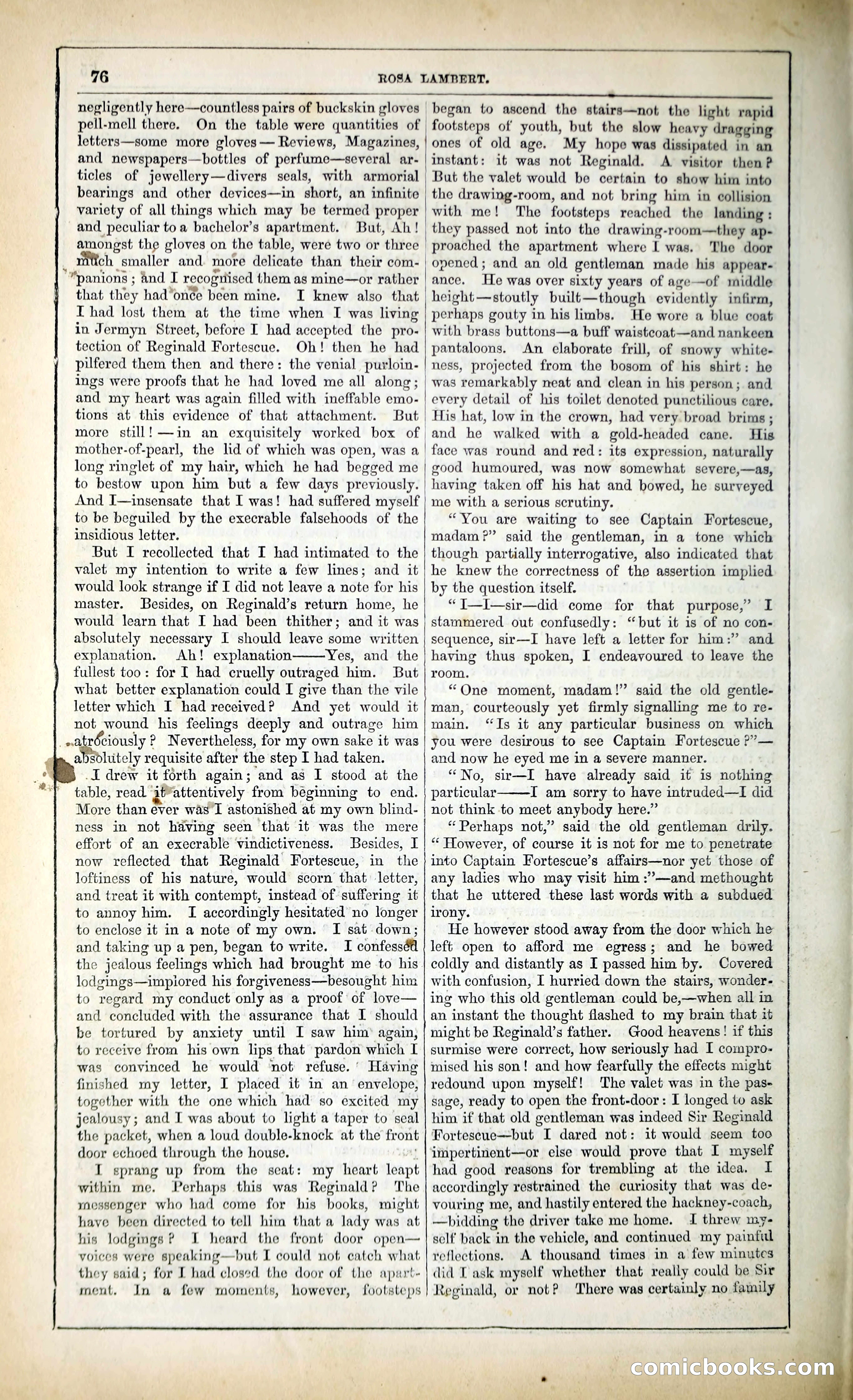
A restored page from Penny Dreadfuls, 1854. Page through the whole issue in the reader above.
📄 Transcribed text from this page (OCR, searchable)
Machine-transcribed from the original scan — historical spelling and the odd misread are preserved.
76 ROSA LAMBERT, negligently here—countless pairs of buckskin gloves pell-mell there. letters—some more gloves — Reviews, Magazines, and newspapers—bottles of perfume—several ar- ticles of jewellery—divers seals, with armorial bearings and other devices—in short, an infinite variety of all things which may be termed proper and peculiar toa bachelor’s apartment. But, Ah! amongst the gloves on the table, were two or three _ mifich smaller and. more delicate than their com- | “panions ; and I recogriised them as mine—or rather | that they had*onée been mine. I knew also that Thad lost them at the time when I was living in Jermyn Street, before I had accepted the pro- tection of Reginald Fortescue. Oh! then he had pilfered them then and there: the venial purloin- ings were proofs that he had loved me all along; and my heart was again filled with ineffable emo- tions at this evidence of that attachment. But more still!—in an exquisitely worked box of mother-of-pearl, the lid of which was open, was a long ringlet of my hair, which he had begged me to bestow upon him but a few days previously. And I—insensate that I was! had suffered myself to be beguiled by the execrable falsehoods of the insidious letter. . But I recollected that I had intimated to the valet my intention to write a few lines; and it would look strange if I did not leave a note for his master. Besides, on Reginald’s return home, he would learn that I had been thither; and it was absolutely necessary I should leave some written explanation. Ah! explanation Yes, and the fullest too: for I had cruelly outraged him. But what better explanation could I give than the vile letter which I had received? And yet would it not wound his feelings deeply and outrage him es fe cously t Nevertheless, for my own sake it was absolutely requisite after the step I had taken. I drew it forth again; and as I stood at the table, read. it”attentively from beginning to end. More than ever was I astonished at my own blind- ness in not having seen that it was the mere effort of an execrable vindictiveness. Besides, I now reflected that Reginald Fortescue, in the Joftiness of his nature, would scorn that letter, and treat it with contempt, instead of suffering it to annoy him. I accordingly hesitated no longer to enclose it in a note of my own. I sat down; and taking up a pen, began to write. I confess the jealous feelings which had brought me to his lodgings—impiored his forgiveness—besought him to regard my conduct only as a proof of love— and concluded with the assurance that I should be tortured by anxiety until I saw him’ again, to receive from his own lips that pardon which I was convinced he would not refuse. ’ Having finished my letter, I placed it in an envelope, together with the one which had so excited my jealousy; and I was about to light a taper to seal the packet, when a loud double-knock at the front door echoed through the house. vay I sprang up from the seat: my heart leapt within me. Perhaps this was Reginald? The mossenger who had come for his books, might have been directed to tell him that a lady was at his lodgings? J heard the front door open— voices were speaking—but I could not catch what they said; for I had closed the door of the apart- ment. In a few moments, however, footsteps On the table were quantities of | | | began to ascend the stairs—not the light rapid footsteps of youth, but the slow heavy dragging ones of old age. My hope was dissipated in an instant: it was not Reginald. A visitor then ? But the valet would be certain to show him into the drawing-room, and not bring him in eollision with me! The footsteps reached the landing : they passed not into the drawing-room—they ap- proached the apartment where I was. The door opened; and an old gentleman made his appear- ance. He was over sixty years of age—of middle height—stoutly built—though evidently infirm, perhaps gouty in his limbs. He wore a blue coat with brass buttons—a buff waisteoat—and nankeen pantaloons. An elaborate frill, of snowy white- ness, projected from the bosom of his shirt: he was remarkably neat and clean in his person; and every detail of his toilet denoted punctilious care, His hat, low in the crown, had very broad brims ; and he walked with a gold-headed cane. Hig face was round and red: its expression, naturally good humoured, was now somewhat severe,—as, having taken off his hat and bowed, he surveyed me with a serious scrutiny. “You are waiting to see Captain Fortescue, madam?” said the gentleman, in a tone which though partially interrogative, also indicated that he knew the correctness of the assertion implied by the question itself. “ I—I—sir—did come for that purpose,’ I stammered out confusedly: “but it is of no con- sequence, sir—I have left a letter for him: and having thus spoken, I endeavoured to leave the room. “One moment, madam!” said the old gentle- man, courteously yet firmly signalling me to re- main. “Is it any particular business on which you were desirous to see Captain Fortescue ?”— and now he eyed me in a severe manner. “No, sir—I have already said it is nothing particular I am sorry to have intruded—lI did not think to meet anybody here.” “Perhaps not,’ said the old gentleman drily. ““ However, of course it is not for me to penetrate into Captain Fortescue’s affairs—nor yet those of any ladies who may visit him :’—and methought that he uttered these last words with a subdued irony. He however stood away from the door which he left open to afford me egress; and he bowed coldly and distantly as I passed him by. Covered with confusion, I hurried down the stairs, wonder. - ing who this old gentleman could be,—when all in an instant the thought flashed to my brain that it might be Reginald’s father. Good heavens! if this surmise were correct, how seriously had I compro- mised his son! and how fearfully the effects might redound upon myself! The valet was in the pas- sage, ready to open the front-door: I longed to ask him if that old gentleman was indeed Sir Reginald Fortescue—but I dared not: it would seem too impertinent—or else would prove that I myself had good reasons for trembling at the idea. I accordingly restrained the curiosity that was de- vouring me, and hastily entered the hackney-coach, —bidding the driver take me home. I threw my- self back in the vehicle, and continued my painful reflections. A thousand times in a few minutes did I ask myself whether that really could be Sir Reginald, or not? ‘There was certainly no family fe Oe ee L Cale ; hi! 7h