
Penny Dreadfuls, 1854 · page 83 of 400
Rosa Lambert — page 83: what you’re looking at
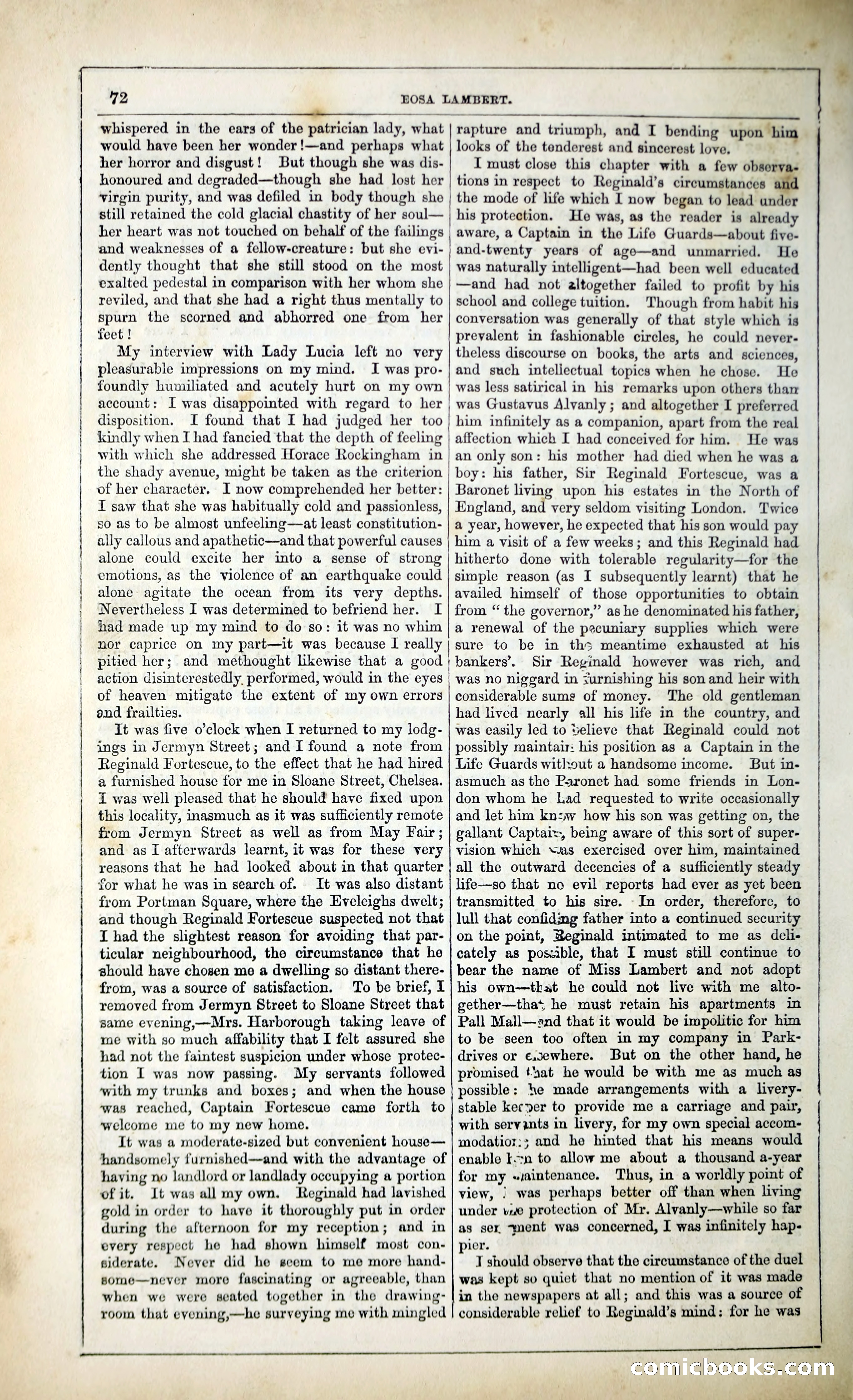
A restored page from Penny Dreadfuls, 1854. Page through the whole issue in the reader above.
📄 Transcribed text from this page (OCR, searchable)
Machine-transcribed from the original scan — historical spelling and the odd misread are preserved.
ae wo | anaes ee Oo? - - Ce e whispered in the ears of the patrician lady, what would have been her wonder!—and perhaps what her horror and disgust! But though she was dis- honoured and degraded—though she had lost her virgin purity, and was defiled in body though she still retained the cold glacial chastity of her soul— her heart was not touched on behalf of the failings and weaknesses of a fellow-creature: but she evi- dently thought that she still stood on the most exalted pedestal i in comparison with her whom she reviled, and that she had a right thus mentally to spurn the scorned and abborred one from her feet ! My interview with Lady Lucia left no very pleasurable impressions on my mind. I was pro- foundly humiliated and acutely hurt on my own account: I was disappointed with regard to her disposition. I found that I had judged her too kindly when I had fancied that the depth of feeling with which she addressed Horace Rockingham in the shady avenue, might be taken as the criterion of her character, I now comprehended her better: IT saw that she was habitually cold and passionless, so as to be almost unfeeling—at least constitution- ally callous and apathetic—and that powerful causes alone could excite her into a sense of strong emotions, as the violence of an earthquake could alone agitate the ocean from its very depths. Nevertheless I was determined to befriend her. I had made up my mind to do so: it was no whim nor caprice on my part—it was because I really pitied her; and methought likewise that a good action disinter estedly, performed, would in the eyes of heaven mitigate the extent of my own errors ond frailties. It was five o’clock when I returned to my lodg- ings in Jermyn Street; and I found a note from Reginald Fortescue, to the effect that he had hired a furnished house for me in Sloane Street, Chelsea. I was well pleased that he should have fixed upon this locality, inasmuch as it was sufliciently remote from Jermyn Street as well as from May Fair; and as I afterwards learnt, it was for these very reasons that he had looked about in that quarter for what he was in search of. It was also distant from Portman Square, where the Eveleighs dwelt; and though Reginald Fortescue suspected not that I had the slightest reason for avoiding that par- ticular neighbourhood, the circumstance that he should have chosen me a dwelling so distant there- from, was a source of satisfaction. To be brief, I removed from Jermyn Street to Sloane Street that same evening,—Mrs. Harborough taking leave of me with so much affability that I felt assured she had not the faintest suspicion under whose protec- tion I was now passing. My servants followed with my trunks and boxes; and when the house was reached, Captain Fortescue came forth to welcome me to my new home. It was a moderate-sized but convenient house— handsomely furnished—and with the advantage of having no landlord or landlady occupying a portion of it. It was all my own. Reginald had lavished gold in order to have it thoroughly put in order during the afternoon for my reception; and in every respect he had shown himself most con- siderate. Never did he seem to me more hand- some—never more fascinating or agreeable, than when we were seated together in the drawing- room that evening,—he surveying me with mingled EOSA LAMBERT. 2s a rapture and triumph, and I bending pets looks of the tenderest and sincerest love. I must close this chapter with a few obsery tions in respect to Reginald’s circumstances wi the mode of life which I now began to lead an his protection. He was, as the reader is already aware, a Captain in the Life Guards—about five- and-twenty years of age—and unmarried. He was naturally intelligent—had been well educated —and had not altogether failed to profit by his school and college tuition. Though from habit his conversation was generally of that style which is prevalent in fashionable circles, he could never- theless discourse on books, the arts and sciences, and such inteliectual topics when he chose. He was less satirical in his remarks upon others thar was Gustavus Alyanly ; and altogether I preferred him infinitely as a companion, apart from the real affection which I had conceived for him. He was an only son: his mother had died when he was a boy: his father, Sir Reginald Fortescue, was a Baronet living upon his estates in the North of England, and very seldom visiting London. Twice a year, however, he expected that his son would pay him a visit of a few weeks; and this Reginald had hitherto done with tolerable regularity—for the simple reason (as I subsequently learnt) that he availed himself of those opportunities to obtain from “ the governor,” as he denominated his father, a renewal of the pecuniary supplies which were sure to be in ths meantime exhausted at his bankers’. Sir Reginald however was rich, and was no niggard in surnishing his son and heir with considerable sums of money. The old gentleman had lived nearly all his life in the country, and was easily led to telieve that Reginald could not possibly maintair: his position as a Captain in the Life Guards without a handsome income. But in- asmuch as the Paronet had some friends in Lon- don whom he Lad requested to write occasionally and let him kn:w how his son was getting on, the gallant Captaiz, being aware of this sort of super- vision which ‘as exercised over him, maintained all the outward decencies of a sufficiently steady life—so that no evil reports had ever as yet been transmitted to his sire. -In order, therefore, to lull that confiding father into a continued security on the point, Reginald intimated to me as deli- cately as posable, that I must still continue to bear the name of Miss Lambert and not adopt his own—tkat he could not live with me alto- gether—tha* he must retain his apartments in Pall Mall—and that it would be impolitic for him to be seen too often in my company in Park- drives or €.sewhere. But on the other hand, he promised tat he would be with me as much as possible: he made arrangements with a livery- stable kecper to provide me a carriage and pair, with servants in livery, for my own special accom- modatior:; and he hinted that his means would enable kn to allow me about a thousand a-year for my «iaintenance. Thus, in a worldly point of view, | was perhaps better off than when living under we protection of Mr. Alvanly—while so far as sex, nent was concerned, I was infinitely hap- ier. I should observe that the circumstance of the duel was kept so quiet that no mention of it was made in the newspapers at all; and this was a source of considerable relief to Reginald’s mind; for he was GOmMic OOK: