
Penny Dreadfuls, 1854 · page 74 of 400
Rosa Lambert — page 74: what you’re looking at
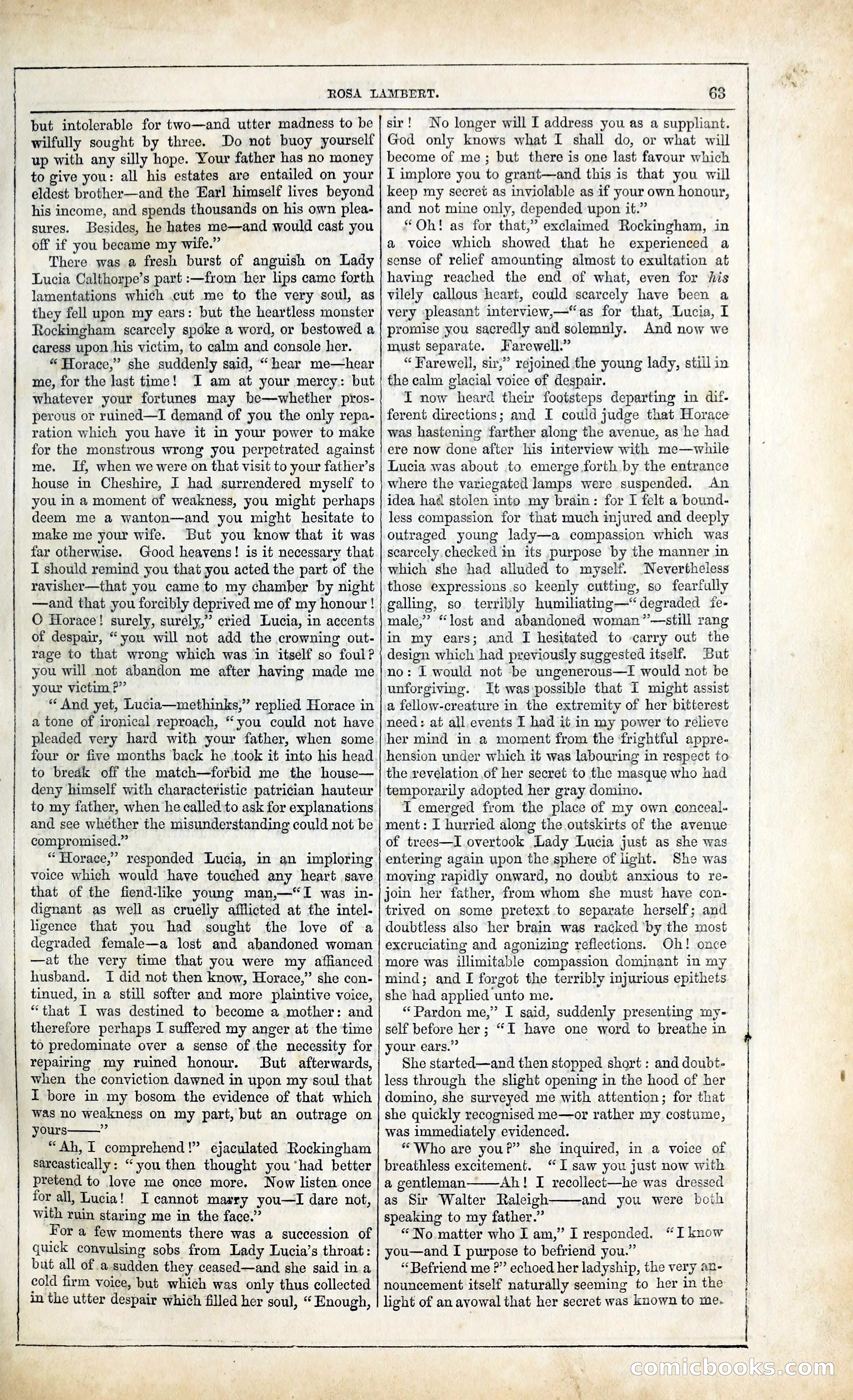
A restored page from Penny Dreadfuls, 1854. Page through the whole issue in the reader above.
📄 Transcribed text from this page (OCR, searchable)
Machine-transcribed from the original scan — historical spelling and the odd misread are preserved.
ne re ee EE hoe nen eB re ROSA LAMBERT. 63 Laac ccc c cece rr Ae ea a a Tt i eC Tc cc eae ceca but intolerable for two—and utter madness to be wilfully sought by three. Do not buoy yourself up with any silly hope. Your father has no money to give you: all his estates are entailed on your eldest brother—and the Earl himself lives beyond his income, and spends thousands on his own plea- sures. Besides, he hates me—and would cast you off if you became my wife.” There was a fresh burst of anguish on Lady Lucia Calthorpe’s part :—from her lips came forth lamentations which cut me to the very soul, as they fell upon my ears: but the heartless monster Rockingham scarcely spoke a word, or bestowed a caress upon his victim, to calm and console her. “ Horace,” she suddenly said, “hear me—hear me, for the last time! I am at your mercy: but whatever your fortunes may he—whether pros- perous or ruined—I demand of you the only repa- ration which you have it in your power to make for the monstrous wrong you perpetrated against me. If, when we were on that visit to your father’s house in Cheshire, I had surrendered myself to you in a moment of weakness, you might perhaps deem me a wanton—and you might hesitate to make me your wife. But you know that it was far otherwise. Good heavens! is it necessary that I should remind you that you acted the part of the ravisher—that you came to my chamber by night —and that you forcibly deprived me of my honour! O Horace! surely, surely,” cried Lucia, in accents of despair, “you will not add the crowning out- rage to that wrong which was in itself so foul? you will not abandon me after having made me your victim ?” “ And yet, Lucia—methinks,” replied Horace in a tone of ironical reproach, “you could not have pleaded very hard with your father, when some four or five months back he took it into his head to breal off the match—forbid me the house— deny himself with characteristic patrician hauteur to my father, when he called to ask for explanations and see whether the misunderstanding could not be compromised.” “Horace,” responded Lucia, in an imploring voice which would haye touched any heart save that of the fiend-lke young man,—“I was in- dignant as well as cruelly afflicted at the intel- ligence that you had sought the love of a degraded female—a lost and abandoned woman —at the very time that you were my aflianced husband. I did not then know, Horace,” she con- tinued, in a still softer and more plaintive voice, “that I was destined to become a mother: and therefore perhaps I suffered my anger at the time to predominate over a sense of the necessity for repairing my ruined honour. But afterwards, when the conviction dawned in upon my soul that I bore in my bosom the evidence of that which was no weakness on my part, but an outrage on yours o “Ah, I comprehend!” ejaculated Rockingham sarcastically: “you then thought you ‘had better pretend to love me once more. Now listen once for all, Lucia! I cannot marry you—I dare not, with ruin staring me in the face.” For a few moments there was a succession of quick conyulsing sobs from Lady Lucia’s throat: but all of a sudden they ceased—and she said in a cold firm voice, but which was only thus collected in the utter despair which filled her soul, “Enough, ) ss + i> sir! No longer will I address you as a suppliant. God only knows what I shall do, or what will become of me; but there is one last favour which I implore you to grant—and this is that you will keep my secret as inviolable as if your own honour, and not mine only, depended upon it.” “Oh! as for that,’ exclaimed Rockingham, in a voice which showed that he experienced a sense of relief amounting almost to exultation at having reached the end of what, even for his vilely callous heart, could scarcely have been a very ‘pleasant interview,—“as for that, Lucia, I promise you sacredly and solemnly. And now we must separate. Farewell.” “Farewell, sir,” rejoined the young lady, still in the calm glacial voice of despair. I now heard thew footsteps departing in dif- ferent directions; and I could judge that Horace was hastening farther along the avenue, as he had ere now done after his interview with me—while Lucia was about to emerge forth by the entrance where the variegated lamps were suspended. An idea had stolen into my brain: for I felt a bound- less compassion for that much injured and deeply outraged young lady—a compassion which was scarcely.checked In its purpose by the manner in which she had alluded to myself. ‘Nevertheless those expressions.so keenly cutting, so fearfully galling, so terribly humiliating—‘“degraded {e- male,” “lost and abandoned woman’’—still rang in my ears; and I hesitated to carry out the design which had previously suggested itself. But no: IL would not be ungenerous—I would not be unforgiving. It was possible that I might assist a fellow-creature in the extremity of her bitterest need: at all.events I had it in my power to relieve her mind in a moment from the frightful appre- hension under which it was labouring in respect to the revelation of her secret to the masque who had temporarily adopted her gray domino. I emerged from the place of my own conceal. ment: I hurried along the outskirts of the avenue of trees—I overtook Lady Lucia just as she was entering again upon the sphere of ght. She was moving rapidly onward, no doubt anxious to re- join her father, from whom she must have con- trived on some pretext to separate herself; and doubtless also her brain was racked ‘by the most excruciating and agonizing reflections. Oh! once more was illimitable compassion dominant in my mind; and [ forgot the terribly injurious epithets she had applied unto me. “Pardon me,” I said, suddenly presenting my- self before her; “I have one word to breathe in your ears.” | She started—and then stopped short : and doubt- less through the slight opening in the hood of her domino, she surveyed me with attention; for that she quickly recognised me—or rather my costume, was immediately evidenced. “Who are your” she inquired, in a voice of breathless excitement. “I saw you just now with a gentleman Ah! I recoliect—he was dressed as Sir Walter Raleigh and you were boih speaking to my father.” “No matter who I am,” I responded. “I know you—and I purpose to befriend you.” | “Befriend me ?” echoed her ladyship, the very an- nouncement itself naturally seeming to her in the light of an ayowal that her secret was known to me. GOmichdoo a rc a i = ee eS ee . - NS ee ee ee —_———_— a i LP ee li eS a a a . cs (E(0)