
Penny Dreadfuls, 1854 · page 71 of 400
Rosa Lambert — page 71: what you’re looking at
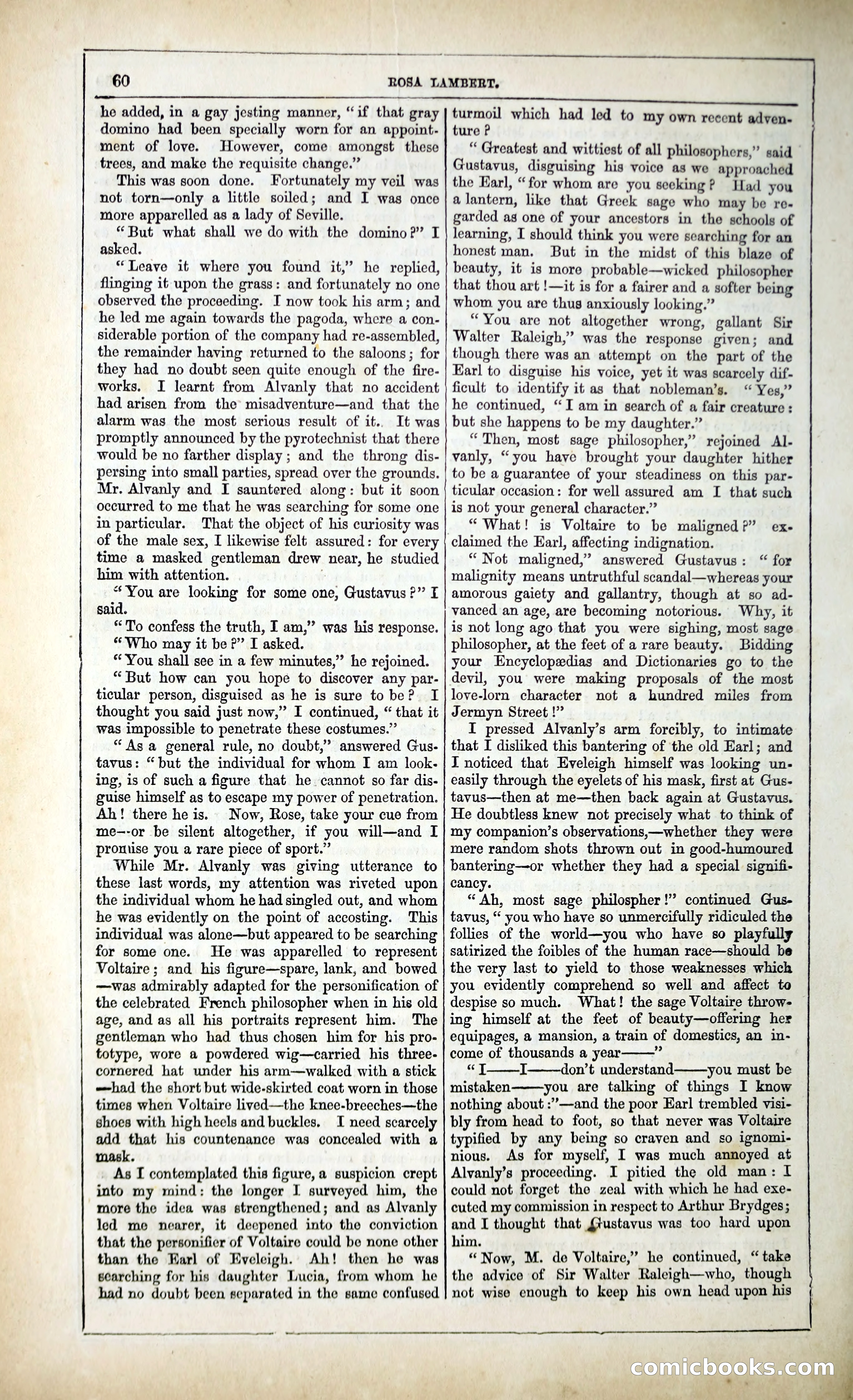
A restored page from Penny Dreadfuls, 1854. Page through the whole issue in the reader above.
📄 Transcribed text from this page (OCR, searchable)
Machine-transcribed from the original scan — historical spelling and the odd misread are preserved.
didi er Cn — 60 he added, in a gay jesting manner, “if that gray domino had been specially worn for an appoint- ment of love. However, come amongst these trees, and make the requisite change,” This was soon done. Fortunately my veil was not torn—only a little soiled; and I was once more apparelled as a lady of Seville. But what shall we do with the domino?” I asked. “Leave it where you found it,” he replied, flinging if upon the grass: and fortunately no one observed the proceeding. I now took his arm; and he led me again towards the pagoda, where a con- siderable portion of the company had re-assembled, the remainder having returned to the saloons; for they had no doubt seen quite enough of the fire- works. I learnt from Alvanly that no accident had arisen from the misadventure—and that the alarm was the most serious result of it.. It was promptly announced by the pyrotechnist that there would be no farther display ; and the throng dis- persing into small parties, spread over the grounds. Mr. Alvanly and I sauntered along: but it soon occurred to me that he was searching for some one in particular. That the object of his curiosity was of the male sex, I likewise felt assured: for every time a masked gentleman drew near, he studied him with attention. ! “You are looking for some one, Gustavus ?” I said. “To confess the truth, I am,” was his response. “Who may it be ?” I asked. “You shall see in a few minutes,” he rejoined. “But how can you hope to discover any par- ticular person, disguised as he is sure tobe? I thought you said just now,” I continued, “ that it was impossible to penetrate these costumes.” “Asa general rule, no doubt,” answered Gus- tavus: “but the individual for whom I am look. ing, is of such a figure that he cannot so far dis- guise himself as to escape my power of penetration. Ah! there he is. Now, Rose, take your cue from me-—-or be silent altogether, if you will—and I promise you a rare piece of sport.” While Mr. Alvanly was giving utterance to these last words, my attention was riveted upon the individual whom he had singled out, and whom he was evidently on the point of accosting. This individual was alone—but appeared to be searching for some one. He was apparelled to represent Voltaire ; and his figure—spare, lank, and bowed —was admirably adapted for the personification of the celebrated French philosopher when in his old age, and as all his portraits represent him. The gentleman who had thus chosen him for his pro- totype, wore a powdered wig—carried his three- cornered hat under his arm—walked with a stick --had the short but wide-skirted coat worn in those times when Voltaire lived—the knee-breeches—the shoes with high heels and buckles, I need scarcely add that his countenance was concealed with a mask. As I contemplated this figure, a suspicion crept into my mind: the longer I surveyed him, the more the idea was strengthened; and as Alvanly led me nearer, it deepened into the conviction that the personifier of Voltaire could be none other than the Warl of Eveleigh. Ah! then he was searching for his daughter Lucia, from whom he had no doubt been separated in the same confused ROSA LAMBERT, ae which had led to my own recent adven- ture “ Greatest and wittiest of all philosophers,” said Gustavus, disguising his voice as we approached the Karl, “for whom are you secking? Had you a lantern, like that Greek sage who may be re- garded as one of your ancestors in the schools of learning, I should think you were searching for an honest man. But in the midst of this blaze of beauty, it is more probable—wicked philosopher that thou art !—it is for a fairer and a softer being whom you are thus anxiously looking.” “You are not altogether wrong, gallant Sir Walter Raleigh,” was the response given; and though there was an attempt on the part of the Earl to disguise his voice, yet it was scarcely dif- ficult to identify it as that nobleman’s. “ Yes,” he continued, “I am in search of a fair creature : but she happens to be my daughter.” “Then, most sage philosopher,” rejoined Al- vanly, “you have brought your daughter hither to be a guarantee of your steadiness on this par- ticular occasion: for well assured am I that such is not your general character.” “What! is Voltaire to be maligned?” ex- claimed the Earl, affecting indignation. “Not maligned,” answered Gustavus: “ for malignity means untruthful scandal—whereas your amorous gaiety and gallantry, though at so ad- vanced an age, are becoming notorious. Why, it is not long ago that you were sighing, most sage philosopher, at the feet of a rare beauty. Bidding your Encyclopedias and Dictionaries go to the devil, you were making proposals of the most love-lorn character not a hundred miles from Jermyn Street !” I pressed Alvanly’s arm forcibly, to intimate that I disliked this bantering of the old Earl; and I noticed that Eveleigh himself was looking un- easily through the eyelets of his mask, first at Gus- tavus—then at me—then back again at Gustavus, He doubtless knew not precisely what to think of my companion’s observations,—whether they were mere random shots thrown out in good-humoured bantering—or whether they had a special signifi- cancy. “ Ah, most sage philospher!’”’ continued Gus- tavus, “ you who have so unmercifully ridiculed the follies of the world—you who have so playfully satirized the foibles of the human race—should be the very last to yield to those weaknesses which you evidently comprehend so well and affect to despise so much. What! the sage Voltaire throw- — ing himself at the feet of beauty—offering her equipages, @ mansion, a train of domestics, an in- come of thousands a year ir “Tl I don’t understand you must be mistaken you are talking of things I know nothing about :”’—and the poor Earl trembled visi- bly from head to foot, so that never was Voltaire typified by any being so craven and so ignomi- nious. As for myself, I was much annoyed at Alvanly’s proceeding. I pitied the old man: I could not forget the zeal with which he had exe- cuted my commission in respect to Arthur Brydges; and I thought that Gustavus was too hard upon him. “Now, M. de Voltaire,’ he continued, “take the advice of Sir Walter Raleigh—who, though not wise enough to keep his own head upon his