
Penny Dreadfuls, 1854 · page 383 of 400
Rosa Lambert — page 383: what you’re looking at
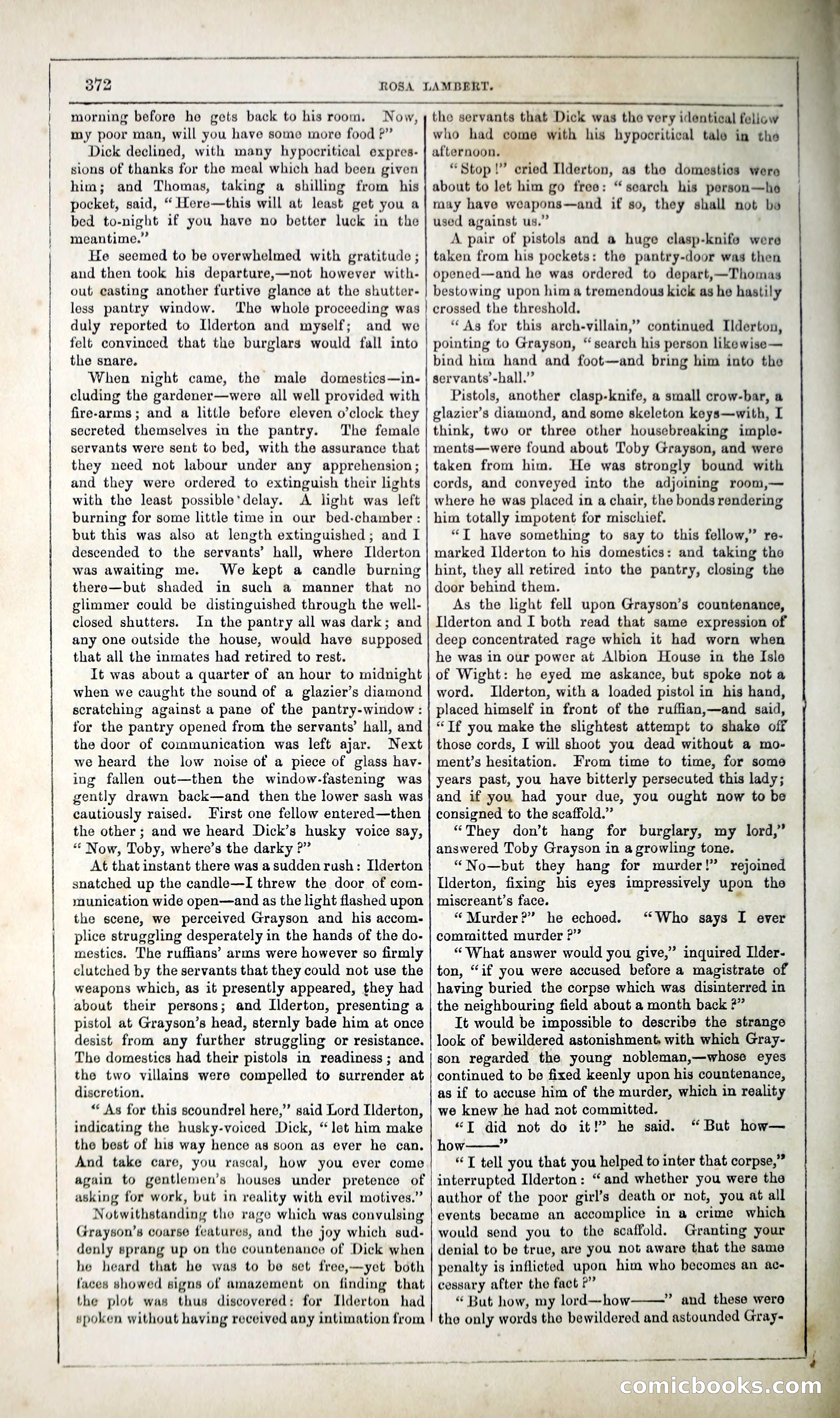
A restored page from Penny Dreadfuls, 1854. Page through the whole issue in the reader above.
📄 Transcribed text from this page (OCR, searchable)
Machine-transcribed from the original scan — historical spelling and the odd misread are preserved.
OD a I LD LEE TEE De OP O72 morning before he gets back to his room. Now, my poor man, will you have some more food P” Dick declined, with many hypocritical expres- sions of thanks for the meal which had been given him; and Thomas, taking a shilling from his pocket, said, “ Here—this will at least get you a bed to-night if you have no better luck in the meantime.” He seemed to be overwhelmed with gratitude ; and then took his departure,—not however with- out easting another furtive glance at the shutter- less pantry window. duly reported to Ilderton and myself; and we felt convinced that the burglars would fall into the snare. When night came, the male domestics—in- cluding the gardener—were all well provided with fire-arms; and a little before eleven o’clock they secreted themselves in the pantry. The female servants were sent to bed, with the assurance that they need not labour under any apprehension; and they were ordered to extinguish their lights with the least possible'delay. A light was left burning for some little time in our bed-chamber : but this was also at length extinguished; and I descended to the servants’ hall, where Ilderton was awaiting me. We kept a candle burning there—but shaded in such a manner that no glimmer could be distinguished through the well- closed shutters. In the pantry all was dark; and any one outside the house, would have supposed that all the inmates had retired to rest. It was about a quarter of an hour to midnight when we caught the sound of a glazier’s diamond scratching against a pane of the pantry-window: for the pantry opened from the servants’ hall, and the door of communication was left ajar. Next we heard the low noise of a piece of glass hay- ing fallen out—then the window-fastening was gently drawn back—and then the lower sash was cautiously raised. First one fellow entered—then the other ; and we heard Dick’s husky voice say, “‘ Now, Toby, where’s the darky ?” At that instant there was asuddenrush: Ilderton snatched up the candle—I threw the door of com- munication wide open—and as the light flashed upon the scene, we perceived Grayson and his accom- plice struggling desperately in the hands of the do- mestics. The ruffians’ arms were however so firmly clutched by the servants that they could not use the weapons which, as it presently appeared, they had about their persons; and Ilderton, presenting a pistol at Grayson’s head, sternly bade him at once desist from any further struggling or resistance. The domestics had their pistols in readiness; and the two villains were compelled to surrender at discretion. “ As for this scoundrel here,”’ said Lord Ilderton, indicating the husky-voiced Dick, “let him make the best of his way hence as soon as ever he can. And take care, you rascal, how you ever come again to gentlemen’s houses under pretence of asking for work, but in reality with evil motives.” Notwithstanding tho rage which was convulsing Grayson’s coarse features, and the joy which sud- denly sprang up on the countenance of Dick when he heard that he was to be set free,—yet both faces showed signs of amazement on finding that the plot was thus discovered: for Ilderton had spoken without having received any intimation from the servants that Dick was the very identical fellow who had come with his hypocritical tale in the afternoon. “Stop!” cried Ilderton, as the domestics were about to let him go free: “search his person—he may have weapons—and if so, they shall not be used against us.’ A pair of pistols and a huge clasp-knife were taken from his pockets: the pantry-door was then opened—and he was ordered to depart,—Thomas bestowing upon him a tremendous kick as he hastily The whole proceeding was | crossed the threshold. ” “As for this arch-villain,” continued Ilderton, pointing to Grayson, “search his person likewise— bind him hand and foot—and bring him into the servants -hall.” Pistols, another clasp-knife, a small crow-bar, a glazier’s diamond, and some skeleton keys—with, I think, two or three other housebreaking imple- ments—were found about Toby Grayson, and were taken from him. He was strongly bound with cords, and conveyed into the adjoining room,— where he was placed in a chair, the bonds rendering him totally impotent for mischief. “TI have something to say to this fellow,” re- marked Ilderton to his domestics: and taking the hint, they all retired into the pantry, closing the door behind them. As the light fell upon Grayson’s countenance, Ilderton and I both read that same expression of deep concentrated rage which it had worn when he was in our power at Albion House in the Isle of Wight: he eyed me askance, but spoke not a word. Ilderton, with a loaded pistol in his hand, placed himself in front of the ruffian,—and said, “Tf you make the slightest attempt to shake off those cords, I will shoot you dead without a mo- ment’s hesitation. From time to time, for some years past, you have bitterly persecuted this lady; and if you had your due, you ought now to be consigned to the scaffold.” “They don’t hang for burglary, my lord,” answered Toby Grayson in a growling tone. “No—but they hang for murder!” rejoined Ilderton, fixing his eyes impressively upon the miscreant’s face. “ Murder?” he echoed. committed murder P” “What answer would you give,” inquired Ilder- ton, “if you were accused before a magistrate of having buried the corpse which was disinterred in the neighbouring field about a month back ?” It would be impossible to describe the strange look of bewildered astonishment, with which Gray- son regarded the young nobleman,—whose eyes continued to be fixed keenly upon his countenance, as if to accuse him of the murder, which in reality we knew he had not committed. “JT did not do it!” he said. how fe “T tell you that you helped to inter that corpse,” interrupted Ilderton: “and whether you were the author of the poor girl’s death or not, you at all events became an accomplice in a crime which would send you to the scaffold. Granting your denial to be true, are you not aware that the same penalty is inflicted upon him who becomes an ac- cessary after the fact P”’ “ But how, my lord—how ” and these were the only words the bewildered and astounded Gray- “Who says I ever “But how— i —— ene . com cS