
Penny Dreadfuls, 1854 · page 374 of 400
Rosa Lambert — page 374: what you’re looking at
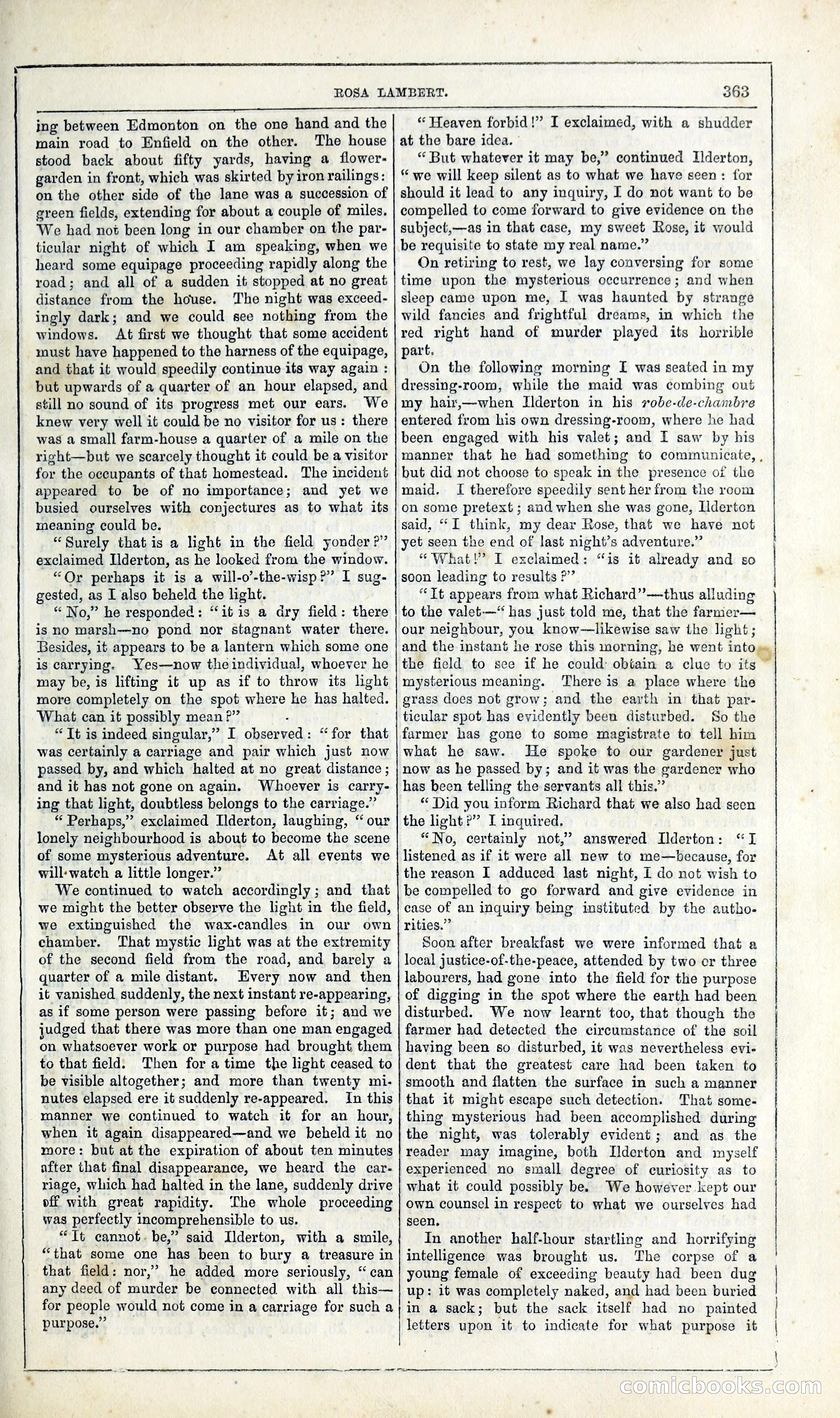
A restored page from Penny Dreadfuls, 1854. Page through the whole issue in the reader above.
📄 Transcribed text from this page (OCR, searchable)
Machine-transcribed from the original scan — historical spelling and the odd misread are preserved.
ROSA LAMBERT. eer eS SS EIS ES PS SS A EN LN STOTT OT A IAA n 363 ia eredtcegiteeasctdtei stat ee EE ETT nT Oe ener ena a PT ing between Edmonton on the one hand and the main road to Enfield on the other. The house stood back about fifty yards, having a flower- garden in front, which was skirted by iron railings: on the other side of the lane was a succession of eveen fields, extending for about a couple of miles. We had not been long in our chamber on the par- ticular night of which I am speaking, when we heard some equipage proceeding rapidly along the road; and all of a sudden it stopped at no great distance from the house. The night was exceed- ingly dark; and we could see nothing from the windows. At first we thought that some accident must have happened to the harness of the equipage, and that it would speedily continue its way again : but upwards of a quarter of an hour elapsed, and still no sound of its progress met our ears. We knew very well it could be no visitor for us: there was a small farm-house a quarter of a mile on the right—but we scarcely thought it could be a visitor for the occupants of that homestead. The incident appeared to be of no importance; and yet we busied ourselves with conjectures as to what its meaning could be. “Surely that is a light in the field yonder?” exclaimed Ilderton, as he looked from the window. “Or perhaps it is a will-o’-the-wisp?”’ I sug- gested, as I also beheld the light. “ No,” he responded: “‘itis a dry field: there is no marsh—no pond nor stagnant water there. Besides, it appears to be a lantern which some one is carrying. Yes—now theindividual, whoever he may be, is lifting it up as if to throw its light more completely on the spot where he has halted. What can it possibly mean?” “ It is indeed singular,” I observed: “for that was certainly a carriage and pair which just now passed by, and which halted at no great distance ; and it has not gone on again. Whoever is carry- ing that light, doubtless belongs to the carriage.” “‘ Perhaps,” exclaimed Ilderton, laughing, ‘ our lonely neighbourhood is about to become the scene of some mysterious adventure. At all events we will:watch a littie longer.” We continued to watch accordingly ; and that we might the better observe the light in the field, we extinguished the wax-candles in our own chamber. That mystic light was at the extremity of the second field from the road, and barely a quarter of a mile distant. Every now and then it vanished suddenly, the next instant re-appearing, as if some person were passing before it; and we judged that there was more than one man engaged on whatsoever work or purpose had brought them to that field. Then for atime the light ceased to be visible altogether; and more than twenty mi- nutes elapsed ere it suddenly re-appeared. In this manner we continued to watch it for an hour, when it again disappeared—and we beheld it no more: but at the expiration of about ten minutes after that final disappearance, we heard the car- riage, which had halted in the lane, suddenly drive off with great rapidity. ‘he whole proceeding was perfectly incomprehensible to us. “Tt cannot. be,” said Ilderton, with a smile, “that some one has been to bury a treasure in that field: nor,” he added more seriously, “can any deed of murder be connected with all this— for people would not come in a carriage for such a purpose.” re rm et I ree ee ee en es ‘“ Heaven forbid!”’ I exclaimed, with a shudder at the bare idea. “ But whatever it may be,” continued Iiderton, we will keep silent as to what we have seen: for should it lead to any inquiry, I do not want to be compelled to come forward to give evidence on the subject,—as in that case, my sweet Rose, it would be requisite to state my real name.” On retiring to rest, we lay conversing for some time upon the mysterious occurrence; and when sleep came upon me, I was haunted by strange wild fancies and frightful dreams, in which the red right hand of murder played its horrible part. On the following morning I was seated in my dressing-room, while the maid was combing out my hair,—when Ilderton in his robe-de-chambre entered from his own dressing-room, where he had been engaged with his valet; and I saw by his manner that he had something to communicate, , but did not choose to speak in the presence of the maid. I therefore speedily sent her from the room on some pretext ; and when she was gone, LIlderton said, ‘I think, my dear Rose, that we have not yet seen the end of last night’s adventure.” “ What!’ I exclaimed: “is it already and so soon leading to results ?” “Tt appears from what Richard”—-thus alluding to the valet-—‘‘ has just told me, that the farmer— our neighbour, you know—likewise saw the light; and the instant he rose this morning, he went into the field to see if he could: obiain a clue to its mysterious meaning. ‘There is a place where the grass does not grow; and the earth in that par- ticular spot has evidently been disturbed. So the farmer has gone to some magistrate to tell him what he saw. He spoke to our gardener just now as he passed by; and it was the gardener who has been telling the servants all this.” “ Did you inform Richard that we also had seen the light?” I inquired. “No, certainly not,’ answered Ilderton: “I listened as if it were all new to me—because, for the reason I adduced last night, i do not wish to be compelled to go forward and give evidence in case of an inquiry being instituted by the autho- rities.” Soon after breakfast we were informed that a local justice-of-the-peace, attended by two or three labourers, had gone into the field for the purpose of digging in the spot where the earth had been disturbed. We now learnt too, that though the farmer had detected the circumstance of the soil having been so disturbed, it was nevertheless evi- dent that the greatest care had been taken to smooth and flatten the surface in such a manner that it might escape such detection. That some- thing mysterious had been accomplished during the night, was tolerably evident; and as the reader may imagine, both Ilderton and myself experienced no small degree of curiosity as to what it could possibly be. We however kept our own counsel in respect to what we ourselves had seen. In another half-hour startling and horrifying intelligence was brought us. The corpse of a young female of exceeding beauty had been dug up: it was completely naked, and had been buried in a sack; but the sack itself had no painted letters upon it to indicate for what purpose it CORMIEOO G ‘Ss Swe ee eee