
Penny Dreadfuls, 1854 · page 362 of 400
Rosa Lambert — page 362: what you’re looking at
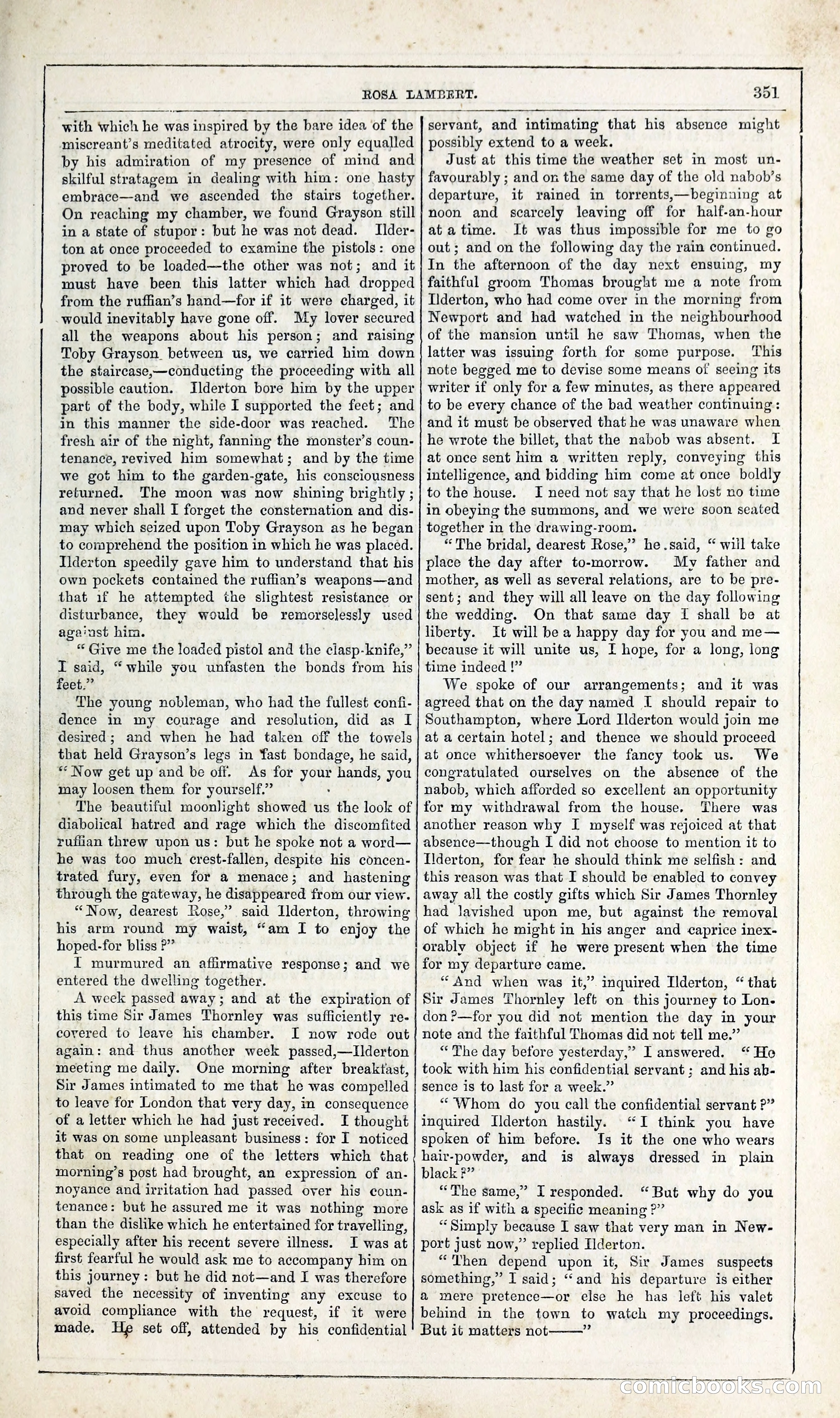
A restored page from Penny Dreadfuls, 1854. Page through the whole issue in the reader above.
📄 Transcribed text from this page (OCR, searchable)
Machine-transcribed from the original scan — historical spelling and the odd misread are preserved.
ROSA LAMBERT. mr nnn ET with which he was inspired by the bare idea of the miscreant’s meditated atrocity, were only equalled by his admiration of my presence of mind and skilful stratagem in dealing with him: one hasty embrace—and we ascended the stairs together. On reaching my chamber, we found Grayson still in a state of stupor: but he was not dead. Ilder- ton at once proceeded to examine the pistols: one proved to be loaded—the other was not; and it must have been this latter which had dropped from the ruffian’s hand—for if it were charged, it would inevitably have gone off. My lover secured all the weapons about his person; and raising Toby Grayson between us, we carried him down the staircase,—conducting the proceeding with all possible caution. Ilderton bore him by the upper part of the body, while I supported the feet; and in this manner the side-door was reached. The fresh air of the night, fanning the monster’s coun- tenance, revived him somewhat; and by the time we got him to the garden-gate, his consciousness returned. The moon was now shining brightly ; and never shall I forget the consternation and dis- may which seized upon Toby Grayson as he began to comprehend the position in which he was placed. Iiderton speedily gave him to understand that his own pockets contained the ruffian’s weapons—and that 1f he attempted the slightest resistance or disturbance, they would be remorselessly used agaiust him. “Give me the loaded pistol and the ciasp-knife,” I said, “while you unfasten the bonds from his feet.” The young nobleman, who had the fullest confi- dence in my courage and resolution, did as I desired; and when he had taken off the towels that held Grayson’s legs in fast bondage, he said, * Now get up ‘and be off. As for you hands, you may loosen them for yourself.” The beautiful moonlight showed us the look of diabolical hatred and rage which the discomfited ruffian threw upon us: but he spoke not a word— he was too much crest-fallen, despite his concen- trated fury, even for a menace; and hastening through the gateway, he disappeared from our view. “Now, dearest Rose,” said Ilderton, throwing his arm round my waist, “am I to enjoy the hoped-for bliss ?” I murmured an affirmative response; and we entered the dwelling together. A week passed away; and at the expiration of this time Sir James Thornley was sufficiently re- covered to leave his chamber. I now rode out again: and thus another week passed,—lIlderton meeting me daily. One morning after breaktast, Sir James intimated to me that he was compelled to leave for London that very day, in consequence of a letter which he had just received. I thought it was on some unpleasant business: for I noticed that on reading one of the letters which that morning’s post had brought, an expression of an- noyance and irritation had passed over his coun- tenance: but he assured me it was nothing more than the dislike which he entertained for travelling, especially after his recent severe illness. I was at first fearful he would ask me to accompany him on this journey: but he did not—and I was therefore saved the necessity of inventing any excuse to avoid compliance with the request, if it were made. He set off, attended by his confidential servant, and intimating that his absence might possibly extend to a week. Just at this time the weather set in most un- favourably ; and on the same day of the old nabob’s departure, it rained in torrents,—beginuing at noon and scarcely leaving off for half-an-hour at atime. It was thus impossible for me to go out; and on the following day the rain continued. In the afternoon of the day next ensuing, my faithful groom Thomas brought me a note from Ilderton, who had come over in the morning from Newport and had watched in the neighbourhood of the mansion until he saw Thomas, when the latter was issuing forth for some purpose. ‘This note begged me to devise some means of seeing its writer if only for a few minutes, as there appeared to be every chance of the bad weather continuing: and it must be observed that he was unaware when he wrote the billet, that the nabob was absent. IL at once sent him a written reply, conveying this intelligence, and bidding him come at once boldly to the house. I need not say that he lost no time in obeying the summons, and we were soon seated together in the drawing-room. “The bridal, dearest Rose,’ he.said, “ will take place the day after to-morrow. My father and mother, as well as several relations, are to be pre- sent; and they will all leave on the day following the wedding. On that same day I shall be at liberty. It will be a happy day for you and me— because it will unite us, I hope, for a long, long time indeed !” We spoke of our arrangements; and it was agreed that on the day named I should repair to Southampton, where Lord Ilderton would join me at a certain hotel; and thence we should proceed at once whithersoever the fancy took us. We congratulated ourselves on the absence of the nabob, which afforded so excellent an opportunity for my withdrawal from the house, There was another reason why I myself was rejoiced at that absence—though I did not choose to mention it to Ilderton, for fear he should think me selfish: and this reason was that I should be enabled to convey away all the costly gifts which Sir James Thornley had lavished upon me, but against the removal of which he might in his anger and caprice inex- orably object if he were present when the time for my departure came. “And when was it,” inquired Ilderton, “ that Sir James Thornley left on this journey to Lon- don ?—for you did not mention the day in your note and the faithful Thomas did not tell me.” “The day before yesterday,’ I answered. “He took with him his confidential servant; and his ak- sence is to last for a week.” "Whom do you call the confidential servant P” inquired Ilderton hastily. “I think you have spoken of him before. Is it the one who wears hair-powder, and is always dressed in plain black ?” “The same,” I responded. “But why do you ask as if with a specific meaning ?” “Simply because I saw that very man in New- port just now,” replied Ilderton. “Then depend upon it, Sir James suspects something,” I said; “‘and his departure is either & mere pretence—or else he has left his valet behind in the town to watch my proceedings. But it matters not oS KSaCO