
Penny Dreadfuls, 1854 · page 353 of 400
Rosa Lambert — page 353: what you’re looking at
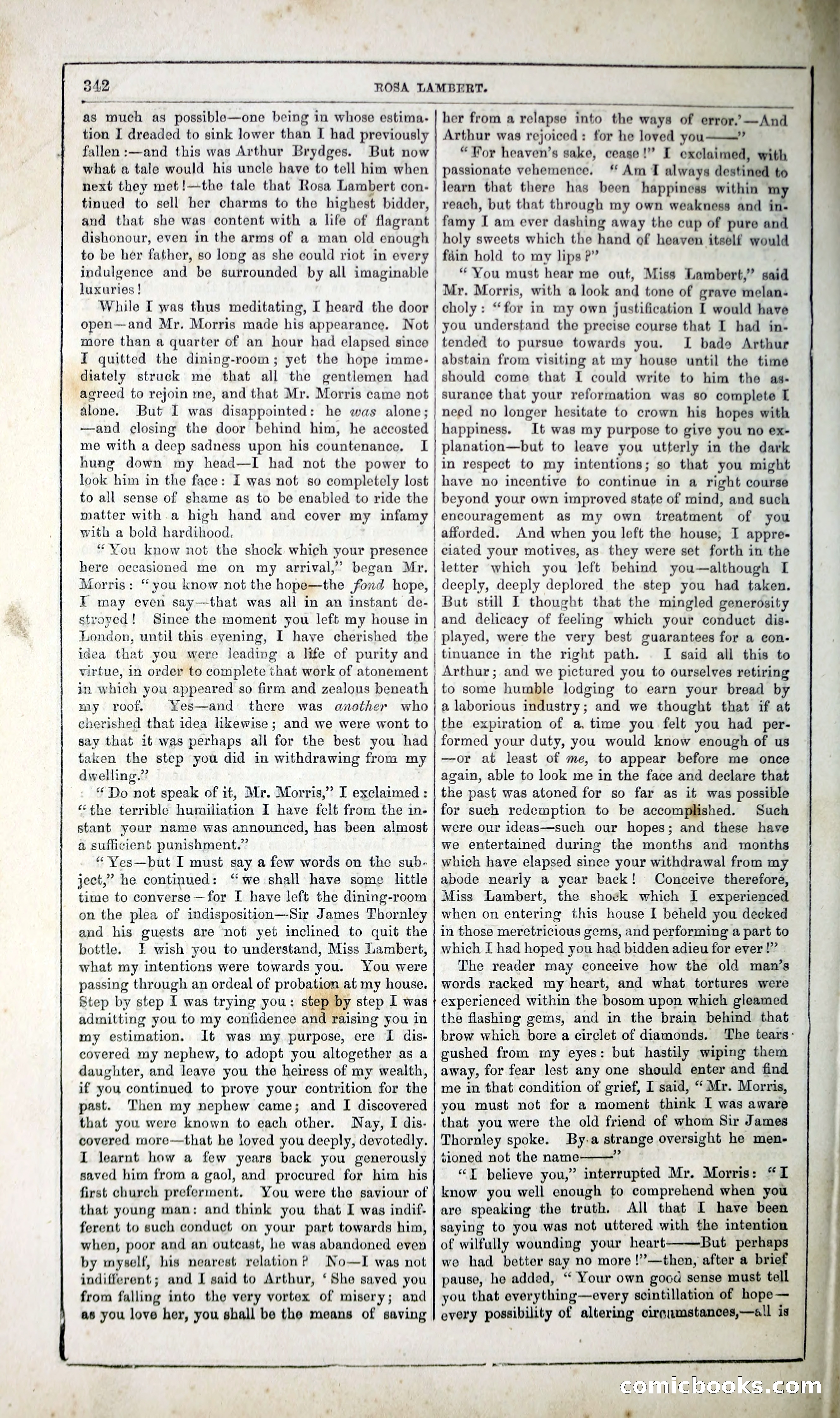
A restored page from Penny Dreadfuls, 1854. Page through the whole issue in the reader above.
📄 Transcribed text from this page (OCR, searchable)
Machine-transcribed from the original scan — historical spelling and the odd misread are preserved.
oA2 as much as possible—one being in whose estima- tion I dreaded to sink lower than I had previously fallen :—and this was Arthur Brydges. But now what a tale would his uncle have to tell him when next they met!—the tale that Rosa Lambert con- tinued to sell her charms to the highest bidder, and that she was content with a life of flagrant dishonour, even 1n the arms of a man old enough to be her father, so long as she could riot in every indulgence and be surrounded by all imaginable luxuries ! While I was thus meditating, I heard the door open—and Mr. Morris made his appearance. Not more than a quarter of an hour had elapsed since I quitted the dining-room; yet the hope imme- diately struck me that all the gentlemen had agreed to rejoin me, and that Mr. Morris came not alone. But I was disappointed: he was alone; —and closing the door behind him, he accosted me with a deep sadness upon his countenance. I hung down my head—I had not the power to look him in the face: I was not so completely lost to all sense of shame as to be enabled to ride the matter with.a high hand and cover my infamy with a bold hardihood. “You know not the shock which your presence here occasioned me on my arrival,” began Mr. Morris: “you know not the hope—the fond hope, T may even say—that was all in an instant de- stroyed! Since the moment you left my house in London, until this eyening, I have cherished the idea that you were leading a life of purity and virtue, in order to complete that work of atonement in which you appeared so firm and zealous beneath my roof. Yes—and there was another who eherished that idea likewise; and we were wont to say that it was perhaps all for the best you had taken the step you did in withdrawing from my dwelling.” “ Do not speak of it, Mr. Morris,” I exclaimed : “the terrible humiliation I have felt from the in- stant your name was announced, has been almost a sufficient punishment.” ““Yes—but I must say a few words on the sub- ject,” he continued: “we shall have some little time to converse —for I have left the dining-room on the plea of indisposition—Sir James Thornley and his guests are not yet inclined to quit the bottle. J wish you to understand, Miss Lambert, what my intentions were towards you. You were passing through an ordeal of probation at my house. Step by step I was trying you: step by step I was admitting you to my confidence and raising you in my estimation. It was my purpose, ere I dis- covered my nephew, to adopt you altogether as a daughter, and leave you the heiress of my wealth, if you continued to prove your contrition for the past. Then my nephew came; and I discovered that you were known to each other. Nay, I dis- covered more—that be loved you deeply, devotedly. I learnt how a few years back you generously saved him from a gaol, and procured for him his first church preferment. You were the saviour of that young man: and think you that I was indif- ferent to such conduct on your part towards him, when, poor and an outcast, he was abandoned even by myself, his nearest relation? No—I was not indifferent; and J said to Arthur, ‘She saved you from falling into the very vortex of misery; and as you love her, you shall be the means of saving — ROSA LAMBERT. her from a relapse into the ways of error.’—And Arthur was rejoiced: for he loved you-—” “or heaven’s sake, cease!” I exclaimed, with passionate vehemence. ‘ Am I always destined to learn that there has been happiness within ° reach, but that through my own weakness and i famy I am ever dashing away the cup of pure and holy sweets which the hand of heaven itself would fain hold to my lips P?” “You must hear me out, Miss Lambert,” said Mr. Morris, with a look and tone of grave melan- choly: “for in my own justification I would have you understand the precise course that I had in- tended to pursue towards you. I bade Arthur abstain from visiting at my house until the time should come that I could write to him the as- surance that your reformation was so complete I need no longer hesitate to crown his hopes with happiness. It was my purpose to give you no ex- planation—but to leave you utterly in the dark in respect to my intentions; so that you might have no incentive to continue in a right course beyond your own improved state of mind, and such encouragement as my own treatment of you afforded. And when you left the house, I appre- ciated your motives, as they were set forth in the letter which you left behind you—although I deeply, deeply deplored the step you had taken. But still I thought that the mingled generosity and delicacy of feeling which your conduct dis- played, were the very best guarantees for a con- tinuance in the right path. I said all this to Arthur; and we pictured you to ourselves retiring to some humble lodging to earn your bread by a laborious industry; and we thought that if at the expiration of a. time you felt you had per- formed your duty, you would know enough of us —or at least of me, to appear before me once again, able to look me in the face and declare that the past was atoned for so far as it was possible for such redemption to be accomplished. Such were our ideas—such our hopes; and these have we entertained during the months and months which have elapsed since your withdrawal from my abode nearly a year back! Conceive therefore, Miss Lambert, the shoek which I experienced when on entering this house I beheld you decked in those meretricious gems, and performing a part to which I had hoped you had bidden adieu for ever !”” The reader may conceive how the old man’s words racked my heart, and what tortures were experienced within the bosom upon which gleamed the flashing gems, and in the brain behind that brow which bore a circlet of diamonds. The tears: gushed from my eyes: but hastily wiping them away, for fear lest any one should enter and find me in that condition of grief, I said, “ Mr. Morris, you must not for a moment think I was aware that you were the old friend of whom Sir James Thornley spoke. By-a strange oversight he men- tioned not the name——” “TI believe you,” interrupted Mr. Morris: “I know you well enough to comprehend when you are speaking the truth. All that I have been saying to you was not uttered with the intention of wilfully wounding your heart But perhaps we had better say no more !’”’—then, after a brief pause, he added, “ Your own good sense must tell you that everything—every scintillation of hope— | every possibility of altering cireumstances,—all is |