
Penny Dreadfuls, 1854 · page 339 of 400
Rosa Lambert — page 339: what you’re looking at
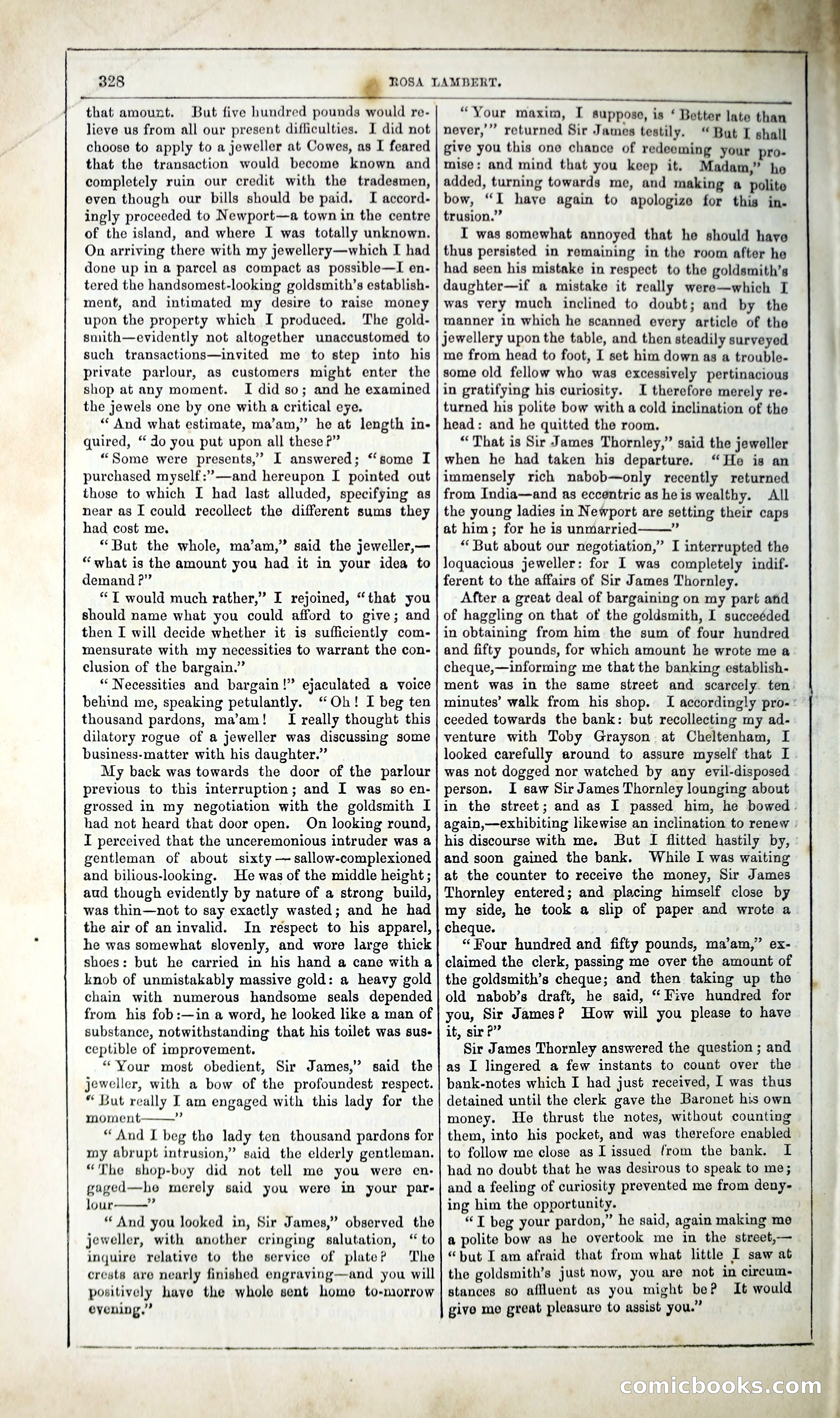
A restored page from Penny Dreadfuls, 1854. Page through the whole issue in the reader above.
📄 Transcribed text from this page (OCR, searchable)
Machine-transcribed from the original scan — historical spelling and the odd misread are preserved.
328 that amount. But five hundred pounds would re- lieve us from all our present difficulties. I did not choose to apply to a jeweller at Cowes, as I feared that the transaction would become known and completely ruin our credit with the tradesmen, even though our bills should be paid. I accord- ingly proceeded to Newport—a town in the centre of the island, and where I was totally unknown. On arriving there with my jewellery—which I had done up in a parcel as compact as possible—I en- tered the handsomest-looking goldsmith’s establish- ment, and intimated my desire to raise money upon the property which I produced. The gold- snuith—evidently not altogether unaccustomed to such transactions—invited me to step into his private parlour, as customers might enter the shop at any moment. I did so; and he examined the jewels one by one with a critical eye, “And what estimate, ma’am,” he at length in- quired, “ do you put upon all these P” “Some were presents,’ I answered; “some I purchased myself :’’—and hereupon I pointed out those to which I had last alluded, specifying as near as I could recollect the different sums they had cost me. “But the whole, ma’am,” said the jeweller,— “what is the amount you had it in your idea to demand P” “IT would much rather,” I rejoined, “that you should name what you could afford to give; and then I will decide whether it is sufficiently com- mensurate with my necessities to warrant the con- clusion of the bargain.” “Necessities and bargain!” ejaculated a voice | behind me, speaking petulantly. ‘Oh! I beg ten thousand pardons, ma’am!_ I really thought this dilatory rogue of a jeweller was discussing some business-matter with his daughter.” My back was towards the door of the parlour previous to this interruption; and I was so en- grossed in my negotiation with the goldsmith I had not heard that door open. On looking round, I perceived that the unceremonious intruder was a gentleman of about sixty — sallow-complexioned and bilious-looking. He was of the middle height ; aud though evidently by nature of a strong build, was thin—not to say exactly wasted; and he had the air of an invalid. In respect to his apparel, he was somewhat slovenly, and wore large thick shoes: but he carried in his hand a cane witha knob of unmistakably massive gold: a heavy gold chain with numerous handsome seals depended from his fob:—in a word, he looked like a man of | substance, notwithstanding that his toilet was sus- ceptible of improvement. “Your most obedient, Sir James,” said the jeweller, with a bow of the profoundest respect. “ But really I am engaged with this lady for the moment ii “And I beg the lady ten thousand pardons for my abrupt intrusion,” said the elderly gentleman. “The shop-boy did not tell me you were en- gaged—he merely said you were in your par- lour if “ And you looked in, Sir James,” observed the jeweller, with another cringing salutation, “ to inquire relative to the service of plate? The crests are nearly finished engravying—and you will positively have the whole sent home to-morrow evening,” ———- 9 OR ne ee é ROSA LAMBERT, _-_ — Oe a eee er ee eee OF 6 ere ee fe te ere ereET ee ee Pee ee eee LL ee iets “Your maxim, I suppose, is ‘ Better late than 9»? never,’”’ returned Sir James testily. “But I shall give you this one chance of redeeming your pro- mise: and mind that you keep it. Madam,” he added, turning towards me, and making a polite bow, “I have again to apologize for this in. trusion.” I was somewhat annoyed that he should have thus persisted in remaining in the room after he had seen his mistake in respect to the goldsmith’s daughter—if a mistake it really were—which I was very much inclined to doubt; and by the manner in which he scanned every article of the jewellery upon the table, and then steadily surveyed me from head to foot, I set him down as a trouble- some old fellow who was excessively pertinacious in gratifying his curiosity. I therefore merely re- turned his polite bow with a cold inclination of the head: and he quitted the room. “That is Sir James Thornley,” said the jeweller when he had taken his departure. “He is an immensely rich nabob—only recently returned from India—and as eccentric as heis wealthy. All the young ladies in Newport are setting their caps at him; for he is unmarried fs “ But about our negotiation,” I interrupted the loquacious jeweller: for I was completely indif- ferent to the affairs of Sir James Thornley. After a great deal of bargaining on my part afd of haggling on that of the goldsmith, I succeéded in obtaining from him the sum of four hundred and fifty pounds, for which amount he wrote me a cheque,—informing me that the banking establish- ment was in the same street and scarcely. ten minutes’ walk from his shop. I accordingly pro-: | ceeded towards the bank: but recollecting my ad- venture with Toby Grayson at Cheltenham, I looked carefully around to assure myself that I was not dogged nor watched by any evil-disposed person. I saw Sir James Thornley lounging about in the street; and as I passed him, he bowed. again,—exhibiting likewise an inclination to renew : But I flitted hastily by, : his discourse with me. and soon gained the bank. While I was waiting at the counter to receive the money, Sir James Thornley entered; and placing himself close by my side, he took a slip of paper and wrote a cheque. “Four hundred and fifty pounds, ma’am,” ex- claimed the clerk, passing me over the amount of the goldsmith’s cheque; and then taking up the old nabob’s draft, be said, “ Five hundred for you, Sir James? How will you please to have it, sir P”’ Sir James Thornley answered the question ; and as I lingered a few instants to count over the bank-notes which I had just received, I was thus detained until the clerk gave the Baronet his own money. He thrust the notes, without counting them, into his pocket, and was therefore enabled to follow me close as I issued from the bank. I had no doubt that he was desirous to speak to me; and a feeling of curiosity prevented me from deny- ing him the opportunity. “T beg your pardon,” he said, again making me a polite bow as he overtook me in the street,— “but I am afraid that from what little I saw at the goldsmith’s just now, you are not in cireum- stances so affluent as you might be? It would give me great pleasure to assist you.” ~ ~~ Go v.00 (E cS (ele)