
Penny Dreadfuls, 1854 · page 262 of 400
Rosa Lambert — page 262: what you’re looking at
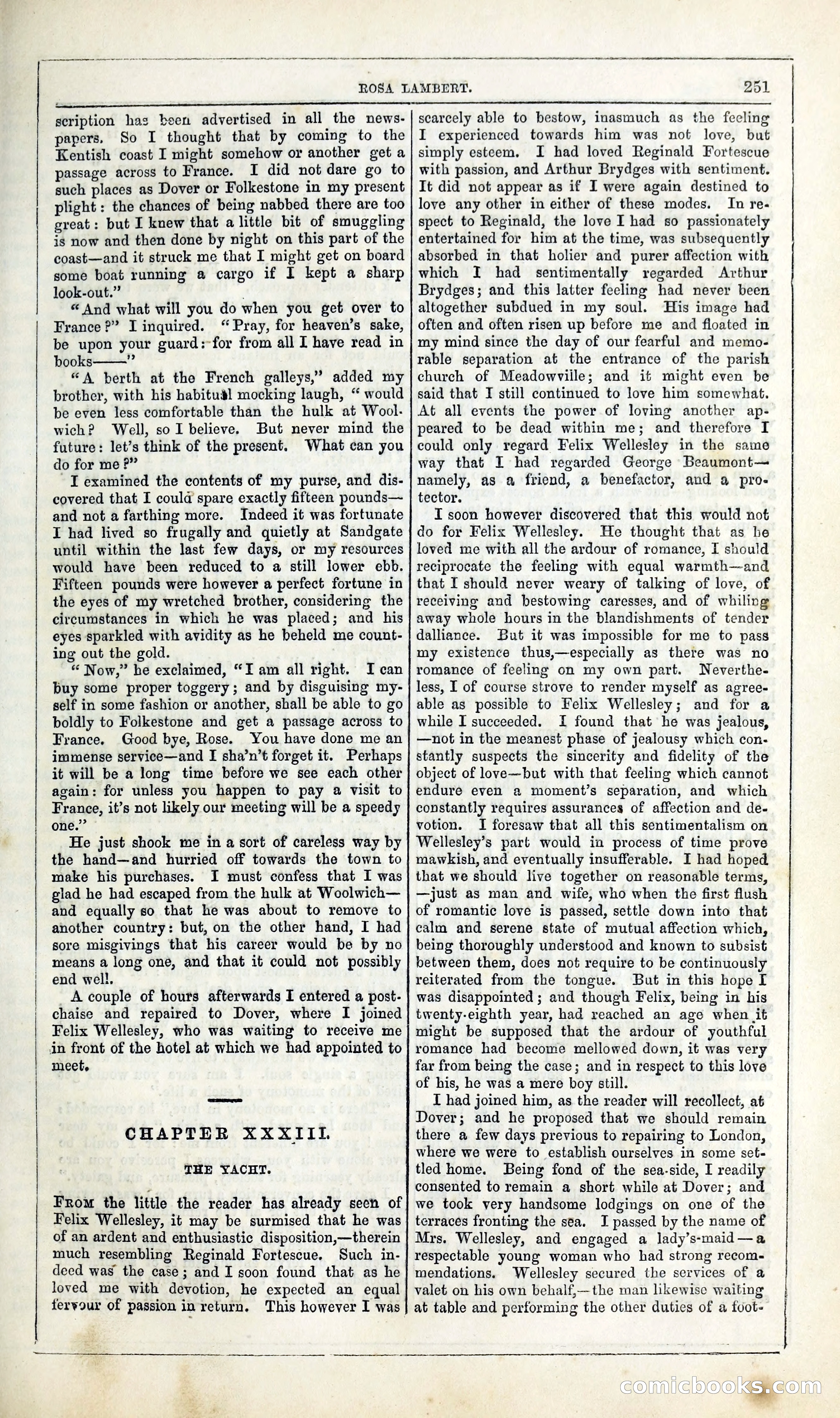
A restored page from Penny Dreadfuls, 1854. Page through the whole issue in the reader above.
📄 Transcribed text from this page (OCR, searchable)
Machine-transcribed from the original scan — historical spelling and the odd misread are preserved.
ROSA LAMBERT. scription haz been advertised in all the news- papers. So I thought that by coming to the Kentish coast I might somehow or another get a passage across to France. I did not dare go to such places as Dover or Folkestone in my present plight : the chances of being nabbed there are too great: but I knew that a little bit of smuggling is now and then done by night on this part of the coast—and it struck me that I might get on board some boat running a cargo if I kept a sharp look-out.” | « And what will you do when you get over to France ®” I inquired. “Pray, for heaven’s sake, be upon your guard:-for from all I have read in books i “A berth at the French galleys,” added my brother, with his habitual mocking laugh, “ would be even less comfortable than the hulk at Wool- wich? Well, sol believe. But never mind the future: let’s think of the present. What can you do for me ?” I examined the contents of my purse, and dis- covered that I could spare exactly fifteen pounds— and not a farthing more. Indeed it was fortunate I had lived so frugally and quietly at Sandgate until within the last few days, or my resources would have been reduced to a still lower ebb. Fifteen pounds were however a perfect fortune in the eyes of my wretched brother, considering the circumstances in which he was placed; and his eyes sparkled with avidity as he beheld me count- ing out the gold. “ Now,” he exclaimed, “Iam all right. I can buy some proper toggery ; and by disguising my- self in some fashion or another, shall be able to go boldly to Folkestone and get a passage across to France. Good bye, Rose. You have done me an immense service—and I sha’n’t forget it. Perhaps it will be a long time before we see each other again: for unless you happen to pay 2 visit to France, it’s not likely our meeting will be a speedy one.” He just shook me in a sort of careless way by the hand—and hurried off towards the town to make his purchases. I must confess that I was glad he had escaped from the hulk at Woolwich— and equally so that he was about to remove to another country: but, on the other hand, I had sore misgivings that his career would be by no means a long one, and that it could not possibly end well, A couple of hours afterwards I entered a post- chaise and repaired to Dover, where I joined Felix Wellesley, who was waiting to receive me an front of the hotel at which we had appointed to meet, CHAPTER XXXIII THE YACHT. From the little the reader has already secn of Felix Wellesley, it may be surmised that he was of an ardent and enthusiastic disposition,—therein much resembling Reginald Fortescue. Such in- deed was the case; and I soon found that as he loved me with devotion, he expected an equal fervour of passion in return. This however I was ne a Le mm mm RE ee es ee re re ee et ee ee ee 201 scarcely able to bestow, inasmuch as the feeling I experienced towards him was not love, but simply esteem, I had loved Reginald Fortescue with passion, and Arthur Brydges with sentiment. It did not appear as if I were again destined to love any other in either of these modes. In re. spect to Reginald, the love I had so passionately entertained for him at the time, was subsequently absorbed in that holier and purer affection with which I had sentimentally regarded Arthur Brydges; and this latter feeling had never been altogether subdued in my soul. His image had often and often risen up before me and floated in my mind since the day of our fearful and memo- rable separation at the entrance of the parish church of Meadowville; and it might even be said that I still continued to love him somewhat. At all events the power of loving another ap- peared to be dead within me; and therefore I could only regard Felix Wellesley in the same way that I had regarded George Beaumont— namely, as a friend, a benefactor, and a pro- tector. I soon however discovered that this would not do for Felix Wellesley. He thought that as he loved me with all the ardour of romance, I should reciprocate the feeling with equal warmth—and that I should never weary of talking of love, of receiving and bestowing caresses, and of whiling away whole hours in the blandishments of tender dalliance. But it was impossible for me to pass my existence thus,—especially as there was no romance of feeling on my own part. WNeverthe- less, I of course strove to render myself as agree- able as possible to Felix Wellesley; and for a while I succeeded. If found that he was jealous, —not in the meanest phase of jealousy which con- stantly suspects the sincerity and fidelity of the object of love—but with that feeling which cannot endure even a moment’s separation, and which constantly requires assurances of affection and de- votion. I foresaw that all this sentimentalism on Wellesley’s part would in process of time prove mawkish, and eventually insufferable. I had hoped that we should live together on reasonable terms, —just as man and wife, who when the first flush of romantic love is passed, settle down into that calm and serene state of mutual affection which, being thoroughly understood and known to subsist between them, does not require to be continuously reiterated from the tongue. But in this hope I was disappointed ; and though Felix, being in his twenty-eighth year, had reached an age when it might be supposed that the ardour of youthful romance had become mellowed down, it was very far from being the case; and in respect to this love of his, he was a mere boy still. I had joined him, as the reader will recollect, at Dover; and he proposed that we should remain there a few days previous to repairing to London, where we were to establish ourselves in some set- tled home. Being fond of the sea-side, I readily consented to remain a short while at Dover; and we took very handsome lodgings on one of the terraces fronting the sea. I passed by the name of Mrs. Wellesley, and engaged a lady’s-maid—a respectable young woman who had strong recom- mendations. Wellesley secured the services of a valet on his own behalf,—the man hkewise waiting at table and performing the other duties of a fvot- A EE Troe 6)(6)(0) iin