
Penny Dreadfuls, 1854 · page 251 of 400
Rosa Lambert — page 251: what you’re looking at
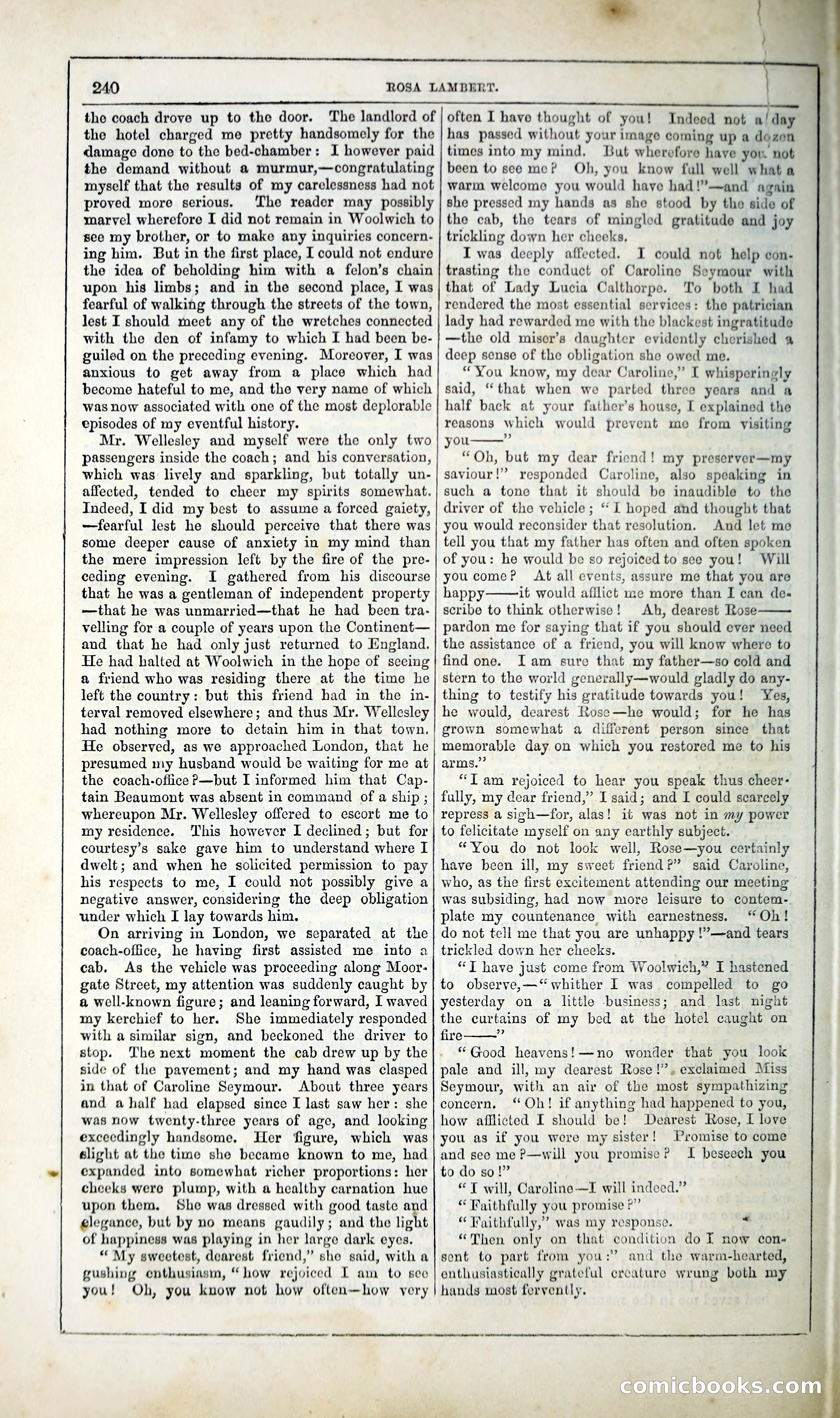
A restored page from Penny Dreadfuls, 1854. Page through the whole issue in the reader above.
📄 Transcribed text from this page (OCR, searchable)
Machine-transcribed from the original scan — historical spelling and the odd misread are preserved.
——EE——— Ome. oe 240 the coach drove up to the door. The landlord of the hotel charged me pretty handsomely for the damage done to the bed-chamber: I however paid the demand without a murmur,—congratulating myself that the results of my carelessness had not proved more serious. The reader may possibly marvel wherefore I did not remain in Woolwich to see my brother, or to make any inquiries concern- ing him. But in the first place, I could not endure the idea of beholding him with a felon’s chain upon his limbs; and in the second place, I was fearful of walking through the strects of the town, Jest I should mect any of the wretches connected with the den of infamy to which I had been be- guiled on the preceding evening. Moreover, I was anxious to get away from a place which had become hateful to me, and the very name of which was now associated with one of the most deplorable episodes of my eventful history. Mr. Wellesley and myself were the only two passengers inside the coach; and his conversation, which was lively and sparkling, but totally un- affected, tended to cheer my spirits somewhat. Indeed, I did my best to assume a forced gaiety, —fearful lest he should perceive that there was some deeper cause of anxiety in my mind than the mere impression left by the fire of the pre- ceding evening. I gathered from his discourse that he was a gentleman of independent property —that he was unmarried—that he had been tra- velling for a couple of years upon the Continent— and that he had only just returned to England. He had halted at Woolwich in the hope of seeing a friend who was residing there at the time he left the country: but this friend had in the in- terval removed elsewhere; and thus Mr. Wellesley had nothing more to detain him in that town. He observed, as we approached London, that he presumed my husband would be waiting for me at the coach-oflice P—but I informed him that Cap- tain Beaumont was absent in command of a ship ; whereupon Mr. Wellesley offered to escort me to my residence. This however I declined; but for courtesy’s sake gave him to understand where I dwelt; and when he solicited permission to pay his respects to me, I could not possibly give a negative answer, considering the deep obligation under which I lay towards him. On arriving in London, we separated at the coach-office, he having first assisted me into a cab. As the vehicle was proceeding along Moor: gate Street, my attention was suddenly caught by a well-known figure; and leaning forward, I waved my kerchief to her. She immediately responded with a similar sign, and beckoned the driver to stop. side of the pavement; and my hand was clasped in that of Caroline Seymour. About three years and a half had elapsed since I last saw her: she was now twenty-three years of age, and looking exceedingly handsome, Jer figure, which was élight at the time she became known to me, had expanded into somewhat richer proportions: her cheeks were plump, with a healthy carnation hue upon them. She was dressed with good taste and elegance, but by no means gaudily; and the light of happiness was playing in her large dark eyes. “ My sweetest, dearest friend,” she said, with a gushing enthusiasm, “ how rejoiced I am to see you! Oh, you know not how often—how very Oe eee | ROSA LAMBERT. The next moment the cab drew up by the]. often I havo thought of you! Indeed not a/day has passed without your image coming up a dozen times into my mind. But wherefore have you. not been to see meP Oh, you know full well what a warm welcome you would haye had!”—and again she pressed my hands as she stood by the side of the cab, the tears of mingled gratitude and joy trickling down her cheeks, I was deeply affected. I could not help con- trasting the conduct of Caroline Seymour with that of Lady Lucia Calthorpe. To both I had rendered the most essential services: the patrician lady had rewarded me with the blackest ingratitude —the old miser’s daughter evidently cherished a deep sense of the obligation she owed me. “You know, my dear Caroline,” I whisperingly said, “that when we parted three years and a half back at your father’s house, I explained the reasons which would prevent me from visiting Ou 9 “Oh, but my dear friend! my preserver—my saviour!’ responded Caroline, also speaking in such a tone that it should be inaudible to the driver of the vehicle; “I hoped and thought that you would reconsider that resolution. And let mo tell you that my father has often and often spoken of you: he would be so rejoi¢ed to see you! Will youcomeP At all events, assure me that you are happy it would afflict me more than I can de« scribe to think otherwise! Ah, dearest Rose pardon me for saying that if you should ever need the assistance of a friend, you will know where to find one. Iam sure that my father—so cold and stern to the world generally—would gladly do any- thing to testify his gratitude towards you! Yes, he would, dearest Rose—he would; for he has grown somewhat a different person since that memorable day on which you restored me to his arms.” “Tam rejoiced to hear you speak thus cheer- fully, my dear friend,” I said; and I could scarcely repress a sigh—for, alas! it was not in my power to felicitate myself on any earthly subject. “You do not look well, Rose—you certainly have been ill, my sweet friend?” said Caroline, who, as the first excitement attending our meeting was subsiding, had now more leisure to contem- plate my countenance with earnestness. “Oh! do not tell me that you are unhappy !’—and tears trickled down her cheeks. “TI have just come from Woolwich,” I hastened to observe,—“‘ whither I was compelled to go yesterday on a little -business; and last might the curtains of my bed at the hotel caught on fire td “Good heavens!—no wonder that you look pale and ill, my dearest Rose!”. exclaimed Miss Seymour, with an air of the most sympathizing concern. “Oh! if anything had happened to you, how afflicted I should be! Dearest Rose, I love you as if you were my sister! Promise to come and see me P—will you promiseP J beseech you to do so!” | © T will, Caroline—I will indeed.” “ Faithfully you promise ?”’ Vaithfully,” was my response. “Then only on that condition do IT now con-« sent to part from you:”’ and the warm-hearted, enthusiastically grateful creature wrung both my hands most fervently, « (ale) 900