
Penny Dreadfuls, 1854 · page 240 of 400
Rosa Lambert — page 240: what you’re looking at
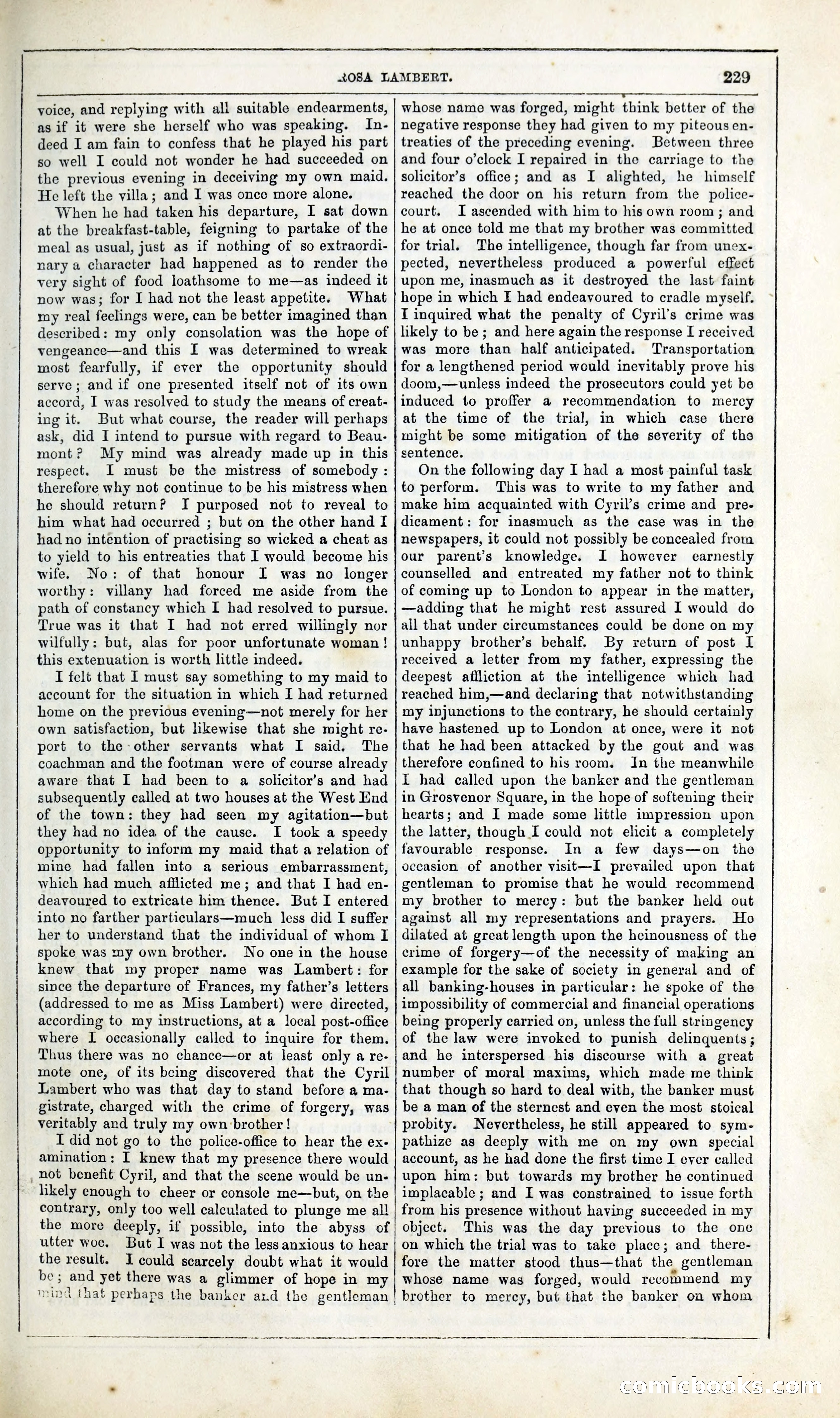
A restored page from Penny Dreadfuls, 1854. Page through the whole issue in the reader above.
📄 Transcribed text from this page (OCR, searchable)
Machine-transcribed from the original scan — historical spelling and the odd misread are preserved.
AtO054A LAMBERT. yoice, and replying with all suitable endearments, as if it were she herself who was speaking. In- deed I am fain to confess that he played his part so well I could not wonder he had succeeded on the previous evening in deceiving my own maid. He left the villa; and I was once more alone. When he had taken his departure, I sat down at the breakfast-table, feigning to partake of the meal as usual, just as if nothing of so extraordi- nary a character had happened as to render the very sight of food loathsome to me—as indeed it now was; for I had not the least appetite. What my real feelings were, can be better imagined than described: my only consolation was the hope of vengeance—and this I was determined to wreak most fearfully, if ever the opportunity should serve; andif one presented itself not of its own accord, I was resolved to study the means of creat- ing it. But what course, the reader will perhaps ask, did I intend to pursue with regard to Beau- mont? My mind was already made up in this respect. I must be the mistress of somebody : therefore why not continue to be his mistress when he should return? I purposed not to reveal to him what had occurred ; but on the other hand I had no intention of practising so wicked a cheat as to yield to his entreaties that I would become his wife. No: of that honour I was no longer worthy: villany had forced me aside from the path of constancy which I had resolved to pursue. True was it that I had not erred willingly nor wilfully: but, alas for poor unfortunate woman ! this extenuation is worth little indeed. I felt that I must say something to my maid to account for the situation in which I had returned home on the previous evening—not merely for her own satisfaction, but lkewise that she might re- port to the other servants what I said. The coachman and the footman were of course already aware that I had been to a solicitor’s and had subsequently called at two houses at the West End of the town: they had seen my agitation—but they had no idea of the cause. I took a speedy opportunity to inform my maid that a relation of mine had fallen into a serious embarrassment, which had much afflicted me; and that I had en- deavoured to extricate him thence. But I entered into no farther particulars—much less did I suffer her to understand that the individual of whom I spoke was my own brother. No one in the house knew that my proper name was Lambert: for since the departure of Frances, my father’s letters (addressed to me as Miss Lambert) were directed, according to my instructions, at a local post-office where I occasionally called to inquire for them. Thus there was no chance—or at least only a re- mote one, of its being discovered that the Cyril Lambert who was that day to stand before a ma- gistrate, charged with the crime of forgery, was veritably and truly my own’brother! I did not go to the police-office to hear the ex- amination: I knew that my presence there would _ not benefit Cyril, and that the scene would be un- likely enough to cheer or console me—but, on the contrary, only too well calculated to plunge me al! the more deeply, if possible, into the abyss of utter woe. But I was not the less anxious to hear the result. I could scarcely doubt what it would be; and yet there was a glimmer of hope in my mind that perhaps the banker ard the gentleman | 229 whose name was forged, might think better of the negative response they had given to my piteous en- treaties of the preceding evening. Between three and four o’clock I repaired in the carriage to the solicitor’s office; and as I alighted, he himself reached the door on his return from the police- court. I ascended with him to his own room; and he at once told me that my brother was committed for trial. The intelligence, though far from unex- pected, nevertheless produced a powerful effect upon me, inasmuch as it destroyed the last faint hope in which I had endeavoured to cradle myself. I inquired what the penalty of Cyril’s crime was likely to be; and here again the response I received was more than half anticipated. Transportation for a lengthened period would inevitably prove his doom,—unless indeed the prosecutors could yet be induced to proffer a recommendation to mercy at the time of the trial, in which case there might be some mitigation of the severity of the sentence. On the following day I had a most painful task to perform. This was to write to my father and make him acquainted with Cyril’s crime and pre- dicament: for inasmuch as the case was in the newspapers, it could not possibly be concealed from our parent's knowledge. I however earnestly |counselled and entreated my father not to think of coming up to London to appear in the matter, —adding that he might rest assured I would do all that under circumstances could be done on my unhappy brother’s behalf. By return of post I received a letter from my father, expressing the deepest affliction at the intelligence which had reached him,—and declaring that notwithstanding my injunctions to the contrary, he should certainly have hastened up to London at once, were it not that he had been attacked by the gout and was therefore confined to his room. In the meanwhile I had called upon the banker and the gentleman in Grosvenor Square, in the hope of softening their hearts; and I made some little impression upon the latter, though I could not elicit a completely favourable response. In a few days—on the occasion of another visit—I prevailed upon that gentleman to promise that he would recommend my brother to mercy: but the banker held out against all my representations and prayers. Hoe dilated at great length upon the heinousness of the crime of forgery—of the necessity of making an example for the sake of society in general and of all banking-houses in particular: he spoke of the impossibility of commercial and financial operations being properly carried on, unless the full stringency of the law were invoked to punish delinquents; and he interspersed his discourse with a great number of moral maxims, which made me think that though so hard to deal with, the banker must be a man of the sternest and even the most stoical probity. Nevertheless, he still appeared to sym- pathize as deeply with me on my own special account, as he had done the first time I ever called upon him: but towards my brother he continued implacable ; and I was constrained to issue forth from his presence without having succeeded in my object. This was the day previous to the one on which the trial was to take place; and there- fore the matter stood thus—that the gentleman whose name was forged, would recommend my brother to merey, but that the banker on whom LL A ET Go 6)(6)6) (C S (EO)