
Penny Dreadfuls, 1854 · page 237 of 400
Rosa Lambert — page 237: what you’re looking at
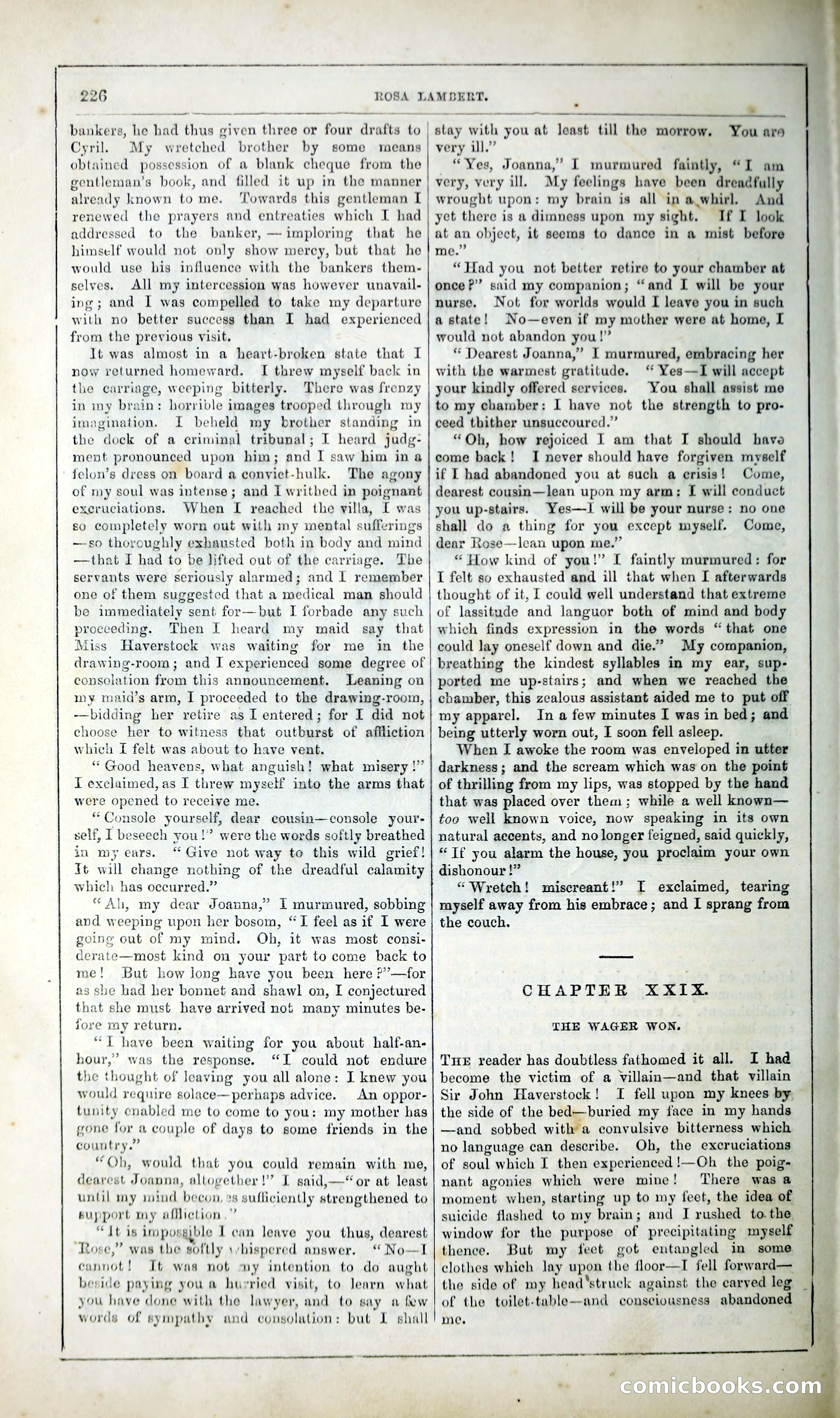
A restored page from Penny Dreadfuls, 1854. Page through the whole issue in the reader above.
📄 Transcribed text from this page (OCR, searchable)
Machine-transcribed from the original scan — historical spelling and the odd misread are preserved.
re rr EE er en ee —- eee —_—-— ————— ee bankers, he had thus given three or four drafts to Cyril. My wretched brother by some means obtained possession of a blank cheque from the centleman’s book, and filled it up in the manner already known to me. ‘Towards this gentleman I renewed the prayers and entreaties which I had addressed to the banker, — imploring that he himself would not only show mercy, but that he would use his influence with the bankers them- selves. All my intercession was however unayail- ing; and I was compelled to take my departure with no better success than I had experienced from the previous visit. It was almost in a heart-broken state that I now returned homeward. I threw myself back in the carriage, weeping bitterly. There was frenzy in iny brain: horrible images trooped through my imagination. I beheld my brother standing in the dock of a criminal tribunal; I heard judg- ment pronounced upon him; and I saw him in a felon’s dress on board a conyict-hulk. The agony of my soul was intense; and I writhed in poignant excruciations. When I reached the villa, I was so completely worn out with my mental sufferings —-so thoroughly exhausted both in body and mind —that I had to be }ifted out of the carriage. The servants were seriously alarmed; and L remember one of them suggested that a medical man should be immediately sent for—but I forbade any such proceeding. Then I heard my maid say that Miss Haverstock was waiting for me in the drawing-room; and I experienced some degree of consolation from this announcement. Leaning on my maid’s arm, I proceeded to the drawing-room, -—bidding her retire as I entered; for I did not choose her to witness that outburst of affliction which f felt was about to have vent. ‘Good heavens, what anguish! what misery !”’ I exclaimed, as I threw myself into the arms that were opened to receive me. “Console yourself, dear cousin—console your- self, I beseech you!” were the words softly breathed in myears. “Give not way te this wild grief! it will change nothing of the dreadful calamity which has occurred.” “Ah, my dear Joanna,’ I murmured, sobbing and weeping upon her bosom, “I feel asif I were going out of my mind. Oh, it was most consi- derate—most kind on your part to come back to me! But how long have you been here ?”’—for as she had her bonnet and shawl on, I conjectured that she must have arrived not many minutes be- jore my return. “JT have been waiting for you about half-an- hour,’ was the response. “I could not endure the thought of leaving you all alone: I knew you would require solace—perhaps advice. An oppor- tunity enabled me to come to you: my mother has gone for a couple of days to some friends in the country.” “Oh, would that you could remain with me, dearest Joanna, altogether!’ J said,—“or at least until my woind becon, 2s sufficiently strengthened to bupport my affliction.” “Jt is impossible I can leave you thus, dearest “Rose,” was the softly \vhispered answer. ‘“ No—I cannot! Jt was not my intention to do aught beside paying you a hurried visit, to learn what you have done with the lawyer, and to gay a few words of sympathy and consolation: but I shall SE TT TS TT A TTT eT a TST TS SS Ct TT ROSA LAMBERT. a stay with you at least till the morrow, very ill.” “Yes, Joanna,” I murmured faintly, “I am very, very ill. My feelings have been dreadfully wrought upon: my brain is all in a whirl, And yet there is a dimness upon my sight. If I look at an object, it seems to dance in a mist before me.” “JFiad you not better retire to your chamber at once P” said my companion; “and I will be your nurse, Not for worlds would I leave you in such a state! No—even if my mother were at home, I would not abandon you!” “ Dearest Joanna,” I murmured, embracing her with the warmest gratitude. ‘* Yes—TI will accept your kindly offered services. You shall assist me to my chamber: I have not the strength to pro- ceed thither unsuccoured.” “Oh, how rejoiced 1 am that I should have come back! I never should have forgiven myself if I had abandoned you at such a erisis! Come, dearest cousin—lean upon my arm: [ will conduct you up-stairs. Yes—JI will be your nurse: no one shall do a thing for you except myself. Come, dear Rose—lean upon me.” “ How kind of you!” I faintly murmured: for I felt so exhausted and ill that when I afterwards thought of it, I could well understand that extreme of lassitude and languor both of mind and body which finds expression in the words “that one could lay oneself down and die.” My companion, breathing the kindest syllables in my ear, sup- ported me up-stairs; and when we reached the chamber, this zealous assistant aided me to put off my apparel. In a few minutes I was in bed; and being utterly worn out, I soon fell asleep. When I awoke the room was enveloped in utter darkness; and the scream which was on the point of thrilling from my lips, was stopped by the hand that was placed over them; while a well known— too well known voice, now speaking in its own natural accents, and no longer feigned, said quickly, “Tf you alarm the house, you proclaim your own dishonour !” “Wretch! miscreant!” I exclaimed, tearing myself away from his embrace; and I sprang from the couch. You ara CHAPTER XXIX. THE WAGER WON. Tux reader has doubtless fathomed it all. I had become the victim of a Villain—and that villain Sir John Haverstock ! the side of the bed—buried my face in my hands —-and sobbed with a convulsive bitterness which no language can describe. Oh, the excruciations of soul which I then experienced !—Oh the poig- nant agonies which were mine! There was a moment when, starting up to my feet, the idea of suicide flashed to my brain; and I rushed to the window for the purpose of precipitating myself — thenee. But my feet got entangled in some clothes which lay upon the floor—I fell forward— a the side of my head'struck against the carved leg of the toilet-table—and consciousness abandoned — me. es (Elo) I fell upon my knees by — 1 Me ~~ ES * oS SSi-~ _ af