
Penny Dreadfuls, 1854 · page 229 of 400
Rosa Lambert — page 229: what you’re looking at
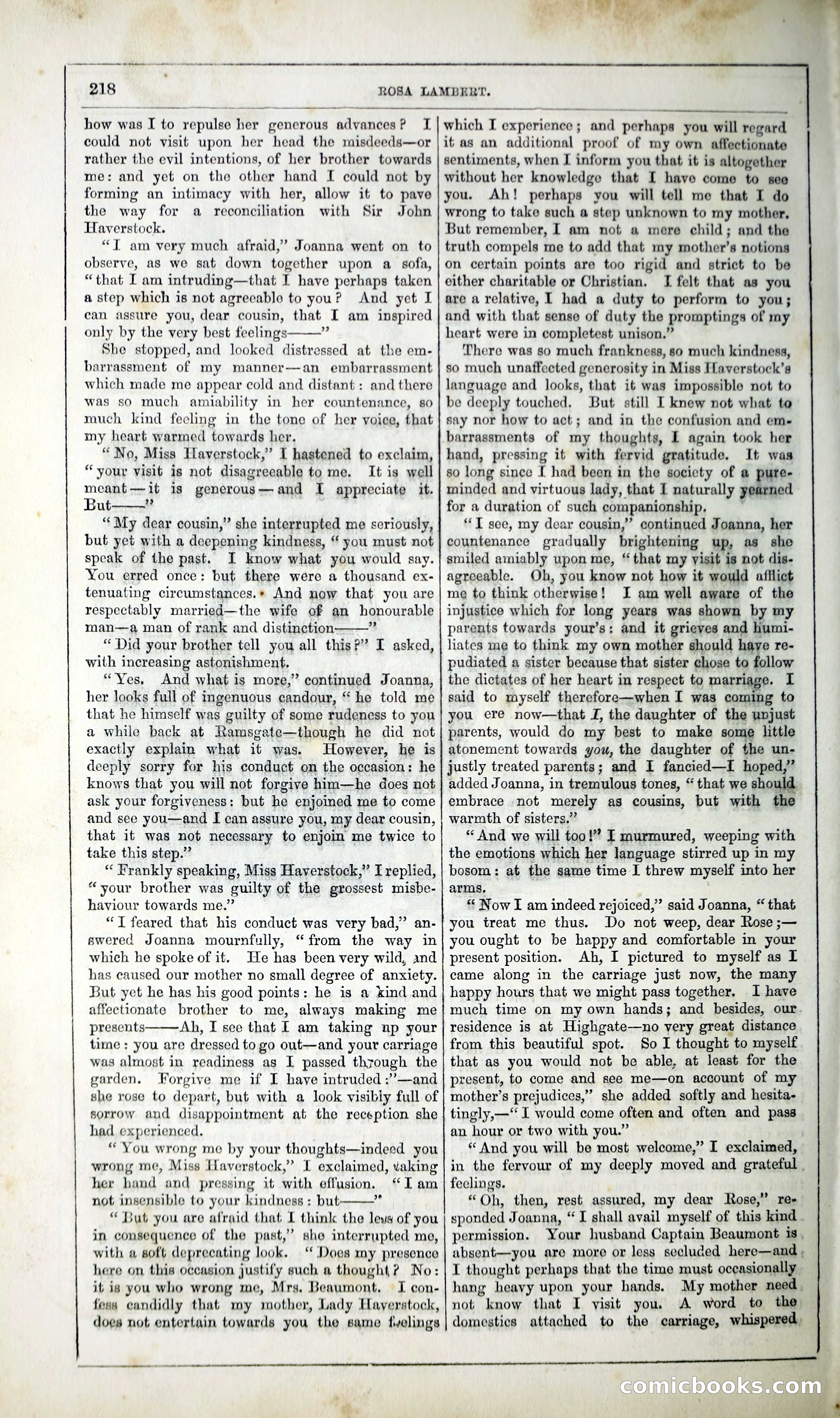
A restored page from Penny Dreadfuls, 1854. Page through the whole issue in the reader above.
📄 Transcribed text from this page (OCR, searchable)
Machine-transcribed from the original scan — historical spelling and the odd misread are preserved.
a a ee ee em + em nmaneee me 218 a a a mee Se how was I to repulse her generous advancesP I could not visit upon her head the misdeeds—or rather the evil intentions, of her brother towards me: and yet on the other hand I could not by forming an intimacy with her, allow it to pave the way for a reconciliation with Sir John Haverstock. “I am very much afraid,’ Joanna went on to observe, as we sat down together upon a sofa, “that I am intruding—that I have perhaps taken a step which is not agreeable to you? And yet I can assure you, dear cousin, that I am inspired only by the very best feelings i She stopped, and looked distressed at the em- barrassment of my manner—an embarrassment which made me appear cold and distant : and there was so much amiability in her countenance, so much kind feeling in the tone of her voice, that my heart warmed towards her. “No, Miss Haverstock,”’ I hastened to exclaim, “your visit is not disagreeable to me. It is well meant—1t 1s generous—and I appreciate it. But ag ‘‘ My dear cousin,” she interrupted me seriously, but yet with a deepening kindness, “ you must not speak of the past. I know what you would say. You erred once: but there were a thousand ex- tenuating circumstances.* And now that you are respectably married—the wife of an honourable man—a man of rank and distinction ‘ ‘Did your brother tell you all this?” I asked, with increasing astonishment, “Yes, And what is more,” continued Joanna, her looks full of ingenuous candour, “ he told me that he himself was guilty of some rudeness to you a while back at Ramsgate—though he did not exactly explain what it was. However, he is deeply sorry for his conduct on the occasion: he knows that you will not forgive him—he does not ask your forgiveness: but he enjoined me to come and see you—and I can assure you, my dear cousin, that it was not necessary to enjoin me twice to take this step.” “ Frankly speaking, Miss Haverstock,” I replied, “your brother was guilty of the grossest misbe- haviour towards me.” “1 feared that his conduct was very bad,’ an- swered Joanna mournfully, “from the way in which he spoke of it. He has been very wild, and has caused our mother no small degree of anxiety. But yet he has his good points: he is a kind and affectionate brother to me, always making me presents Ah, I see that I am taking up your time : you are dressed to go out—and your carriage was almost in readiness as I passed through the garden. Forgive me if I haye intruded :’—and she rose to depart, but with a look visibly full of sorrow and disappointment at the reception she had experienced. “ You wrong me by your thoughts—indeed you wrong me, Miss Iaverstock,” I exclaimed, vaking her hand and pressing it with effusion. “Iam not insensible to your kindness : but 7 “ But you are afraid that I think the lews of you in consequence of the past,” she interrupted me, with a soft deprecating look. “ Does my presenco here on this occasion justify such a thought? No: it ig you who wrong me, Mrs. Beaumont, I con- fess candidly that my mother, Lady Hayerstock, does not entertain towards you the same fyelings ROSA LAMBERT. a — a which I experience; and perhaps you will regard it as an additional proof of my own affectionate sentiments, when I inform you that it is altogether without her knowledge that I have come to see you. Ah! perhaps you will tell me that I do wrong to take such a step unknown to my mother, But remember, I am not a mere child; and the truth compels me to add that my mother’s notions on certain points are too rigid and strict to be either charitable or Christian, I felt that as you are a relative, I had a duty to perform to you; and with that sense of duty the promptings of my heart were in completest unison.” There was so much frankness, s0 much kindness, so much unaffected generosity in Miss Haverstock’s language and looks, that it was impossible not to be deeply touched. But still I knew not what to say nor how to act; and in the confusion and em- barrassments of my thoughts, L again took her hand, pressing it with fervid gratitude. It was so long since I had been in the society of a pute- minded and virtuous lady, that I naturally yearned for a duration of such companionship, : “T see, my dear cousin,’ continued Joanna, her countenance gradually brightening up, as she smiled amiably upon me, “that my yisit is not dis- agreeable. Oh, you know not how it would afflict me to think otherwise! I am well aware of the injustice which for long years was shown by my parents towards your’s: and it grieyes and humi- liates me to think my own mother should haye re- pudiated a sister because that sister chose to follow the dictates of her heart in respect to marriage. I said to myself therefore—when I was coming to you ere now—that J, the daughter of the unjust parents, would do my best to make some little atonement towards you, the daughter of the un- justly treated parents; and I fancied—I hoped,’ added Joanna, in tremulous tones, “that we should embrace not merely as cousins, but with the warmth of sisters.” “ And we will too!” I murmured, weeping with the emotions which her language stirred up in my bosom: at the same time I threw myself into her arms. | , * Now IL am indeed rejoiced,” said Joanna, “ that you treat me thus. Do not weep, dear Rose ;— you ought to be happy and comfortable in your present position. Ah, I pictured to myself as L came along in the carriage just now, the many happy hours that we might pass together. 1 have much time on my own hands; and besides, our. residence is at Highgate—no very great distance from this beautiful spot. So I thought to myself that as you would not be able, at least for the present, to come and see me—on account of my mother’s prejudices,” she added softly and hesita- tingly,—‘ I would come often and often and pass_ an hour or two with you.” « And you will be most welcome,” I exclaimed, in the fervour of my deeply moved and grateful | feclings. ! “Oh, then, rest assured, my dear Rose,” re sponded Joanna, “I shall avail myself of this kind - permission. Your husband Captain Beaumont 1s, — absent—you are more or less secluded here—and, — I thought perhaps that the time must occasionally hang heavy upon your hands. My mother need | not know that I visit you. A word to the — domestics attached to the carriage, whispered , 1