
Penny Dreadfuls, 1854 · page 216 of 400
Rosa Lambert — page 216: what you’re looking at
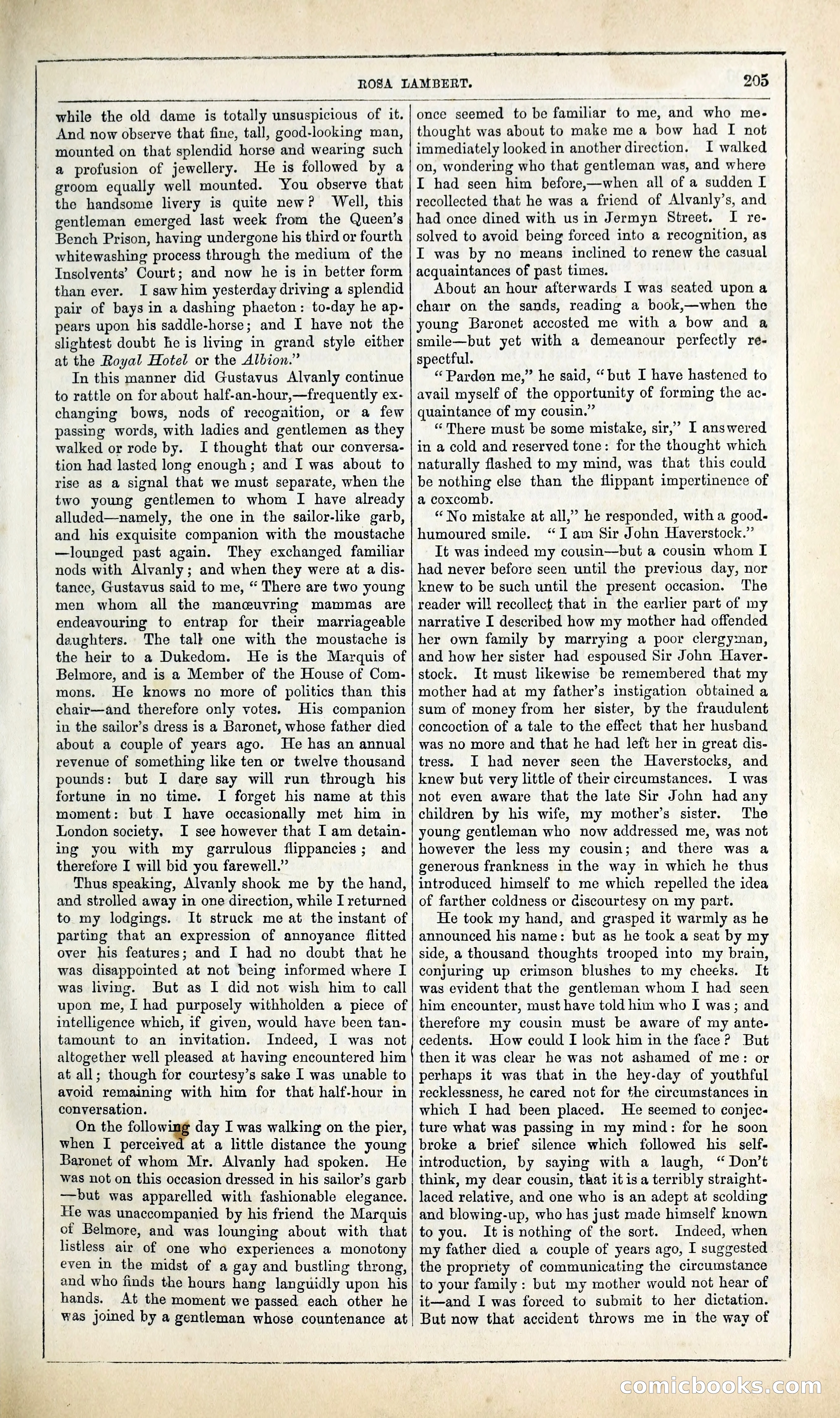
A restored page from Penny Dreadfuls, 1854. Page through the whole issue in the reader above.
📄 Transcribed text from this page (OCR, searchable)
Machine-transcribed from the original scan — historical spelling and the odd misread are preserved.
ROSA LAMBERT. while the old dame is totally unsuspicious of it. And now observe that fine, tall, good-looking man, mounted on that splendid horse and wearing such a profusion of jewellery. He is followed by a groom equally well mounted. You observe that the handsome livery is quite new? Well, this gentleman emerged last week from the Queen's Bench Prison, having undergone his third or fourth whitewashing process through the medium of the Insolvents’ Court; and now he is in better form than ever. I saw him yesterday driving a splendid pair of bays in a dashing phacton: to-day he ap- pears upon his saddle-horse; and I have not the slightest doubt he is living in grand style either at the Royal Hotel or the Albion.” In this manner did Gustavus Alvanly continue to rattle on for about half-an-hour,—frequently ex- changing bows, nods of recognition, or a few passing words, with ladies and gentlemen as they walked or rode by. I thought that our conversa- tion had lasted long enough; and I was about to rise as a signal that we must separate, when the two young gentlemen to whom I have already alluded—namely, the one in the sailor-like garb, and his exquisite companion with the moustache —lounged past again. They exchanged familiar nods with Alvanly; and when they were at a dis- tance, Gustavus said to me, “ There are two young men whom all the mancuvring mammas are endeavouring to entrap for their marriageable daughters. The talk one with the moustache is the heir to a Dukedom. He is the Marquis of Belmore, and is a Member of the House of Com- mons. He knows no more of politics than this chair—and therefore only votes. His companion in the sailor’s dress is a Baronet, whose father died about a couple of years ago. He has an annual revenue of something lke ten or twelve thousand pounds: but I dare say will run through his fortune in no time. I forget his name at this moment: but I have occasionally met him in London society. I see however that I am detain- ing you with my garrulous flippancies; and therefore I will bid you farewell.” Thus speaking, Alvanly shook me by the hand, and strolled away in one direction, while I returned | to my lodgings. It struck me at the instant of parting that an expression of annoyance flitted over his features; and I had no doubt that he was disappointed at not being informed where I was living. But as I did not wish him to call upon me, I had purposely withholden a piece of intelligence which, if given, would have been tan- tamount to an invitation. Indeed, I was not altogether well pleased at having encountered him at all; though for courtesy’s sake I was unable to avoid remaining with him for that half-hour in conversation. On the followimg day I was walking on the pier, when I perceived at a little distance the young Baronet of whom Mr. Alvanly had spoken. He was not on this occasion dressed in his sailor’s garb —hbut was apparelled with fashionable elegance. He was unaccompanied by his friend the Marquis of Belmore, and was lounging about with that listless air of one who experiences a monotony even in the midst of a gay and bustling throng, and who finds the hours hang languidly upon his hands. At the moment we passed each other he Was joined by a gentleman whose countenance at 203 thought was about to make me a bow had [ not immediately looked in another direction. I walked on, wondering who that gentleman was, and where I had seen him before,—when all of a sudden I recollected that he was a friend of Alvanly’s, and had once dined with usin Jermyn Street. I re- solved to avoid being forced into a recognition, as I was by no means inclined to renew the casual acquaintances of past times. About an hour afterwards I was seated upon a chair on the sands, reading a book,—when the | young Baronet accosted me with a bow and a smile—but yet with a demeanour perfectly re- spectful. “Pardon me,” he said, “but I have hastened to avail myself of the opportunity of forming the ac- quaintance of my cousin.” “There must be some mistake, sir,’ I answered in a cold and reserved tone: for the thought which naturally flashed to my mind, was that this could be nothing else than the flippant impertinence of a coxcomb. “No mistake at all,” he responded, witha good- humoured smile. “Iam Sir John Haverstock.” It was indeed my cousin—but a cousin whom I had never before seen until the previous day, nor knew to be such until the present occasion. The reader wil! recollect that in the earlier part of my narrative I described how my mother had offended her own family by marrying a poor clergyman, and how her sister had espoused Sir John Haver- stock. It must likewise be remembered that my mother had at my father’s instigation obtained a sum of money from her sister, by the fraudulent concoction of a tale to the effect that her husband was no more and that he had left her in great dis- tress. I had never seen the Haverstocks, and knew but very little of their circumstances. I was not even aware that the late Sir John had any children by his wife, my mother’s sister. The young gentleman who now addressed me, was not however the iess my cousin; and there was a generous frankness in the way in which he thus introduced himself to me which repelled the idea of farther coldness or ciscourtesy on my part. He took my hand, and grasped it warmly as he announced his name: but as he took a seat by my side, a thousand thoughts trooped into my brain, conjuring up crimson blushes to my cheeks. It was evident that the gentleman whom I had seen him encounter, must have told him who I was; and therefore my cousin must be aware of my ante- cedents. How could I look him in the face? But then it was clear he was not ashamed of me: or perhaps 16 was that in the hey-day of youthful recklessness, he cared not for the circumstances in which I had been placed. He seemed to conjec- ture what was passing in my mind: for he soon broke a brief silence which followed his selfs introduction, by saying with a laugh, “ Don’t think, my dear cousin, that itis a terribly straight- laced relative, and one who is an adept at scolding and blowing-up, who has just made himself known to you. It is nothing of the sort. Indeed, when my father died a couple of years ago, I suggested the propriety of communicating the circumstance to your family: but my mother would not hear of it—and I was forced to submit to her dictation. But now that accident throws me in the way of once seemed to be familiar to me, and who me- (EON! OOO) ‘S (Elo)