
Penny Dreadfuls, 1854 · page 214 of 400
Rosa Lambert — page 214: what you’re looking at
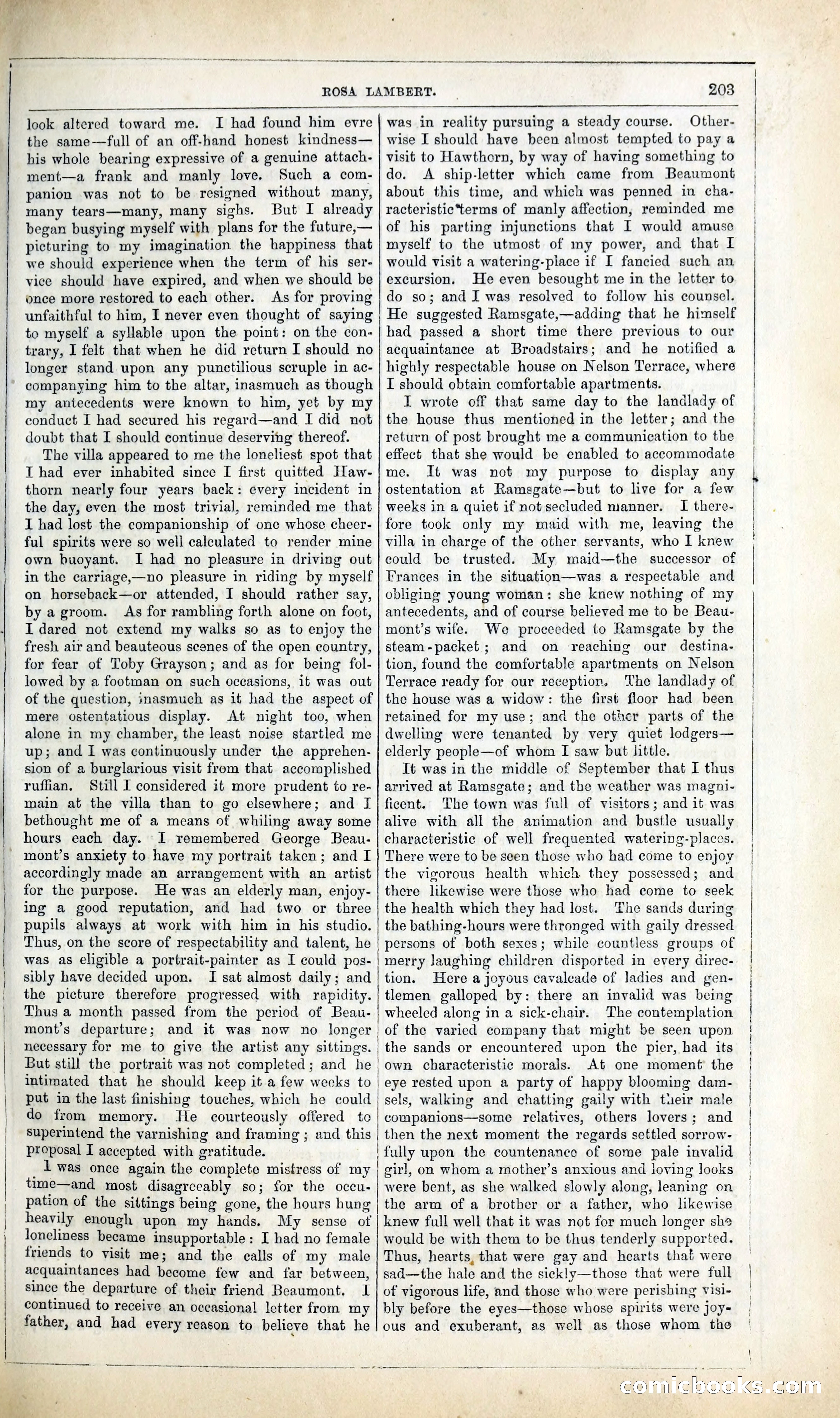
A restored page from Penny Dreadfuls, 1854. Page through the whole issue in the reader above.
📄 Transcribed text from this page (OCR, searchable)
Machine-transcribed from the original scan — historical spelling and the odd misread are preserved.
LLL A Ty EE le yk ea - ROSA LAMBERT. LEILA LE A Al a i lit a tle. a a ee ee eee 203 snr nnn neta dEIEES USSD En look altered toward me. I had found him evre the same—full of an off-hand honest kindness— his whole bearing expressive of a genuine attach- ment—a frank and manly love. Such a com- panion was not to be resigned without many, many tears—many, many sighs. But I already began busying myself with plans for the future,— picturing to my imagination the happiness that we should experience when the term of his ser- vice should have expired, and when we should be once more restored to each other. As for proving unfaithful to him, I never even thought of saying to myself a syllable upon the point: on the con- trary, I felt that when he did return I should no longer stand upon any punctilious scruple in ac- - companying him to the altar, inasmuch as though my antecedents were known to him, yet by my conduct I had secured his regard—and I did not doubt that I should continue deserving thereof. The villa appeared to me the loneliest spot that IT had ever inhabited since I first quitted Haw- thorn nearly four years back: every incident in the day, even the most trivial, reminded me that I had lost the companionship of one whose cheer- ful spirits were so well calculated to render mine own buoyant. I had no pleasure in driving out in the carriage,—no pleasure in riding by myself on horseback—or attended, I should rather say, by agroom. As for rambling forth alone on foot, I dared not extend my walks so as to enjoy the fresh air and beauteous scenes of the open country, for fear of Toby Grayson; and as for being fol- lowed by a footman on such oceasions, 1t was out of the question, inasmuch as it had the aspect of mere ostentatious display. At night too, when alone in my chamber, the least noise startled me up; and I was continuously under the apprehen- sion of a burglarious visit from that accomplished rufian. Still I considered it more prudent to re- main at the villa than to go elsewhere; and I bethought me of a means of whiling away some hours each day. I remembered George Beau- mont’s anxiety to have my portrait taken; and I accordingly made an arrangement with an artist for the purpose. He was an elderly man, enjoy- ing a good reputation, and had two or three pupils always at work with him in his studio. Thus, on the score of respectability and talent, he was as eligible a portrait-painter as I could pos- sibly have decided upon. I sat almost daily; and the picture therefore progressed with rapidity. Thus a month passed from the period of Beau- mont’s departure; and it was now no longer necessary for me to give the artist any sittings. But still the portrait was not completed; and he intimated that he should keep it a few weeks to put in the last finishing touches, which he could do from memory. He courteously offered to superintend the varnishing and framing ; and this proposal I accepted with gratitude. _ i was once again the complete mistress of my time—and most disagreeably so; for the occu- pation of the sittings being gone, the hours hung heavily enough upon my hands. My sense of loneliness became insupportable: I had no female friends to visit me; and the calls of my male acquaintances had become few and far between, since the departure of their friend Beaumont. I continued to receive an occasional letter from my father, and had every reason to believe that he was in reality pursuing a steady course. Other- wise I should have been almost tempted to pay a visit to Hawthern, by way of having something to do. A ship-letter which came from Beaumont about this time, and which was penned in cha- racteristic*terms of manly affection, reminded me of his parting injunctions that I would amuse myself to the utmost of my power, and that I would visit a watering-place if I fancied such an excursion. He even besought me in the letter to do so; and I was resolved to follow his counsel. He suggested Ramsgate,—adding that he himself had passed a short time there previous to our acquaintance at Broadstairs; and he notified a highly respectable house on Nelson Terrace, where I should obtain comfortable apartments. I wrote off that same day to the landlady of the house thus mentioned in the letter; and the return of post brought me a communication to the effect that she would be enabled to accommodate me. It was not my purpose to display any ostentation at Ramsgate—but to live for a few weeks in a quiet if not secluded manner. I there- fore took only my maid with me, leaving the villa in charge of the other servants, who I knew could be trusted. My maid—the successor of Frances in the situation—was a respectable and obliging young woman: she knew nothing of my antecedents, and of course believed me to be Beau- mont’s wife. We proceeded to Ramsgate by the steam-packet; and on reaching our destina- tion, found the comfortable apartments on Nelson Terrace ready for our reception, The landlady of the house was a widow: the first floor had been retained for my use; and the other parts of the dwelling were tenanted by very quiet lodgers— elderly people—of whom I saw but little. It was in the middle of September that I thus arrived at Ramsgate; and the weather was magni- ficent. The town was full of visitors; and it was alive with all the animation and bustle usually characteristic of well frequented watering-places. There were to be seen those who had come to enjoy the vigorous health which they possessed; and there likewise were those who had come to seek the health which they had lost. The sands during the bathing-hours were thronged with gaily dressed persons of both sexes; while countless groups of merry laughing children disported in every Girec- tion. Here a joyous cavalcade of ladies and gen- tlemen galloped by: there an invalid was being wheeled along in a sick-chair. The contemplation of the varied company that might be seen upon the sands or encountered upon the pier, had its own characteristic morals. At one moment the eye rested upon a party of happy blooming dam- sels, walking and chatting gaily with tueir male companions—some relatives, others lovers; and then the next moment the regards settled sorrow- fully upon the countenance of some pale invalid girl, on whom a mother’s anxious and loving looks were bent, as she walked slowly along, leaning on | the arm of a brother or a father, who likewise knew full well that it was not for much longer she would be with them to be thus tenderly supported. Thus, hearts, that were gay and hearts thal were sad—the hale and the sickly—those that were full of vigorous life, and those who were perishing visi- bly before the eyes—those whose spirits were joy- ous and exuberant, as well as those whom the a FE ee re -— re oe eee rete nk sags wanted» tated ome a ~- e a ee rr via Eomichboo (E SS nn Sn CS (El)