
Penny Dreadfuls, 1854 · page 119 of 400
Rosa Lambert — page 119: what you’re looking at
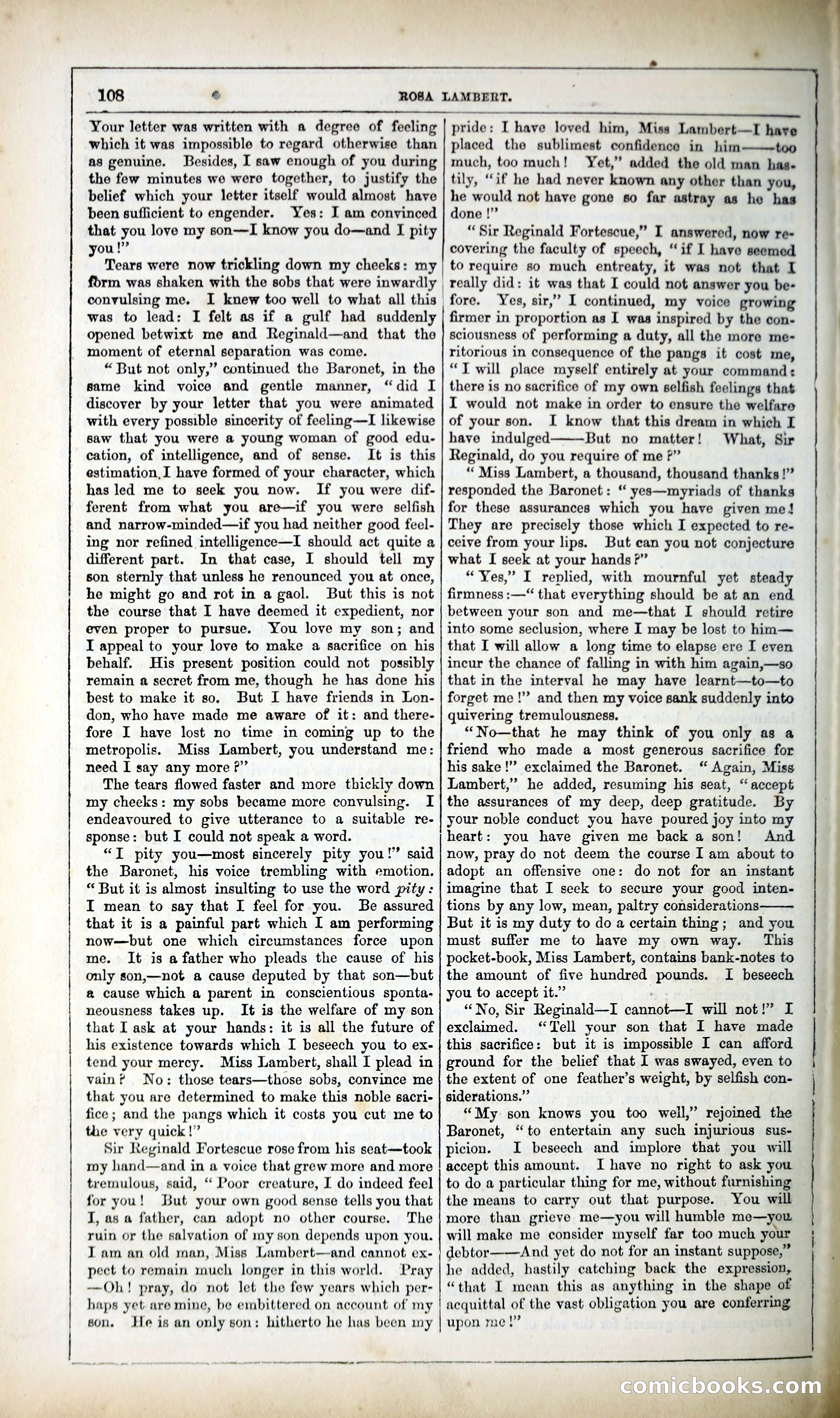
A restored page from Penny Dreadfuls, 1854. Page through the whole issue in the reader above.
📄 Transcribed text from this page (OCR, searchable)
Machine-transcribed from the original scan — historical spelling and the odd misread are preserved.
108 ® Your letter was written with a degree of feeling which it was impossible to regard otherwise than as genuine. Besides, I saw enough of you during the few minutes we were together, to justify the belief which your letter itself would almost have been suflicient to engender. Yes: I am convinced that you love my son—I know you do—and I pity ou!” d Tears were now trickling down my cheeks: my form was shaken with the sobs that were inwardly convulsing me, I knew too well to what all this was to lead: I felt as if a gulf had suddenly opened betwixt me and Reginald—and that the moment of eternal separation was come. “But not only,” continued the Baronet, in the same kind voice and gentle manner, “did I discover by your letter that you were animated with every possible sincerity of feeling—I likewise saw that you were a young woman of good edu- cation, of intelligence, and of sense. It is this estimation,I have formed of your character, which has led me to seek you now. If you were dif- ferent from what you are—if you were selfish and narrow-minded—if you had neither good feel- ing nor refined intelligence—I should act quite a different part. In that case, I should tell my son sternly that unless he renounced you at once, he might go and rot in a gaol. But this is not the course that I have deemed it expedient, nor even proper to pursue. You love my son; and I appeal to your love to make a sacrifice on his behalf. His present position could not possibly remain a secret from me, though he has done his best to make it so, But I have friends in Lon- don, who have made me aware of it: and there- fore I have lost no time in coming up to the metropolis. Miss Lambert, you understand me: need I say any more ?”’ The tears flowed faster and more thickly down my cheeks: my sobs became more convulsing. I endeavoured to give utterance to a suitable re- sponse: but I could not speak a word. “I pity you—most sincerely pity you!” said the Baronet, his voice trembling with emotion. “ But it is almost insulting to use the word pity: I mean to say that I feel for you. Be assured that it is a painful part which I am performing now—but one which circumstances force upon me. It is a father who pleads the cause of his only son,—not a cause deputed by that son—but @ cause which a parent in conscientious sponta- neousness takes up. It is the welfare of my son that I ask at your hands: it 1s all the future of his existence towards which I beseech you to ex- tend your mercy. Miss Lambert, shall I plead in vain? No: those tears—those sobs, convince me that you are determined to make this noble sacri- fice; and the pangs which it costs you cut me to the very quick!” Sir Reginald Fortescue rose from his seat—took my hand—and in a voice that grew more and more tremulous, said, ‘‘ Poor creature, I do indeed feel for you! But your own good sense tells you that J, as a father, can adopt no other course. The ruin or the salvation of my son depends upon you. I am an old man, Miss Lambert—and cannot ex- pect to remain much longer in this world. Pray —Oh! pray, do not let the few years which per- haps yet are mine, be embittered on account of my son. Ile is an only son: hitherto he has been my ROBA LAMBERT. Oe EEE EEE EE pride: I have loved him, Miss Lambert—I have placed the sublimest confidence in him too much, too much! Yet,” added the old man has- tily, “if he had never known any other than you, he would not have gone so far astray as he has done !” “Sir Reginald Fortescue,” I answered, now re- covering the faculty of speech, “if I have seemed to require so much entreaty, it was not that I really did: it was that I could not answer you be- fore. Yes, sir,” I continued, my voice growing firmer in proportion as I was inspired by the con- sciousness of performing a duty, all the more me- ritorious in consequence of the pangs it cost me, “J will place myself entirely at your command: there is no sacrifice of my own selfish feelings that I would not make in order to ensure the welfare of your son. I know that this dream in which I have indulged But no matter! What, Sir Reginald, do you require of me ?” “ Miss Lambert, a thousand, thousand thanks !” responded the Baronet: “‘ yes—myriads of thanks for these assurances which you have given me! They are precisely those which I expected to re- ceive from your lips. But can you not conjecture what I seek at your hands?” “Yes,” I replied, with mournful yet steady firmness :—“ that everything should be at an end between your son and me—that I should retire into some seclusion, where I may be lost to him— that I will allow a long time to elapse ere I even incur the chance of falling in with him again,—so that in the interval he may have learnt—to—to forget me !’’ and then my voice sank suddenly into quivering tremulousness. “No—that he may think of you only as a friend who made a most generous sacrifice for his sake!” exclaimed the Baronet. “ Again, Miss Lambert,” he added, resuming his seat, “ accept the assurances of my deep, deep gratitude. By your noble conduct you have poured joy into my heart: you have given me back a son! And now, pray do not deem the course I am about to adopt an offensive one: do not for an instant imagine that I seek to secure your good inten- tions by any low, mean, paltry considerations But it is my duty to do a certain thing; and you must suffer me to have my own way. This pocket-book, Miss Lambert, contains bank-notes to the amount of five hundred pounds. I beseech you to accept it.” | “No, Sir Reginald—I cannot—I will not!” I exclaimed. “Tell your son that I have made this sacrifice: but it is impossible I can afford ground for the belief that I was swayed, even to the extent of one feather’s weight, by selfish con- siderations.” “My son knows you too well,” rejoined the Baronet, “to entertain any such injurious sus- picion. I beseech and implore that you will accept this amount. Ihave no right to ask you to do a particular thing for me, without furnishing the means to carry out that purpose. You will more than grieve me—you will humble me—you will make me consider myself far too much your debtor——And yet do not for an instant suppose,” he added, hastily catching back the expression, “that I mean this as anything in the shape of acquittal of the vast obligation you are conferring upon me?” —— rr ee ee “