
Penny Dreadfuls, 1854 · page 114 of 400
Rosa Lambert — page 114: what you’re looking at
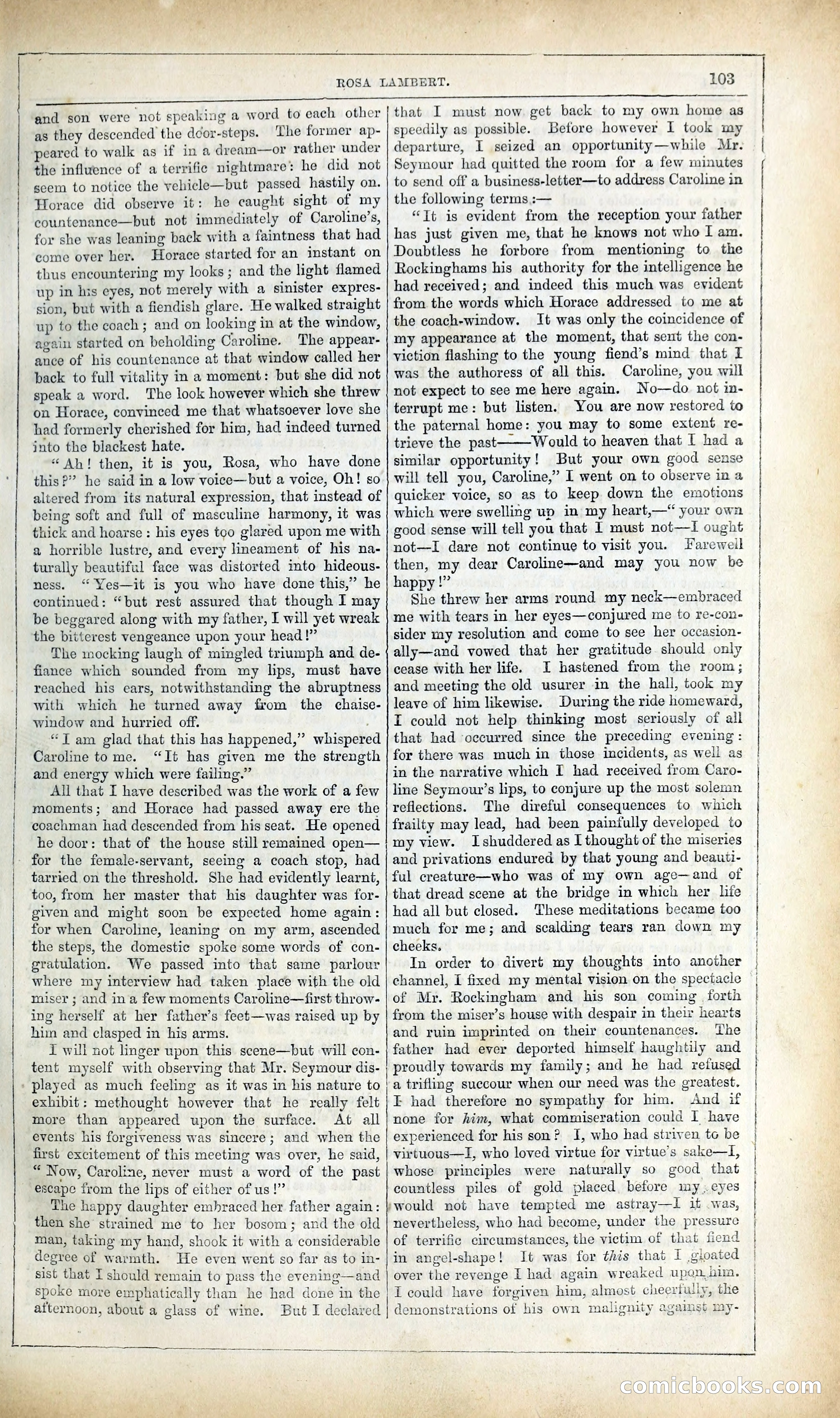
A restored page from Penny Dreadfuls, 1854. Page through the whole issue in the reader above.
📄 Transcribed text from this page (OCR, searchable)
Machine-transcribed from the original scan — historical spelling and the odd misread are preserved.
RS St se LL I LT a Oe Oy ee ee ey OG he » Ma ‘ 7 * | 7 ¢ a eS ROSA LAMBERT. and son were not speaking a word to each other as they descended the deor-steps. ‘The former ap- peared to walk as if in a dream—or rather under the influence of a terrific nightmare: he did not seem to notice the vehicle—but passed hastily on. Horace did observe it: he caught sight of my countenance—but not immediately of Caroline’s, for she was leaning back with a faintness that had come over her. Horace started for an instant on thus encountering my looks; and the light flamed up in his eyes, not merely with a sinister expres- sion, but with a fiendish glare. He walked straight up to the coach; and on looking in at the window, again started on beholding Caroline. The appear- ance of his countenance at that window called her back to full vitality in a moment: but she did not speak a word. The look however which she threw on Horace, convinced me that whatsoever love she had formerly cherished for him, had indeed turned into the blackest hate. “Ah! then, it is you, Rosa, who have done this?” he said in a low voice—but a voice, Oh! so altered from its natural expression, that instead of being soft and full of masculine harmony, it was thick and hoarse: his eyes too glared upon me with a horrible lustre, and every lineament of his na- turally beautiful face was distorted imto hideous- ness. ‘“ Yes—it is you who have done this,” he continued: “but rest assured that though I may be beggared along with my father, I will yet wreak the bitterest vengeance upon your head!” The mocking laugh of mingled triumph and de- fiance which sounded from my lps, must have reached his ears, notwithstanding the abruptness with which he turned away from the chaise- window and hurried off. ; “Tam glad that this has happened,” whispere Caroline tome. “It has given me the strength and energy which were failing.” All that I have described was the work of a few moments; and Horace had passed away ere the coachman had descended from his seat. He opened he door: that of the house still remained open— for the female-servant, seeing a coach stop, had tarried on the threshold. She had evidently learnt, too, from her master that his daughter was for- given and might soon be expected home again: for when Caroline, leaning on my arm, ascended the steps, the domestic spoke some words of con- gratulation. We passed into that same parlour where my interview had taken place with the old miser ; and ina few moments Caroline—first throw- ing herself at her father’s feet—was raised up by him and clasped in his arms. i will not linger upon this scene—but will con- tent myself with observing that Mr. Seymour dis- » played as much feeling as it was in his nature to exhibit: methought however that he really felt more than appeared upon the surface. At all events his forgiveness was sincere; and when the first excitement of this meeting was over, he said, “ Now, Caroline, never must a word of the past escape from the lips of either of us!” The happy daughter embraced her father again: then she strained me to her bosom; and the old man, taking my hand, shook it with a considerable degree of warmth. He even went so far as to in- sist that I should remain to pass the evening—and spoke more emphatically than he had done in the atternoon, about a glass of wine. But I declared 103 that I must now get back to my own home as speedily as possible. Before however I took my departure, I seized an opportunity—while Mr. Seymour had quitted the room for a few minutes to send off a business-letter—to address Caroline in the following terms :— “It is evident from the reception your father has just given me, that he knows not who I am. Doubtless he forbore from mentioning to the Rockinghams his authority for the intelligence he had received; and indeed this much was evident from the words which Horace addressed to me at the coach-window. It was only the coincidence of my appearance at the moment, that sent the con- viction flashing to the young fiend’s mind that I was the authoress of all this. Caroline, you will not expect to see me here again. No—do not m- terrupt me: but listen. You are now restored to the paternal home: you may to some extent re- trieve the past———W ould to heaven that { had a similar opportunity! But your own good sense will tell you, Caroline,” I went on to observe in a quicker voice, so as to keep down the emotions which were swelling up in my heart,—“ your own good sense will tell you that I must not—I ought not—-I dare not continue to visit you. Fareweil then, my dear Caroline—and may you now be happy!” She threw her arms round my neck—embraced me with tears in her eyes—conjured me to re-con- sider my resolution and come to see her occasion- ally—and vowed that her gratitude should only cease with her life. I hastened from the room; and meeting the old usurer in the hall, took my leave of him likewise. During the ride homeward, I could not help thinking most seriously of all that had occurred since the preceding evening : for there was much in those incidents, as well as in the narrative which I had received from Caro- line Seymour’s lips, to conjure up the most solemn reflections. The direful consequences to which frailty may lead, had been painfully developed to my view. Ishuddered as I thought of the miseries and privations endured by that young and beauii- | ful creature—who was of my own age—and of that dread scene at the bridge in which her lie had all but closed. These meditations became too much for me; and scalding tears ran down my cheeks. In order to divert my thoughts into another channel, I fixed my mental vision on the spectacle of Mr. Rockingham and his son coming forth from the miser’s house with despair in their hearts and ruin imprinted on their countenances. the father had ever deported himself haughtily and proudly towards my family; and he had retused a trifling succour when our need was the greatest. E had therefore no sympathy for bim. And if none for him, what commiseration could I have experienced for his son? I, who had striven to be virtuous—I, who loved virtue for virtue’s sake—l, whose principles were naturally so good that countless piles of gold placed. before my; eyes would not have tempted me astray—I it .was, nevertheless, who had become, under the pressure of terrific circumstances, the victim of that fiend in angel-shape! It was for this that I gloated over the revenge I had again wreaked upon.oim. I could have forgiven him, almost cheertully, the demonstrations of his own malignity against my- (E) JOO Ry A . LS ES nr re rr eee = areas, EN pp er ww ee ——— — SN ee er gs ee . LL LS OTE ALON A I CO A GI CO a “ » oe <S (E(0)