
Penny Dreadfuls, 1854 · page 112 of 400
Rosa Lambert — page 112: what you’re looking at
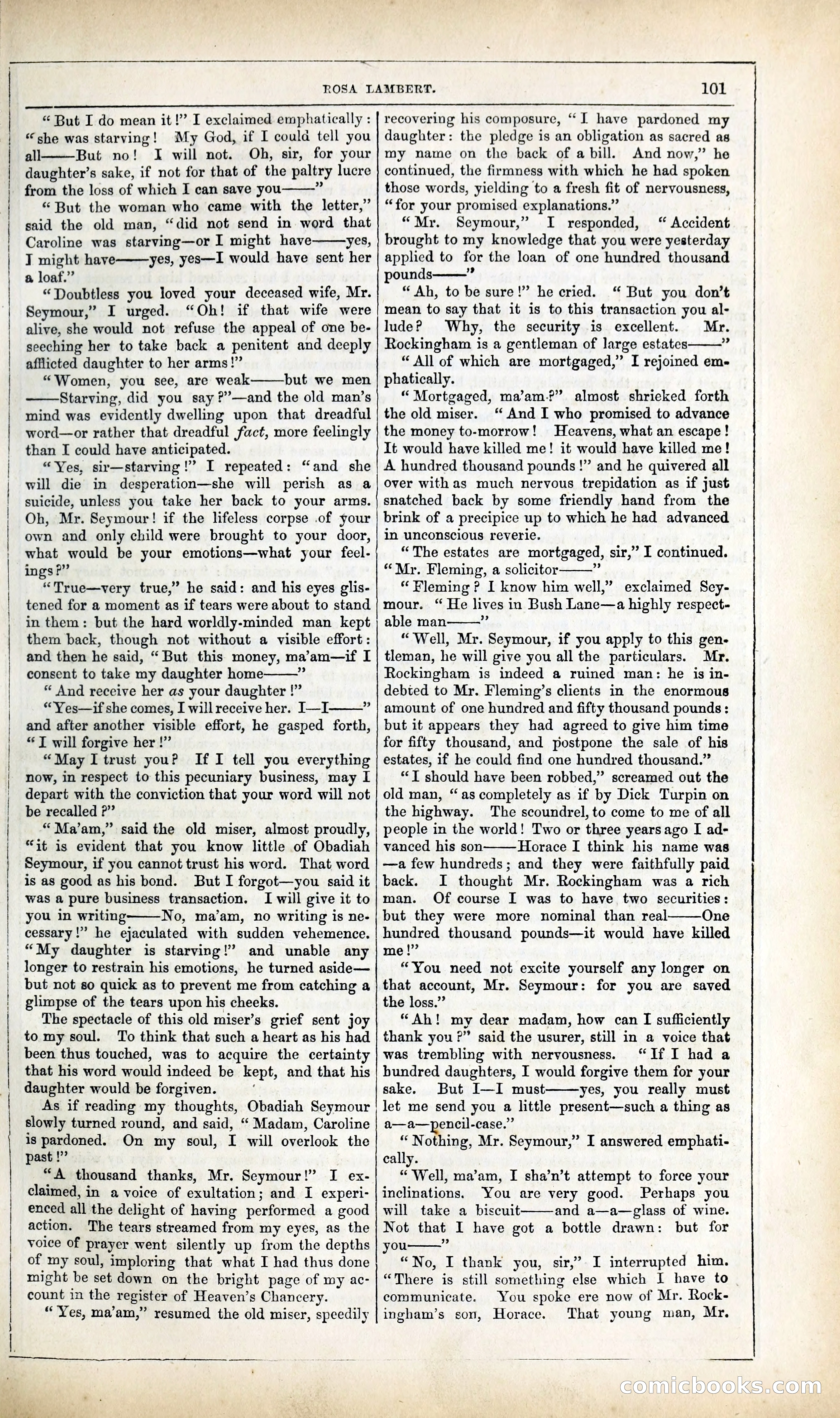
A restored page from Penny Dreadfuls, 1854. Page through the whole issue in the reader above.
📄 Transcribed text from this page (OCR, searchable)
Machine-transcribed from the original scan — historical spelling and the odd misread are preserved.
i a ee — eee a ee ee ee al — ee Se) eee ees - + —--- —- + - ROSA LAMBERT. —————— “ But I do mean it!’ I exclaimed emphatically : “she was starving! My God, if I coulda tell you all But no! I will not. Oh, sir, for your daughter’s sake, if not for that of the paltry lucre from the loss of which I can save you a “ But the woman who came with the letter,” said the old man, “did not send in word that Caroline was starving—or I might have yes, T might have yes, yes—I would have sent her a loaf.” “Doubtless you loved your deceased wife, Mr. Seymour,” I urged. “Oh! if that wife were alive, she would not refuse the appeal of one be- seeching her to take back a penitent and deeply afflicted daughter to her arms?” “Women, you see, are weak but we men Starving, did you say ?’—and the old man’s mind was evidently dwelling upon that dreadful word—or rather that dreadful fact, more feelingly than I could have anticipated. “Yes, sir—starving!”’ I repeated: “and she will die in desperation—she will perish as a suicide, unless you take her back to your arms. Oh, Mr. Seymour! if the lifeless corpse .of your own and only child were brought to your door, what would be your emotions—what your feel. ings P”” “True—very true,” he said: and his eyes glis- tened for a moment as if tears were about to stand in them: but the hard worldly-minded man kept them back, though not without a visible effort: and then he said, “ But this money, ma’am—if I consent to take my daughter home ts “ And receive her as your daughter !” *“Yes—if she comes, I will receive her. I—I and after another visible effort, he gasped forth, “TI will forgive her !” “May I trust youP If I tell you everything now, in respect to this pecuniary business, may I depart with the conviction that your word will not be recalled ?” “Ma'am,” said the old miser, almost proudly, “it is evident that you know little of Obadiah Seymour, if you cannot trust his word. That word is as good as his bond. But I forgot—you said it was a pure business transaction. I will give it to you in writing No, ma’am, no writing is ne- cessary!” he ejaculated with sudden vehemence. “My daughter is starving!’ and unable any longer to restrain his emotions, he turned aside— but not so quick as to prevent me from catching a glimpse of the tears upon his cheeks. The spectacle of this old miser’s grief sent joy to my soul. To think that such a heart as his had been thus touched, was to acquire the certainty that his word would indeed be kept, and that his daughter would be forgiven. As if reading my thoughts, Obadiah Seymour slowly turned round, and said, “ Madam, Caroline is pardoned. On my soul, I will overlook the «A thousand thanks, Mr. Seymour!” I ex- claimed, in a voice of exultation ; and I experi- enced all the delight of having performed a good action. The tears streamed from my eyes, as the voice of prayer went silently up from the depths of my soul, imploring that what I had thus done might be set down on the bright page of my ac- count in the register of Heaven’s Chancery. “Yes, ma’am,” resumed the old miser, speedily 99 101 recovering his composure, “ I have pardoned my daughter: the pledge is an obligation as sacred as my name on the back of a bill. And now,” he continued, the firmness with which he had spoken those words, yielding to a fresh fit of nervousness, “for your promised explanations.” “Mr. Seymour,” I responded, “ Accident brought to my knowledge that you were yesterday applied to for the loan of one hundred thousand pounds tf “ Ah, to be sure!” he cried. “ But you don’t mean to say that it is to this transaction you al- ludeP? Why, the security is excellent. Mr. Rockingham is a gentleman of large estates i, “All of which are mortgaged,” I rejoined em- phatically. “Mortgaged, ma’am-?” almost shrieked forth the old miser. ‘ And I who promised to advance the money to-morrow! Heavens, what an escape! It would have killed me! it would have killed me! A hundred thousand pounds!” and he quivered all over with as much nervous trepidation as if just snatched back by some friendly hand from the brink of a precipice up to which he had advanced In unconscious reverie. “The estates are mortgaged, sir,” I continued. “Mr. Fleming, a solicitor ss Fleming ? I know him well,” exclaimed Sey- mour. “ He hives in Bush Lane—a highly respect- able man i “Well, Mr. Seymour, if you apply to this gen- tleman, he will give you all the particulars. Mr. Rockingham is indeed a ruined man: he is in- debted to Mr. Fleming’s clients in the enormous amount of one hundred and fifty thousand pounds: but it appears they had agreed to give him time for fifty thousand, and postpone the sale of his estates, if he could find one hundred thousand.” ‘I should have been robbed,” screamed out the old man, “as completely as if by Dick Turpin on the highway. The scoundrel, to come to me of all people in the world! Two or three years ago I ad- vanced his son Horace I think his name was —a few hundreds; and they were faithfully paid back. I thought Mr. Rockingham was a rich man. Of course I was to have two securities: but they were more nominal than real One hundred thousand pounds—it would have killed me ! q?? “You need not excite yourself any longer on that account, Mr. Seymour: for you are saved the loss.” “Ah! my dear madam, how can I sufficiently thank you! ?” said the usurer, still in a voice that was trembling with nervousness. “If I had a bundred daughters, I would forgive them for your sake. But I—I must yes, you really must let me send you a little present—such a thing as a—a—pencil-case.’ “ Nothing, Mr. Seymour,” I answered emphati- cally. “Well, ma’am, I sha’n’t attempt to force your inclinations. You are very good. Perhaps you will take a biscuit and a—a—glass of wine. Not that I have got a bottle drawn: but for you 99 “No, I thank you, sir,’ I el eeaiicd him. “There is still something else which I have to communicate. You spoke ere now of Mr. Rock- ingham’s son, Horace. That young man, Mr. (EO) € cS (EO) eee