
Penny Dreadfuls, 1854 · page 104 of 400
Rosa Lambert — page 104: what you’re looking at
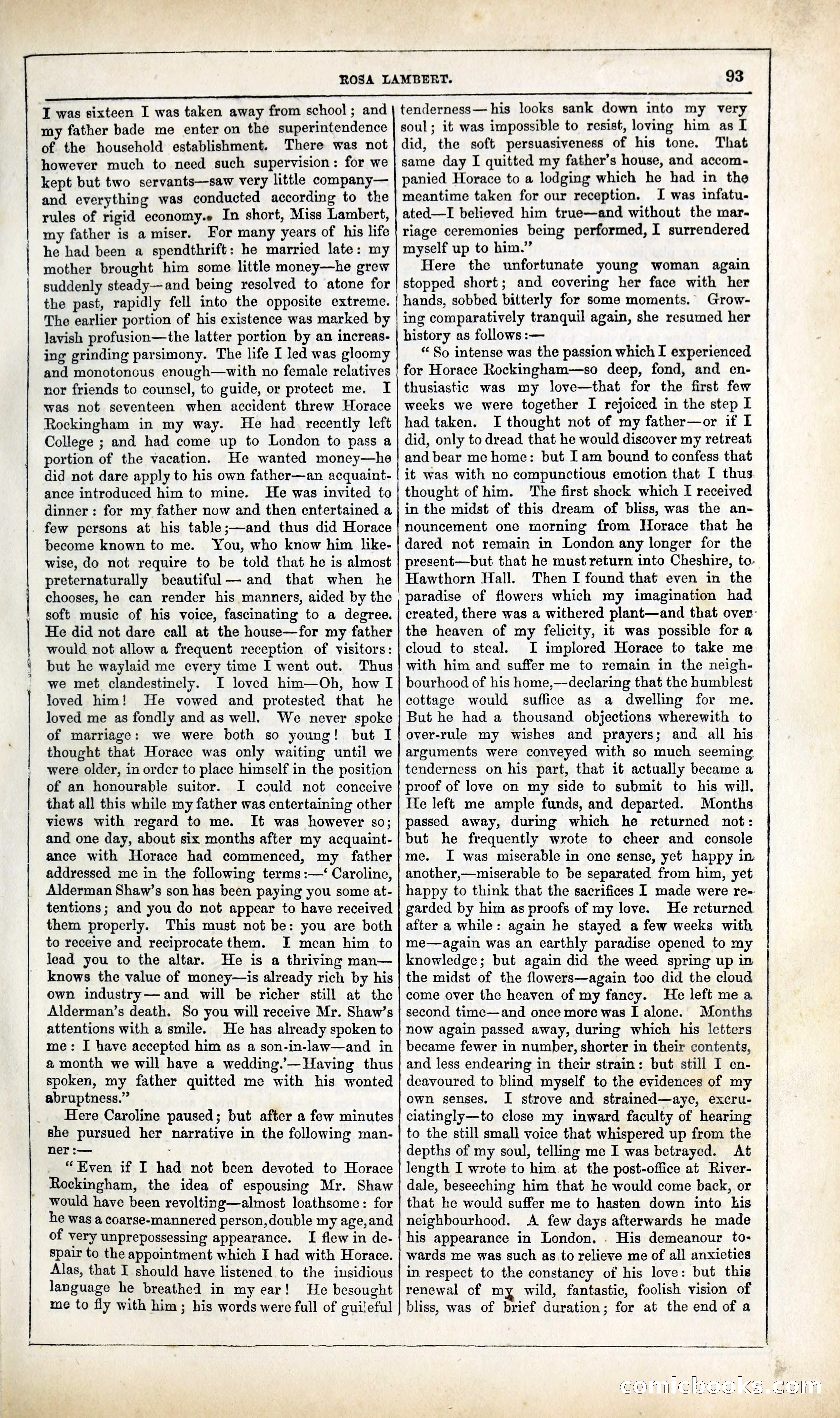
A restored page from Penny Dreadfuls, 1854. Page through the whole issue in the reader above.
📄 Transcribed text from this page (OCR, searchable)
Machine-transcribed from the original scan — historical spelling and the odd misread are preserved.
I was sixteen I was taken away from school ; and my father bade me enter on the superintendence of the household establishment. There was not however much to need such supervision: for we kept but two servants—saw very little company— and everything was conducted according to the rules of rigid economy.» In short, Miss Lambert, my father is a miser. For many years of his life he had been a spendthrift: he married late: my mother brought him some little money—he grew suddenly steady—and being resolved to atone for the past, rapidly fell into the opposite extreme. The earlier portion of his existence was marked by lavish profusion—the latter portion by an increas- ing grinding parsimony. The life I led was gloomy and monotonous enough—with no female relatives nor friends to counsel, to guide, or protect me. I was not seventeen when accident threw Horace Rockingham in my way. He had recently left College ; and had come up to London to pass a portion of the vacation. He wanted money—he did not dare apply to his own father—an acquaint- ance introduced him to mine. He was invited to dinner : for my father now and then entertained a _ few persons at his table;—and thus did Horace become known to me. You, who know him like- wise, do not require to be told that he is almost preternaturally beautiful— and that when he chooses, he can render his manners, aided by the soft music of his voice, fascinating to a degree. He did not dare call at the house—for my father would not allow a frequent reception of visitors: but he waylaid me every time I went out. Thus we met clandestinely. I loved him—Oh, how I loved him! He vowed and protested that he loved me as fondly and as well. We never spoke of marriage: we were both so young! but I thought that Horace was only waiting until we were older, in order to place himself in the position of an honourable suitor. I could not conceive that all this while my father was entertaining other views with regard to me. It was however so; and one day, about six months after my acquaint- ance with Horace had commenced, my father addressed me in the following terms :—‘ Caroline, Alderman Shaw’s son has been paying you some at- tentions; and you do not appear to have received them properly. This must not be: you are both to receive and reciprocate them. I mean him to lead you to the altar. He is a thriving man— knows the value of money—is already rich by his own industry— and will be richer still at the Alderman’s death. So you will receive Mr. Shaw’s attentions with a smile. He has already spoken to me: I have accepted him as a son-in-law—and in a month we will have a wedding.’—Having thus spoken, my father quitted me with his wonted abruptness.” Here Caroline paused; but after a few minutes she pursued her narrative in the following man- ner :— : “Kven if I had not been devoted to Horace Rockingham, the idea of espousing Mr. Shaw would have been revolting—almost loathsome: for he was a coarse-mannered person, double my age,and of very unprepossessing appearance. I flew in de- spair to the appointment which I had with Horace. Alas, that I should have listened to the insidious language he breathed in my ear! He besought me to fly with him ; his words were full of guileful ROSA LAMBERT. 93 tenderness— his looks sank down into my very soul; it was impossible to resist, loving him as I did, the soft persuasiveness of his tone. That same day I quitted my father’s house, and accom- panied Horace to a lodging which he had in the meantime taken for our reception. I was infatu- ated—I believed him true—and without the mar- riage ceremonies being performed, I surrendered myself up to him.” Here the unfortunate young woman again stopped short; and covering her face with her hands, sobbed bitterly for some moments. Grow- ing comparatively tranquil again, she resumed her history as follows :— ‘So intense was the passion which I experienced for Horace Rockingham—so deep, fond, and en- thusiastic was my love—that for the first few weeks we were together I rejoiced in the step I had taken. JI thought not of my father—or if L did, only to dread that he would discover my retreat and bear me home: but I am bound to confess that it was with no compunctious emotion that I thus thought of him. The first shock which I received in the midst of this dream of bliss, was the an- nouncement one morning from Horace that he dared not remain in London any longer for the present—but that he must return into Cheshire, to- Hawthorn Hall. Then I found that even in the paradise of flowers which my imagination had created, there was a withered plant—and that over: the heaven of my felicity, it was possible for a cloud to steal. I implored Horace to take me with him and suffer me to remain in the neigh- bourhood of his home,—declaring that the humblest cottage would suffice as a dwelling for me. But he had a thousand objections wherewith to over-rule my wishes and prayers; and all his arguments were conveyed with so much seeming tenderness on his part, that it actually became a proof of love on my side to submit to his will. He left me ample funds, and departed. Months passed away, during which he returned not: but he frequently wrote to cheer and console me. JI was miserable in one sense, yet happy in another,—miserable to be separated from him, yet happy to think that the sacrifices I made were re- garded by him as proofs of my love. He returned after a while: again he stayed a few weeks with me—again was an earthly paradise opened to my knowledge; but again did the weed spring up in the midst of the flowers—again too did the cloud come over the heaven of my fancy. He left me a second time—and once more was I alone. Months now again passed away, during which his letters became fewer in number, shorter in their contents, and less endearing in their strain: but still I en- deavoured to blind myself to the evidences of my own senses. I strove and strained—aye, excru- clatingly—to close my inward faculty of hearing to the still small voice that whispered up from the depths of my soul, telling me I was betrayed. At length I wrote to him at the post-office at River- dale, beseeching him that he would come back, or that he would suffer me to hasten down into his neighbourhood. A few days afterwards he made his appearance in London. - His demeanour to- wards me was such as to relieve me of all anxieties in respect to the constancy of his love: but this renewal of my wild, fantastic, foolish vision of bliss, was of brief duration; for at the end of a (E(6) 6)(6\(0) SS (Eo)