
Penny Dreadfuls, 1854 · page 102 of 400
Rosa Lambert — page 102: what you’re looking at
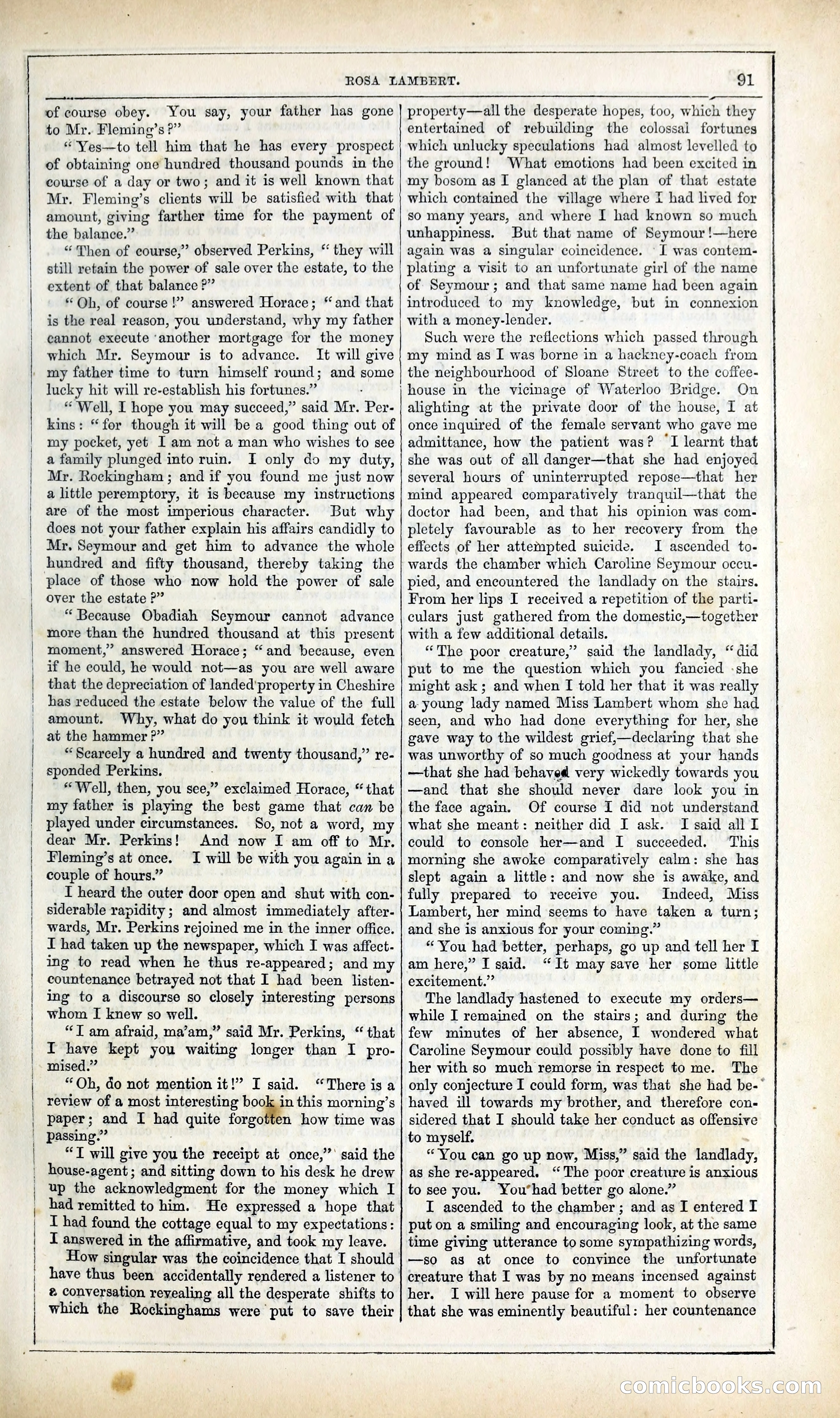
A restored page from Penny Dreadfuls, 1854. Page through the whole issue in the reader above.
📄 Transcribed text from this page (OCR, searchable)
Machine-transcribed from the original scan — historical spelling and the odd misread are preserved.
—— ee a LT ————— an — Ce St —_— ee ROSA LAMBERT. of course obey. You say, your father has gone to Mr. Fleming’s ?” “ Yes—to tell him that he has every prospect of obtaining one hundred thousand pounds in the course of a day or two; and it is well known that Mr. Fleming’s clients will be satisfied with that amount, giving farther time for the payment of the balance.” “Then of course,” observed Perkins, “ they will still retain the power of sale over the estate, to the extent of that balance P” * Oh, of course !” answered Horace; and that is the real reason, you understand, why my father cannot execute ‘another mortgage for the money which Mr. Seymour is to advance. It will give _ my father time to turn himself round; and some lucky hit will re-establish his fortunes.” “Well, I hope you may succeed,” said Mr. Per- kins: “for though it will be a good thing out of my pocket, yet I am not a man who wishes to see a family plunged into ruin. I only do my duty, Mr. Rockingham ; and if you found me just now a little peremptory, it is because my instructions are of the most imperious character. But why does not your father explain his affairs candidly to Mr. Seymour and get him to advance the whole hundred and fifty thousand, thereby taking the place of those who now hold the power of sale over the estate ?” “ Because Obadiah Seymour cannot advance more than the hundred thousand at this present moment,’ answered Horace; “and because, even if he could, he would not—as you are well aware that the depreciation of landed'property in Cheshire has reduced the estate below the value of the full amount. Why, what do you think it would fetch at the hammer ?” “Searcely a hundred and twenty thousand,” re- sponded Perkins. Well, then, you see,” exclaimed Horace, “ that my father is playing the best game that can be played under circumstances. So, not a word, my dear Mr. Perkins! And now I am off to Mr. Fleming’s at once. I will be with you again in a couple of hours.” 3 I heard the outer door open and shut with con- siderable rapidity ; and almost immediately after- wards, Mr. Perkins rejoined me in the inner office. I had taken up the newspaper, which I was affect- ing to read when he thus re-appeared; and my countenance betrayed not that I had been listen- ing to a discourse so closely interesting persons whom I knew so well. “T am afraid, ma’am,” said Mr. Perkins, “ that I have kept you waiting longer than I pro- mised.” “Oh, do not mention it!” I said. “There isa review of a most interesting ae this morning’s paper; and I had quite forgotten how time was passing.” : “T will give you the receipt at once,” said the house-agent ; and sitting down to his desk he drew up the acknowledgment for the money which I had remitted to him. He expressed a hope that I had found the cottage equal to my expectations: I answered in the affirmative, and took my leave. How singular was the coincidence that I should have thus been accidentally rendered a listener to @ conversation reyealing all the desperate shifts to which the Rockinghams were put to save their we ) house in the vicinage of Waterloo Bridge. 91 property—all the desperate hopes, too, which they entertained of rebuilding the colossal fortunes which unlucky speculations had almost levelled to the ground! ‘What emotions had been excited in my bosom as I glanced at the plan of that estate which contained the village where 1 had lived for so many years, and where I had known so much unhappiness. But that name of Seymour !—here again was a singular coincidence. ‘I was contem- plating a visit to an unfortunate girl of the name of Seymour; and that same name had been again introduced to my knowledge, but in connexion with a money-lender. Such were the reflections which passed through my mind as I was borne in a hackney-coach from the neighbourhood of Sloane Street to the coffee- On alighting at the private door of the house, I at once inquired of the female servant who gave me admittance, how the patient was? “I learnt that she was out of all danger—that she had enjoyed several hours of uninterrupted repose—that her mind appeared comparatively tranquil—that the doctor had been, and that his opinion was com- pletely favourable as to her recovery from the effects of her attempted suicide. I ascended to- wards the chamber which Caroline Seymour occu- pied, and encountered the landlady on the stairs. From her lips I received a repetition of the parti- culars just gathered from the domestic,—together with a few additional details. “The poor creature,’ said the landlady, “ did put to me the question which you fancied -she might ask; and when I told her that it was really a- young lady named Miss Lambert whom she had seen, and who had done everything for her, she gave way to the wildest grief,—declaring that she was unworthy of so much goodness at your hands —that she had behaved very wickedly towards you —and that she should never dare look you in the face agam. Of course I did not understand what she meant: neither did I ask. I said all I could to console her—and I succeeded. ‘This morning she awoke comparatively calm: she has slept again a little: and now she is awake, and fully prepared to receive you. Indeed, Miss Lambert, her mind seems to have taken a turn; and she is anxious for your coming.” “You had better, perhaps, go up and tell her I am here,’ I said. “It may save her some little excitement.” The landlady hastened to execute my orders— while I remained on the stairs; and during the few minutes of her absence, I wondered what Caroline Seymour could possibly have done to fill her with so much remorse in respect tome. The only conjecture I could form, was that she had be-" haved ill towards my brother, and therefore con- sidered that I should take her conduct as offensive to myself. : “You can go up now, Miss,” said the landlady as she re-appeared. “The poor creature is anxious to see you. You*had better go alone.” I ascended to the chamber ; and as I entered I put on a smiling and encouraging look, at the same time giving utterance to some sympathizing words, —so as at once to convince the unfortunate creature that I was by no means incensed against her. I will here pause for a moment to observe that she was eminently beautiful: her countenance es (e) 60)(0) é cS (E(®)