
Penny Dreadfuls, 1900 · page 194 of 196
A Queer Race: The Story of a Strange People — page 194: what you’re looking at
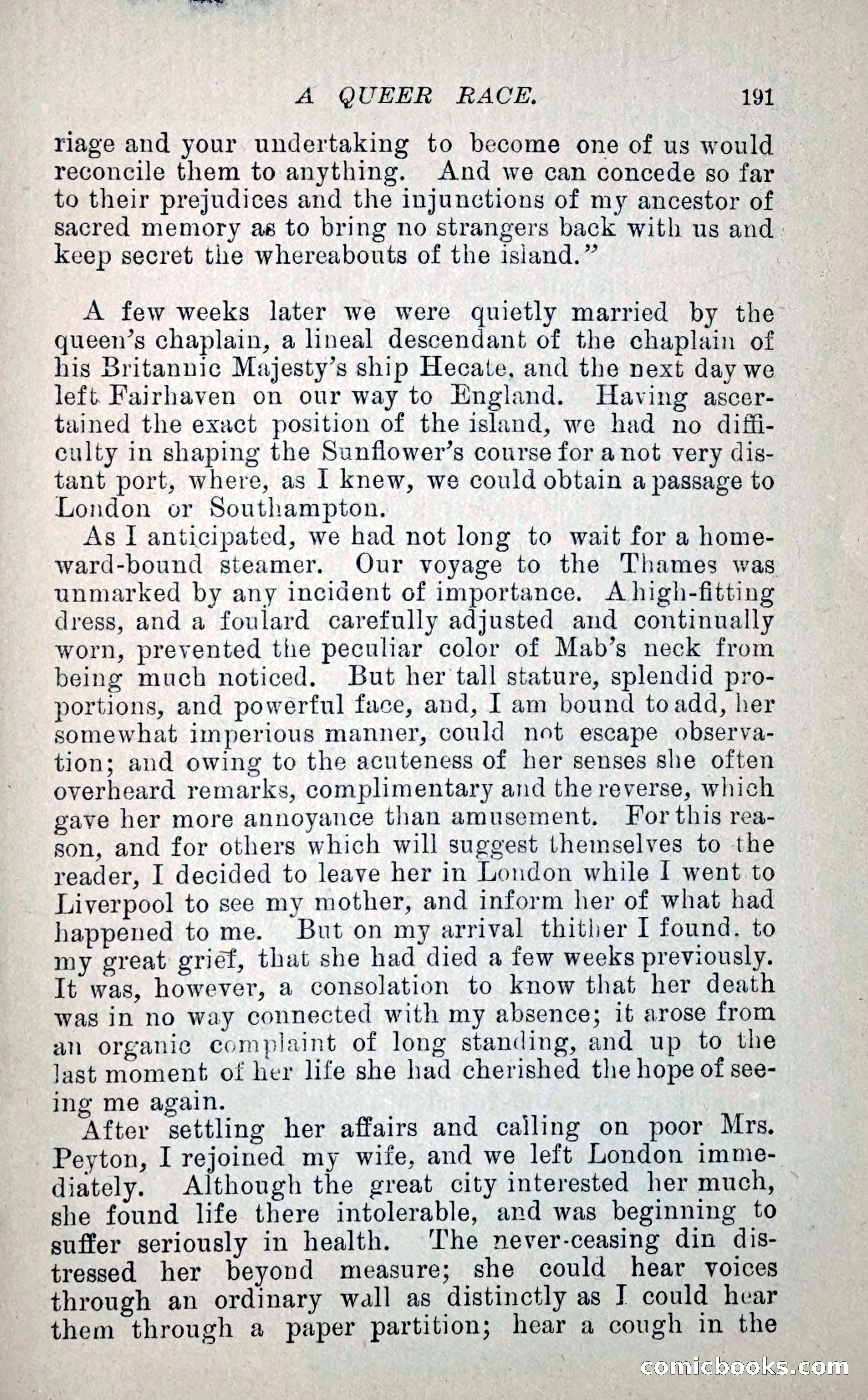
A restored page from Penny Dreadfuls, 1900. Page through the whole issue in the reader above.
📄 Transcribed text from this page (OCR, searchable)
Machine-transcribed from the original scan — historical spelling and the odd misread are preserved.
A QUEER RACE. 191 riage and your undertaking to become one of us would reconcile them to anything. And we can concede so far to their prejudices and the injunctions of my ancestor of sacred memory as to bring no strangers back with us and. keep secret the whereabouts of the isiand.” A few weeks later we were quietly married by the queen’s chaplain, a lineal descendant of the chaplain of his Britannic Majesty’s ship Hecate, and the next day we left. Fairhaven on our way to England. Having ascer- tained the exact position of the island, we had no diffi- culty in shaping the Sunflower’s course for a not very dis- tant port, where, as I knew, we could obtain a passage to London or Southampton. As I anticipated, we had not long to wait for a home- ward-bound steamer. Our voyage to the Thames was unmarked by any incident of importance. A high-fitting dress, and a foulard carefully adjusted and continually worn, prevented the peculiar color of Mab’s neck from being much noticed. But her tall stature, splendid pro- portions, and powerful face, and, I am bound toadd, her somewhat imperious manner, could not escape observa- tion; and owing to the acuteness of her senses she often overheard remarks, complimentary and the reverse, which gave her more annoyance than amusement. For this rea- son, and for others which will suggest themselves to the reader, I decided to leave her in London while | went to Liverpool to see my mother, and inform her of what had happened to me. But on my arrival thither I found. to my great grief, that she had died a few weeks previously. It was, however, a consolation to know that her death was in no way connected with my absence; it arose from an organic complaint of long standing, and up to the last moment of her life she had cherished the hope of see- ing me again. | After settling her affairs and calling on poor Mrs. Peyton, I rejoined my wife, and we left London imme- diately. Although the great city interested her much, she found life there intolerable, and was beginning to suffer seriously in health. The never-ceasing din dis- tressed her beyond measure; she could hear voices through an ordinary wall as distinctly as I could hear them through a paper partition; hear a cough in the Eomicbooks (E (0)