
Penny Dreadfuls, 1900 · page 173 of 196
A Queer Race: The Story of a Strange People — page 173: what you’re looking at
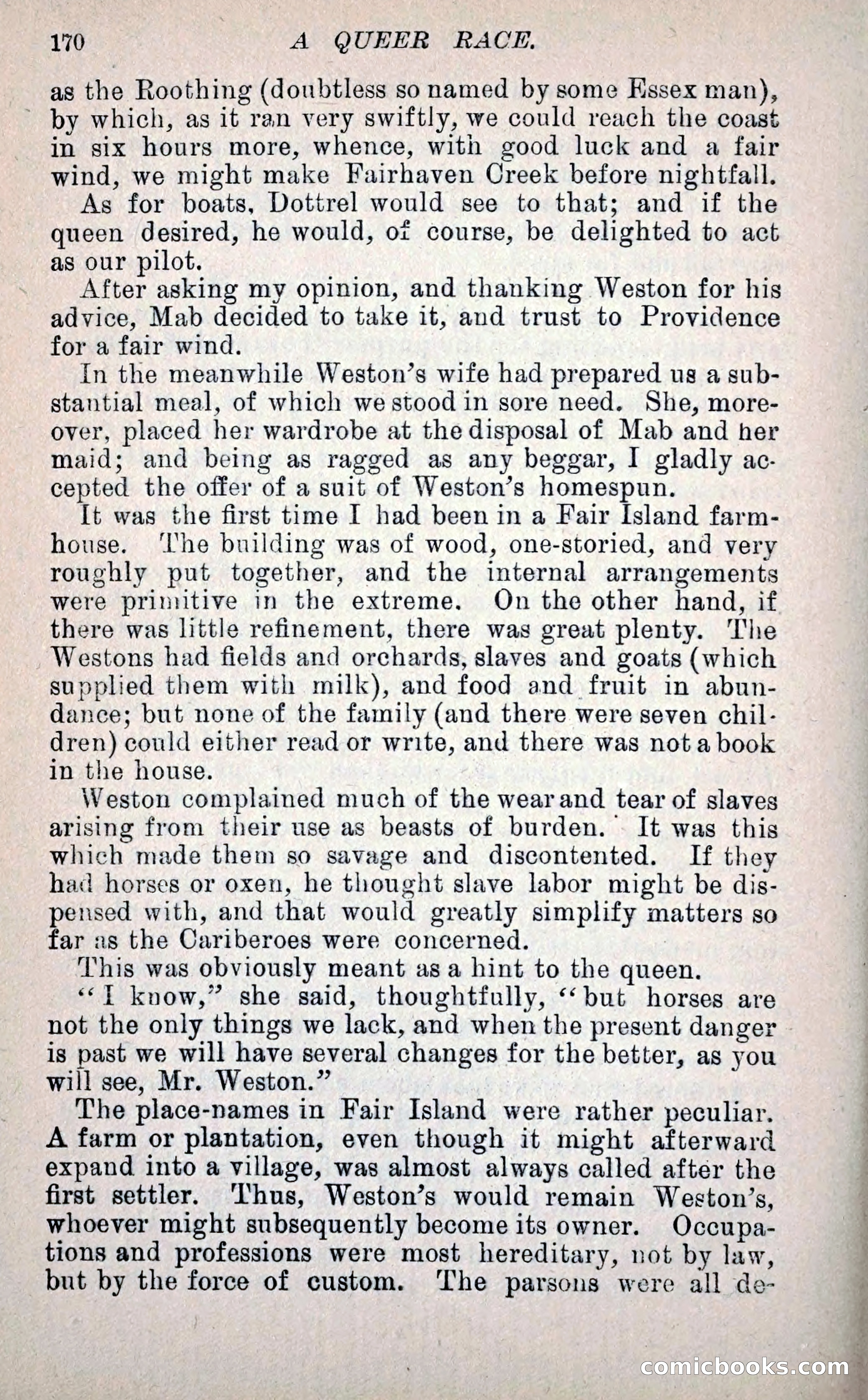
A restored page from Penny Dreadfuls, 1900. Page through the whole issue in the reader above.
📄 Transcribed text from this page (OCR, searchable)
Machine-transcribed from the original scan — historical spelling and the odd misread are preserved.
170 A QUEER RACE. as the Roothing (doubtless so named by some Hssex man), ~ by which, as it ran very swiftly, we could reach the coast in six hours more, whence, with good luck and a fair wind, we might make Fairhaven Creek before nightfall. As for boats, Dottrel would see to that; and if the queen desired, he would, ot course, be delighted to act as our pilot. After asking my opinion, and thanking Weston for his advice, Mab decided to take it, and trust to Providence for a fair wind. In the meanwhile Weston’s wife had prepared us a sub- stantial meal, of which we stood in sore need. She, more- over, placed her wardrobe at the disposal of Mab and her maid; and being as ragged as any beggar, I gladly ac. cepted the offer of a suit of Weston’s homespun. It was the first time I had been in a Fair Island farm- house. ‘he building was of wood, one-storied, and very roughly put together, and the internal arrangements were primitive in the extreme. On the other hand, if there was little refinement, there was great plenty. ‘he Westons had fields and orchards, slaves and goats (which supplied them with milk), and food and fruit in abun- dance; but none of the family (and there were seven chil- dren) could either read or write, and there was not a book in the house. Weston complained much of the wearand tear of slaves arising from their use as beasts of burden. It was this which made them so savage and discontented. If they had horses or oxen, he thought slave labor might be dis- pensed with, and that would greatly simplify matters so far as the Cariberoes were concerned. This was obviously meant asa hint to the queen. “‘} know,” she said, thoughtfully, ‘‘but horses are not the only things we lack, and when the present danger is past we will have several changes for the better, as you will see, Mr. Weston.” The place-names in Fair Island were rather peculiar. A farm or plantation, even though it might afterward expand into a village, was almost always called after the first settler. ‘hus, Weston’s would remain Weston’s, whoever might subsequently become its owner. Occupa- tions and professions were most hereditary, not by law, but by the force of custom. ‘The parsons were all de- Eom C JOO SH |