
Penny Dreadfuls, 1891 · page 83 of 331
The Price He Paid — page 83: what you’re looking at
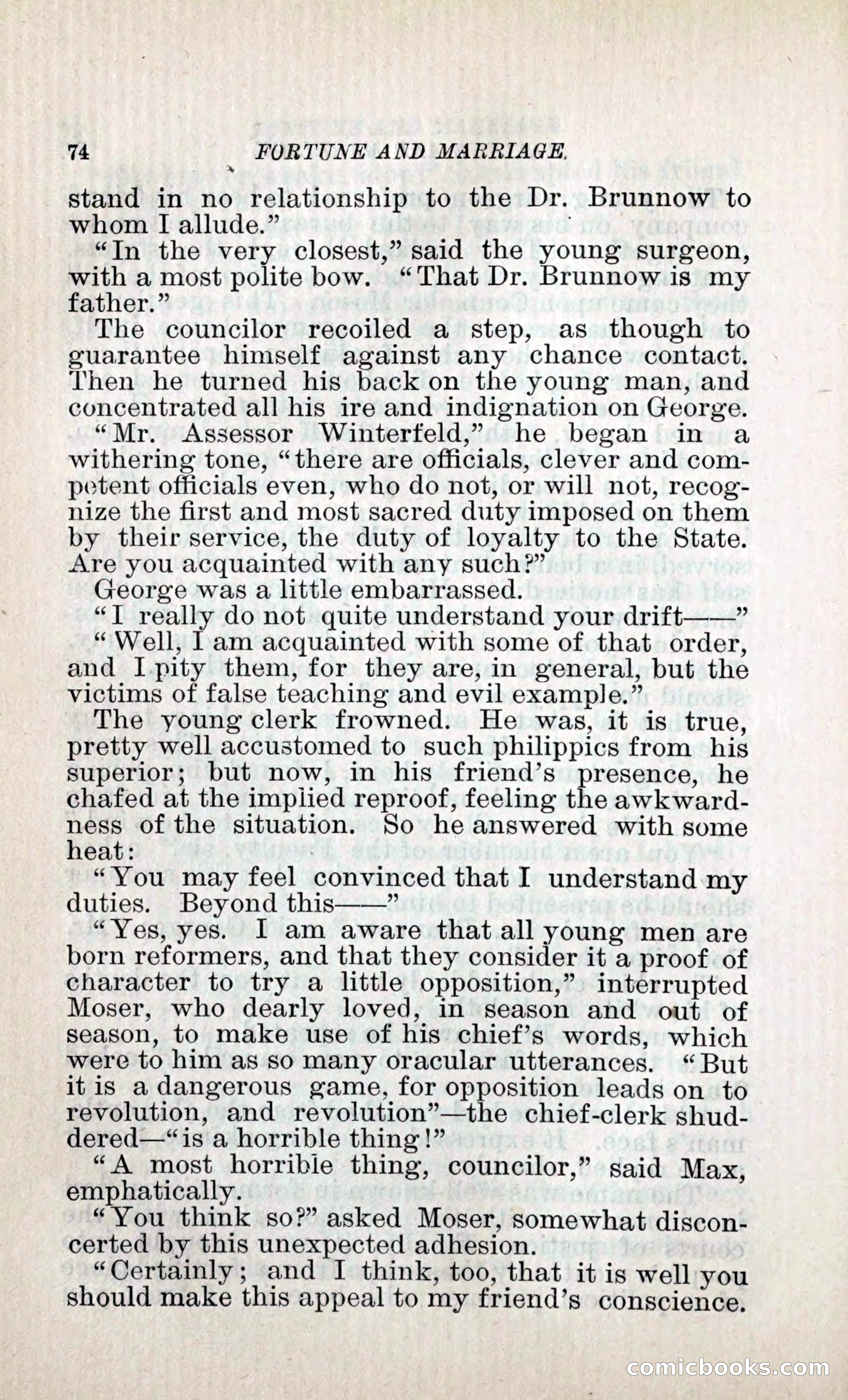
A restored page from Penny Dreadfuls, 1891. Page through the whole issue in the reader above.
📄 Transcribed text from this page (OCR, searchable)
Machine-transcribed from the original scan — historical spelling and the odd misread are preserved.
74 FORTUNE AND MARRIAGE, stand in no relationship to the Dr. Brunnow to whom I allude.” } “In the very closest,” said the young surgeon, with a most polite bow. “That Dr. Brunnow is my father.” The councilor recoiled a step, as though to guarantee himself against any chance contact. Then he turned his back on the young man, and concentrated all his ire and indignation on George. “Mr. Assessor Winterfeld,” he began in a withering tone, “there are officials, clever and com- petent officials even, who do not, or will not, recog- nize the first and most sacred duty imposed on them by their service, the duty of loyalty to the State. Are you acquainted with any such?” George was a little embarrassed. “J really do not quite understand your drift——” “Well, lam acquainted with some of that order, and I pity them, for they are, in general, but the victims of false teaching and evil example.” The young clerk frowned. He was, it is true, pretty well accustomed to such philippics from his superior; but now, in his friend’s presence, he chafed at the impiied reproof, feeling the awkward- ep of the situation. So he answered with some eat: “You may feel convinced that I understand my duties. Beyond this——” “Yes, yes. | am aware that all young men are born reformers, and that they consider it a proof of character to try a little opposition,” interrupted Moser, who dearly loved, in season and out of season, to make use of his chief’s words, which were to him as so many oracular utterances. “But itis adangerous game, for opposition leads on to revolution, and revolution”—the chief-clerk shud- dered—“is a horrible thing!” “A most horrible thing, councilor,” said Max, emphatically. “You think so?” asked Moser, somewhat discon- certed by this unexpected adhesion. “Certainly; and I think, too, that it is well you should make this appeal to my friend’s conscience. Eomichboo “S (EO)