
Penny Dreadfuls, 1857 · page 388 of 400
Pickwick Abroad; or, The Tour in France — page 388: what you’re looking at
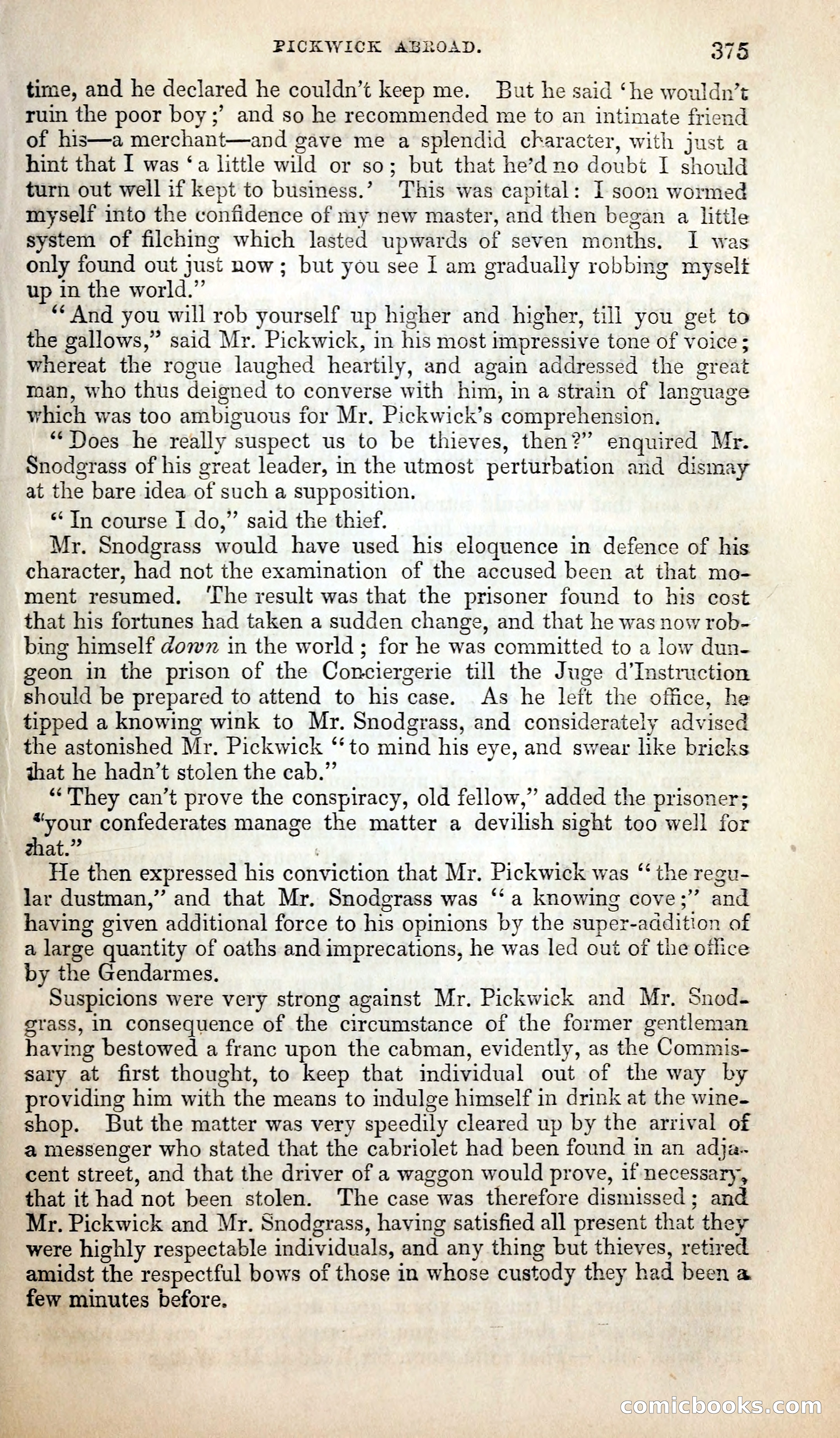
A restored page from Penny Dreadfuls, 1857. Page through the whole issue in the reader above.
📄 Transcribed text from this page (OCR, searchable)
Machine-transcribed from the original scan — historical spelling and the odd misread are preserved.
PICKWICK ABROAD. 375 time, and he declared he couldn’t keep me. But he said ‘he wouldn’t ruin the poor boy ;’ and so he recommended me to an intimate friend of his—a merchant—and gave me a splendid character, with just a hint that I was ‘a little wild or so; but that he’d no doubt I should turn out well if kept to business.’ This was capital: I soon wormed myself into the confidence of my new master, and then began a litile system of filching which lasted upwards of seven months. I was only found out just now; but you see I am gradually robbing myself up in the world.” ** And you will rob yourself up higher and higher, till you get to the gallows,” said Mr. Pickwick, in his most impressive tone of voice; whereat the rogue laughed heartily, and again addressed the great man, who thus deigned to converse with him, in a strain of language which was too ambiguous for Mr, Pickwick’s comprehension. “Does he really suspect us to be thieves, then?” enquired Mr. Snodgrass of his great leader, in the utmost perturbation and dismay at the bare idea of such a supposition. “In course I do,” said the thief. Mr. Snodgrass would have used his eloquence in defence of his character, had not the examination of the accused been at that mo- ment resumed. ‘The result was that the prisoner found to his cost that his fortunes had taken a sudden change, and that he was now rob- bing himself down in the world; for he was committed to a low dun- geon in the prison of the Conciergerie till the Juge d’Instruction should be prepared to attend to his case. As he left the office, he tipped a knowing wink to Mr. Snodgrass, and considerately advised _ the astonished Mr, Pickwick “to mind his eye, and swear like bricks that he hadn’t stolen the cab.” ** They can’t prove the conspiracy, old fellow,” added the prisoner; “your confederates manage the matter a devilish sight too well for zhat.” , He then expressed his conviction that Mr. Pickwick was ‘‘ the regu- lar dustman,” and that Mr. Snodgrass was “a knowing cove;” and having given additional force to his opinions by the super-addition of a large quantity of oaths and imprecations, he was led out of tie oilice by the Gendarmes. Suspicions were very strong against Mr. Pickwick and Mr. Snod- grass, in consequence of the circumstance of the former gentleman having bestowed a franc upon the cabman, evidently, as the Commis- sary at first thought, to keep that individual out of the way by providing him with the means to indulge himself in drink at the wine- shop. But the matter was very speedily cleared up by the arrival of a messenger who stated that the cabriolet had been found in an adja- cent street, and that the driver of a waggon would prove, if necessary, that it had not been stolen. The case was therefore dismissed; and Mr. Pickwick and Mr. Snodgrass, having satisfied all present that they were highly respectable individuals, and any thing but thieves, retired _ amidst the respectful bows of those in whose custody they had been a few minutes before. Eomichbooks (E(@) =