
Penny Dreadfuls, 1857 · page 386 of 400
Pickwick Abroad; or, The Tour in France — page 386: what you’re looking at
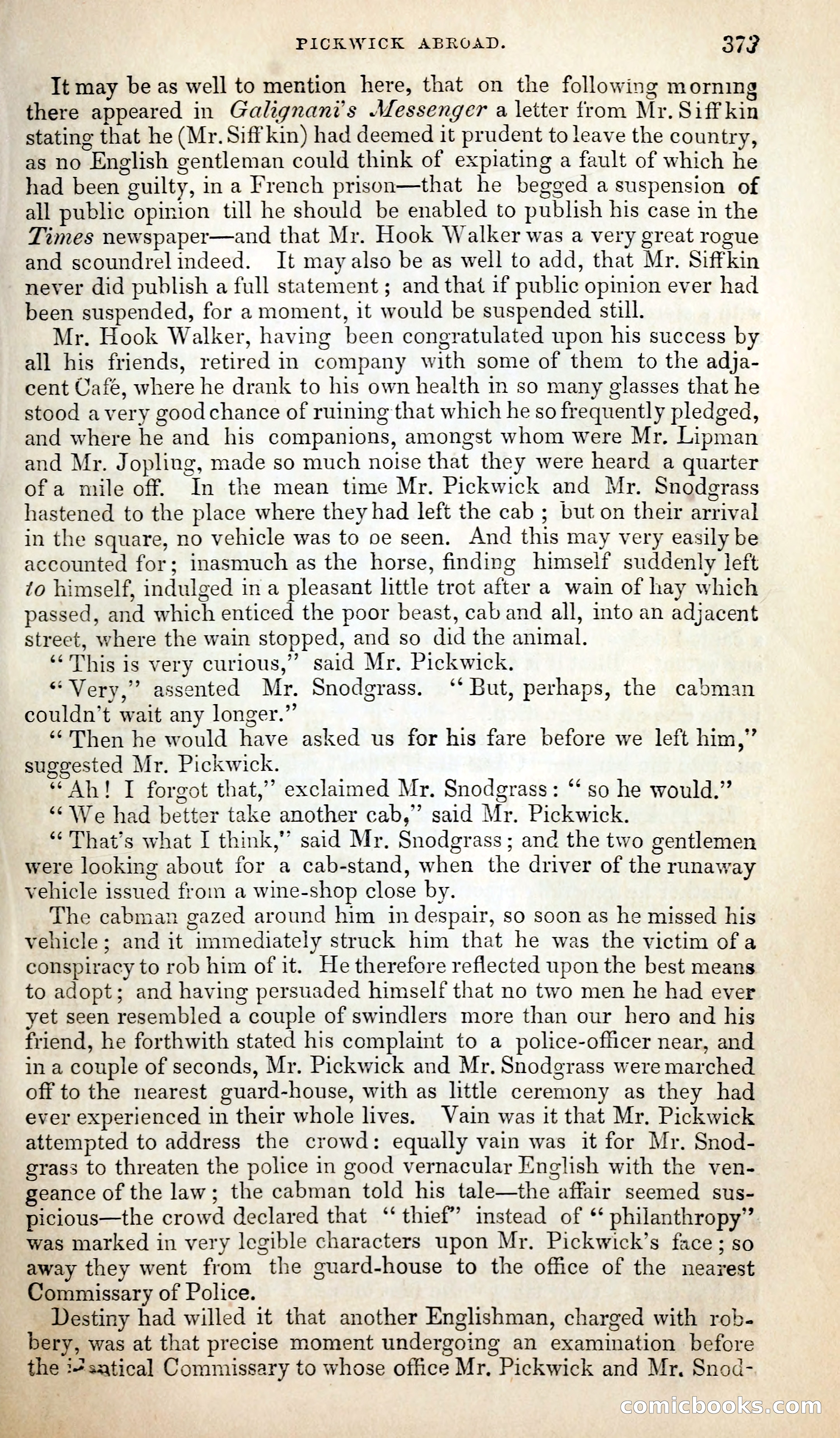
A restored page from Penny Dreadfuls, 1857. Page through the whole issue in the reader above.
📄 Transcribed text from this page (OCR, searchable)
Machine-transcribed from the original scan — historical spelling and the odd misread are preserved.
PICKWICK ABROAD. 377 It may be as well to mention here, that on the following mornin there appeared in Galignani’s Messenger a letter from Mr. Siffkin stating that he (Mr. Siff kin) had deemed it prudent to leave the country, as no English gentleman could think of explating a fault of which he had been guilty, in a French prison—that he begged a suspension of all public opimion till he should be enabled to publish his case in the Times newspaper—and that Mr. Hook Walker was a very great rogue and scoundrelindeed. It mayalso be as well to add, that Mr. Siffkin never did publish a full statement; and that if public opmion ever had been suspended, for a moment, it would be suspended still. Mr. Hook Walker, having been congratulated upon his success by all his friends, retired in company with some of them to the adja- cent Café, where he drank to his own health in so many glasses that he stood avery goodchance of ruining that which he so frequently pledged, and where he and his companions, amongst whom were Mr. Lipman and Mr. Jopling, made so much noise that they were heard a quarter ofa mile off. In the mean time Mr. Pickwick and Mr. Snodgrass hastened to the place where they had left the cab ; but on their arrival in the square, no vehicle was to oe seen. And this may very easily be accounted for; inasmuch as the horse, finding himself suddenly left to himself, indulged in a pleasant little trot after a wain of hay which passed, and which enticed the poor beast, cab and all, into an adjacent street, where the wain stopped, and so did the animal. “This is very curious,” said Mr. Pickwick. “Very,” assented Mr. Snodgrass. ‘* But, perhaps, the cabman couldn’t wait any longer.” ‘‘Then he would have asked us for his fare before we left him,” suggested Mr. Pickwick. “Ah! I forgot that,” exclaimed Mr. Snodgrass: *‘ so he would.” ‘We had better take another cab,” said Mr. Pickwick. ‘“¢'That’s what I think,” said Mr. Snodgrass ; and the two gentlemen were looking about for a cab-stand, when the driver of the runaway vehicle issued from a wine-shop close by. The cabman gazed around him in despair, so soon as he missed his vehicle; and it immediately struck him that he was the victim ofa conspiracy to rob him of it. He therefore reflected upon the best means to adopt; and having persuaded himself that no two men he had ever yet seen resembled a couple of swindlers more than our hero and his friend, he forthwith stated his complaint to a police-officer near, and in a couple of seconds, Mr. Pickwick and Mr. Snodgrass were marched off to the nearest guard-house, with as little ceremony as they had ever experienced in their whole lives. Vain was it that Mr, Pickwick attempted to address the crowd: equally vain was it for Mr. Snod- grass to threaten the police in good vernacular English with the ven- geance of the law; the cabman told his tale—the affair seemed sus- picious—the crowd declared that ‘“‘ thief’? instead of ‘‘ philanthropy” was marked in very legible characters upon Mr. Pickwick’s face; so away they went from the guard-house to the office of the neayest Commissary of Police. Destiny had willed it that another Englishman, charged with rob. bery, was at that precise moment undergoing an examination before the ?#satical Commissary to whose office Mr. Pickwick and Mr. Snod- Eomichbooks (E(@) =)