
Penny Dreadfuls, 1857 · page 344 of 400
Pickwick Abroad; or, The Tour in France — page 344: what you’re looking at
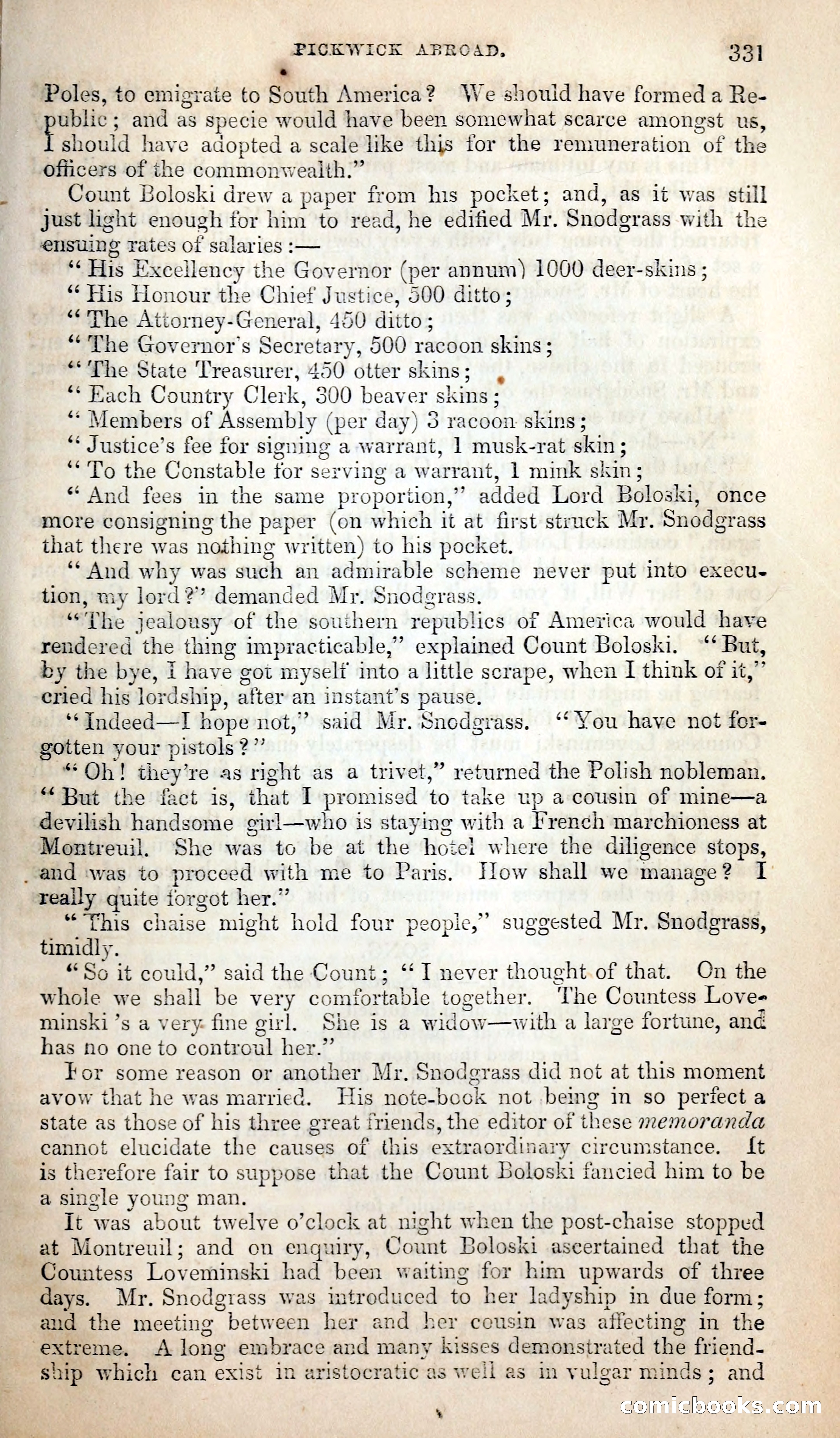
A restored page from Penny Dreadfuls, 1857. Page through the whole issue in the reader above.
📄 Transcribed text from this page (OCR, searchable)
Machine-transcribed from the original scan — historical spelling and the odd misread are preserved.
PICKWICK ABRCAD, 331 Poles, to emigrate to South America? We shouid have formed a Re- ublic; and as specie would have been somewhat scarce amongst us, should | have adopted a scale like this for the remuneration “Of the officers of the commonwealth.” Count Boloski drew a paper from his pocket; and, as it was still just hght enough for him to read, he edified Mr. Snodgrass with the ensuing rates of salaries :-— *< His Excellency the Governor (per annum) 1000 deer-skins ; ** His Honour the Chief Justice, 500 ditto; “The Attorney-General, 450 ditto ; “The Governor's Secretary, 500 racoon skins; “The State Treasurer, 450 otter skins; , ** Fach Country Clerk, 5300 beaver skins; ‘** Members of f Assembly (per day) 3 racoon. Skins 3 ** Justice’s fee for signing a warrant, 1 musk-rat skin; : “To the Constable for serving a warrant, 1 mink alan’: *“And fees in the same proportion,” added Lord Boloski, once more consigning the paper (on which it at first struck Mr. Snoder ass that there was nothing written) to his pocket. ‘* And he was such an admirable scheme never put into execu- tion, my lord ?” demanded Mr. Snodgrass. “The Seligincsy of the southern republics of America would have rendered the skins impracticable,” explained Count Boloski. “ But, by the bye, I have got myself into a little scrape, when I think of it,’ eried his lordship, after an instant’s pause, ‘‘Indeed—! hope not,” said Mr. Snodgrass. ‘* You have not for- gotten your pistols?” “Oh! they’ re as right as a trivet,” returned the Polish nobleman. “ But the fact is, that I promised to take up a cousin of mine—a devilish handsome eirl—who is staying with a French marchioness at Montreuil. She was to be at the hotel where the diligence stops, _and ‘was to proceed with me to Paris. [low shall we manage? I really quite tor “This chaise might hold four people,” suggested Mr. Snodgrass, got her.” timidly. “So it could,” said the Count; ‘‘ I never thought.of that. On the whole we shall be very comior table together. ‘The Countess Love- minski ’s a very: fine girl. She is a widow—with a lar ve fortune, ané has no one to controul her.” For some reason or another Mr. Snodgrass did not at this moment avow that he was married. His note-book not bemg im so periect a state as those of his three great friends, the editor of these memoranda cannot elucidate the causes of this extraordinary circumstance. It is therefore fair to suppose that the Count Boloski fancied him to be a single young man. It was about twelve o’clock at night when the post-chaise stopped at Montreuil; and on enquiry, Count Boloski ascertained that the Gountess Loveminski had been w aiting for him upwards of three days. Mr. Snodgrass was in saagelyr ies to her ladyship in due form; and the meeting between her and her ceusin was affecting in the extreme. A long embrace and many kisses demonstrated the friend- ship which can exist in aristocratic as well as in vulgar minds; and ‘ Comigbooks: com