
Penny Dreadfuls, 1857 · page 324 of 400
Pickwick Abroad; or, The Tour in France — page 324: what you’re looking at
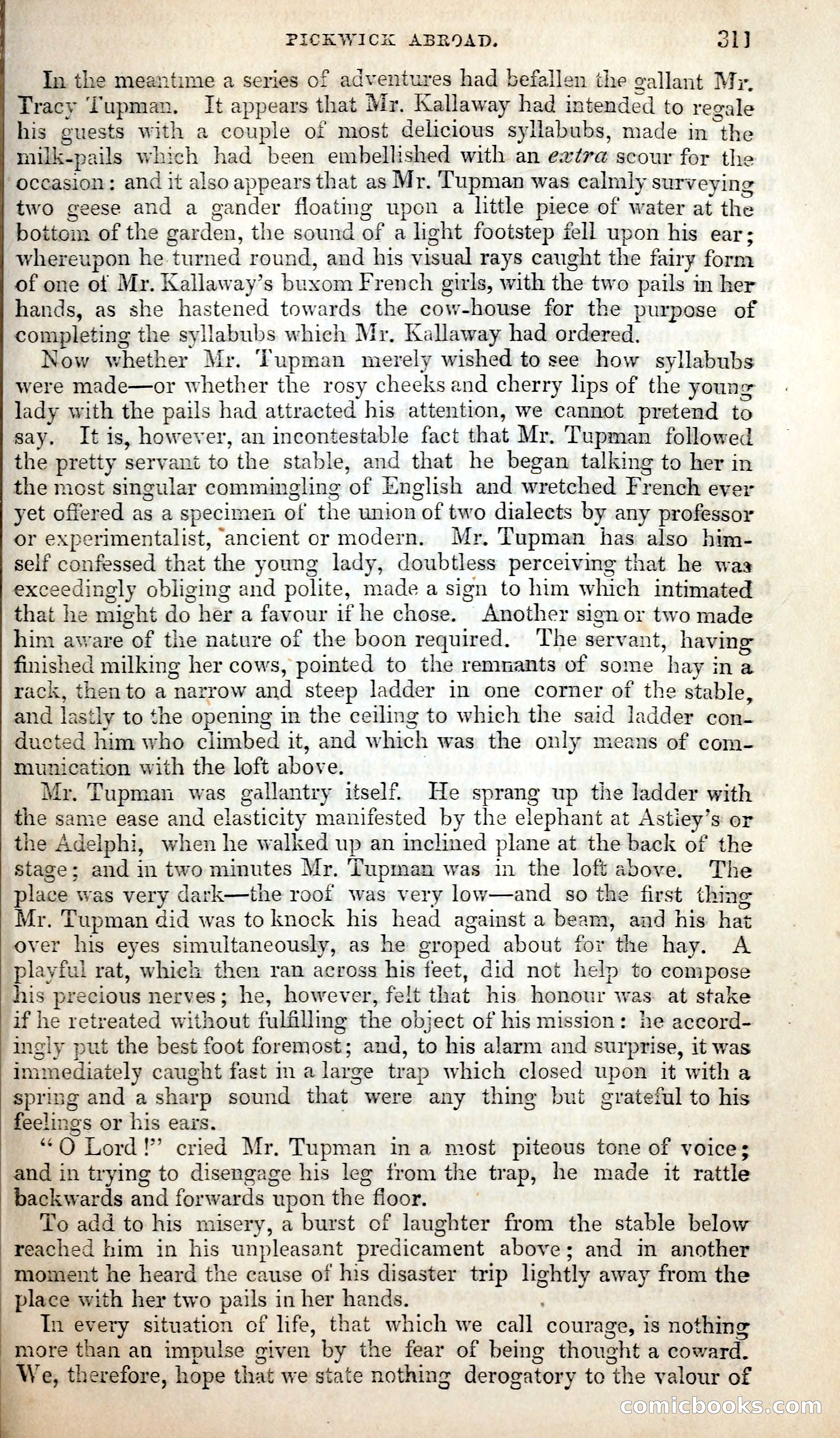
A restored page from Penny Dreadfuls, 1857. Page through the whole issue in the reader above.
📄 Transcribed text from this page (OCR, searchable)
Machine-transcribed from the original scan — historical spelling and the odd misread are preserved.
PICKWICK ABROAD. ol) In the meantime a series of adventures had befallen the gallant Mr. Tracy Tupman. It appears that Mr. Kallaway had intended to regale his guests with a couple of most delicious syllabubs, made in the muk-pails which had been embellished with an extra scour for the occasion: and it also appears that as Mr. Tupman was calmly surveying two geese and a gander floating upon a little piece of water at the bottem of the garden, the sound of a light footstep fell upon his ear; whereupon he turned round, and his visual rays caught the fairy form of one ot Mr. Kallaway’s buxom French girls, with the two pails in her hands, as she hastened towards the cow-house for the purpose of completing the syllabubs which Mr, Kallaway had ordered. Now whether Mr. Tupman merely wished to see how syllabubs were made—or whether the rosy cheeks and cherry lips of the young lady with the pails had attracted his attention, we cannot pretend to say. It is, however, an incontestable fact that Mr. Tupman followed the pretty servant to the stable, and that he began talking to her in the most singular commingling of English and wretched French ever yet offered as a specimen of the union of two dialects by any professor or experimentalist, ancient or modern. Mr. Tupman has also him- self confessed that the young lady, doubtless perceiving that he waa exceedingly obliging and polite, made a sign to him which intimated that he might do her a favour if he chose. Another sign or two made him aware of the nature of the boon required. The servant, having finished milking her cows, pointed to the remnants of some hay ina rack, then to a narrow and steep ladder in one corner of the stable, and lastly to the opening in the ceiling to which the said ladder con- ducted him who climbed it, and which was the only means of com- munication with the loft above. Mr. Tupman was gallantry itself. He sprang up the ladder with the same ease and elasticity manifested by the elephant at Astiey’s or the Adelphi, when he walked up an inclined plane at the back of the stage; and in two minutes Mr. Tupman was in the loft above. The place was very dark—the roof was very low—and so the first thing Mr. Tupman did was to knock his head against a beam, and his hat over his eyes simultaneously, as he groped about for the hay. A playful rat, which then ran across his feet, did not help to compose his precious nerves; he, however, felt that his honour was: at stake if he retreated without fulfilling the object of his mission: he aceord- ingly put the best foot foremost; and, to his alarm and surprise, it was immediately caught fast ina large trap which closed upon it witha spring and a sharp sound that were any thing but grateful to his feelings or his ears. “O Lord!” cried Mr. Tupman ina most piteous tone of voice; and in trying to disengage his leg from the trap, he made it rattle backwards and forwards upon the floor. To add to his misery, a burst of laughter from the stable below reached him in his unpleasant predicament above; and in another moment he heard the cause of his disaster trip lightly away from the place with her two pails in her hands. In every situation of life, that which we call courage, is nothing more than an impulse given by the fear of being thought a coward. We, therefore, hope that we state nothing derogatory to the valour of - . ee COMME IOO CS aEO =) }