
Penny Dreadfuls, 1857 · page 206 of 400
Pickwick Abroad; or, The Tour in France — page 206: what you’re looking at
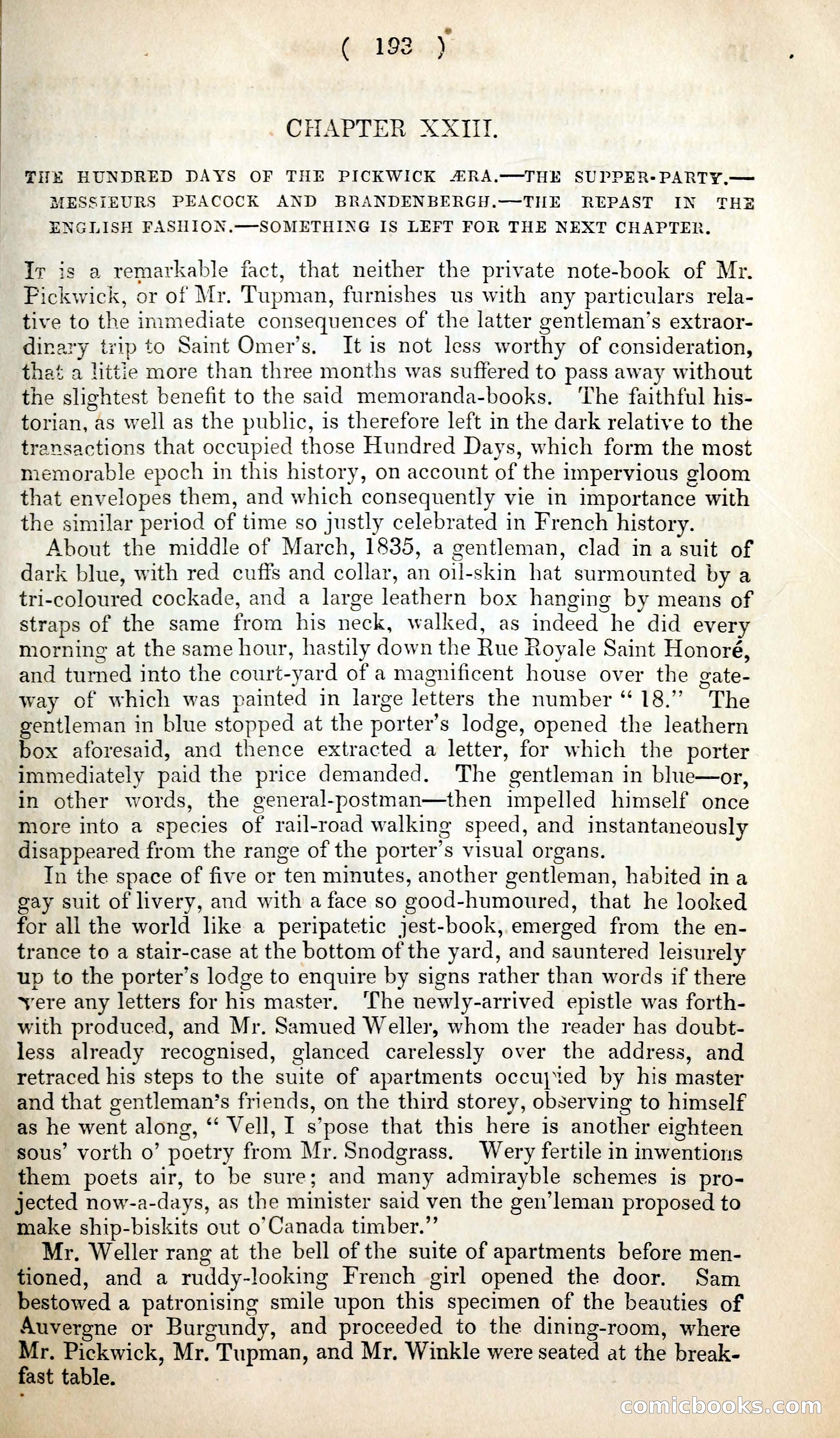
A restored page from Penny Dreadfuls, 1857. Page through the whole issue in the reader above.
📄 Transcribed text from this page (OCR, searchable)
Machine-transcribed from the original scan — historical spelling and the odd misread are preserved.
( 193 “ CHAPTER XXIII. THE HUNDRED DAYS OF THE PICKWICK 4RA.—THE SUPPER-PARTY.— MESSIEURS PEACOCK AND BRANDENBERGH.—THE REPAST IN THE ENGLISH FASHION.—SOMETHING IS LEFT FOR THE NEXT CHAPTER. Ir is a remarkable fact, that neither the private note-book of Mr. Fickwick, or of Mr. Tupman, furnishes us with any particulars rela- tive to the immediate consequences of the latter gentleman’s extraor- dinary trip to Saint Omer’s. It is not less worthy of consideration, that a hittie more than three months was suffered to pass away without the slightest benefit to the said memoranda-books. ‘The faithful his- torian, as well as the public, is therefore left in the dark relative to the transactions that occupied those Hundred Days, which form the most memorable epoch in this history, on account of the impervious gloom that envelopes them, and which consequently vie in importance with the similar period of time so justly celebrated in French history. About the middle of March, 1835, a gentleman, clad in a suit of dark blue, with red cuffs and collar, an oil-skin hat surmounted by a tri-coloured cockade, and a large leathern box hanging by means of straps of the same from his neck, walked, as indeed he did every morning at the same hour, hastily down the Rue Royale Saint Honoré, and turned into the court-yard of a magnificent house over the gate- way of which was painted in large letters the number “18.’’ The gentleman in blue stopped at the porter’s lodge, opened the leathern box aforesaid, and thence extracted a letter, for which the porter immediately paid the price demanded. The gentleman in blue—or, in other words, the general-postman—then impelled himself once more into a species of rail-road walking speed, and instantaneously disappeared from the range of the porter’s visual organs. In the space of five or ten minutes, another gentleman, habited ina gay suit of livery, and with a face so good-humoured, that he looked for all the world like a peripatetic jest-book, emerged from the en- trance to a stair-case at the bottom of the yard, and sauntered leisurely up to the porter’s lodge to enquire by signs rather than words if there vere any letters for his master. ‘The newly-arrived epistle was forth- with produced, and Mr. Samued Weller, whom the reader has doubt- less already recognised, glanced carelessly over the address, and retraced his steps to the suite of apartments occuj‘ed by his master and that gentleman’s friends, on the third storey, observing to himself as he went along, “‘ Vell, I s’pose that this here is another eighteen sous’ vorth o’ poetry from Mr. Snodgrass. Wery fertile in inwentions them poets air, to be sure; and many admirayble schemes is pro- jected now-a-days, as the minister said ven the gen’leman proposed to make ship-biskits out o Canada timber.” Mr. Weller rang at the bell of the suite of apartments before men- tioned, and a ruddy-looking French girl opened the door. Sam _ bestowed a patronising smile upon this specimen of the beauties of Auvergne or Burgundy, and proceeded to the dining-room, where Mr. Pickwick, Mr. Tupman, and Mr. Winkle were seated at the break- fast table. | EO MICLOOOLKS (EO) =)