
Penny Dreadfuls, 1839 · page 398 of 400
Pickwick Abroad: or, The Tour in France — page 398: what you’re looking at
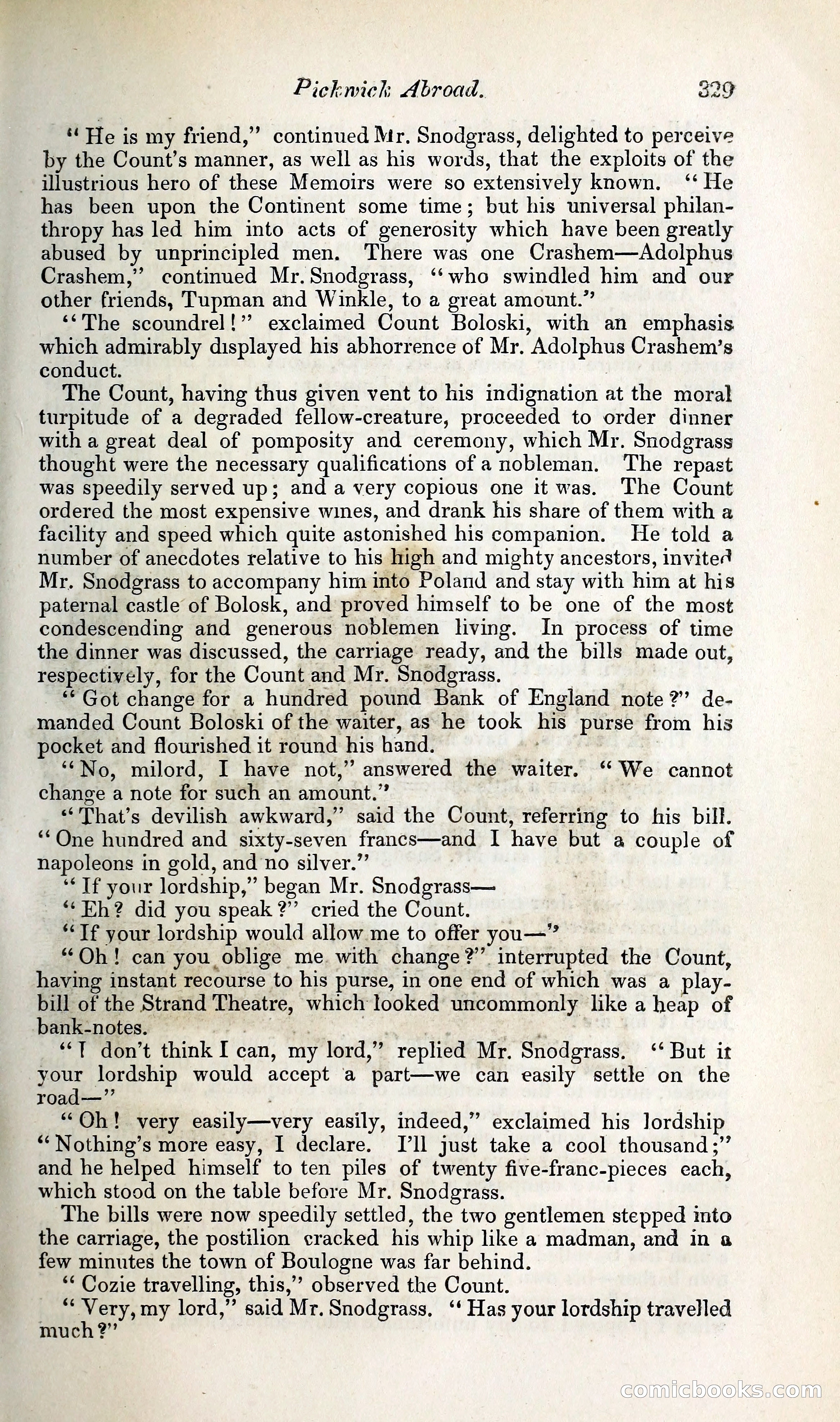
A restored page from Penny Dreadfuls, 1839. Page through the whole issue in the reader above.
📄 Transcribed text from this page (OCR, searchable)
Machine-transcribed from the original scan — historical spelling and the odd misread are preserved.
Pickwick Abroad. 329 “ He is my friend,” continued Mr. Snodgrass, delighted to perceive by the Count’s manner, as well as his words, that the exploits of the illustrious hero of these Memoirs were so extensively known. ‘‘ He has been upon the Continent some time; but his universal philan- thropy has led him into acts of generosity which have been greatly abused by unprincipled men. There was one Crashem—Adolphus Crashem,” continued Mr. Snodgrass, ‘‘who swindled him and our other friends, Tupman and Winkle, to a great amount.” ‘‘'The scoundrel!” exclaimed Count Boloski, with an emphasis which admirably displayed his abhorrence of Mr. Adolphus Crashem’s conduct. : The Count, having thus given vent to his indignation at the moral turpitude of a degraded fellow-creature, proceeded to order dinner with a great deal of pomposity and ceremony, which Mr. Snodgrass thought were the necessary qualifications of a nobleman. The repast was speedily served up; and a very copious one it was. The Count ordered the most expensive wines, and drank his share of them with a facility and speed which quite astonished his companion. He told a number of anecdotes relative to his high and mighty ancestors, invited Mr. Snodgrass to accompany him into Poland and stay with him at his paternal castle of Bolosk, and proved himself to be one of the most condescending and generous noblemen living. In process of time the dinner was discussed, the carriage ready, and the bills made out, respectively, for the Count and Mr. Snodgrass. | ‘Got change for a hundred pound Bank of England note 2?” de- manded Count Boloski of the waiter, as he took his purse from his pocket and flourished it round his hand. ‘“‘No, milord, I have not,’ answered the waiter. “ We cannot change a note for such an amount.” | ““That’s devilish awkward,” said the Count, referring to his bill. “One hundred and sixty-seven francs—and I have but a couple of napoleons in gold, and no silver.” ‘If your lordship,” began Mr. Snodgrass— ** Eh? did you speak ?”’ cried the Count. ‘Tf your lordship would allow me to offer you—” “Oh! can you oblige me. with change?” interrupted the Count, having instant recourse to his purse, in one end of which was a play- bill of the Strand ‘Theatre, which looked uncommonly like a heap of bank-notes. alge 3 inane | ho ‘‘t don’t think I can, my lord,” replied Mr. Snodgrass. ‘‘ But it your lordship would accept a part—we can easily settle on the road—”’ ; “Oh! very easily—very easily, indeed,” exclaimed his lordship ‘‘ Nothing’s more easy, I declare. I'll just take a cool thousand;”’ and he helped himself to ten piles of twenty five-franc-pieces each, which stood on the table before Mr. Snodgrass. The bills were now speedily settled, the two gentlemen stepped into the carriage, the postilion cracked his whip like a madman, and in a few minutes the town of Boulogne was far behind. ** Cozie travelling, this,” observed the Count. we pone my lord,” said Mr. Snodgrass, ‘‘ Has your lordship travelled much ?” ECOMMICLOO© iS (C(O)