
Penny Dreadfuls, 1839 · page 369 of 400
Pickwick Abroad: or, The Tour in France — page 369: what you’re looking at
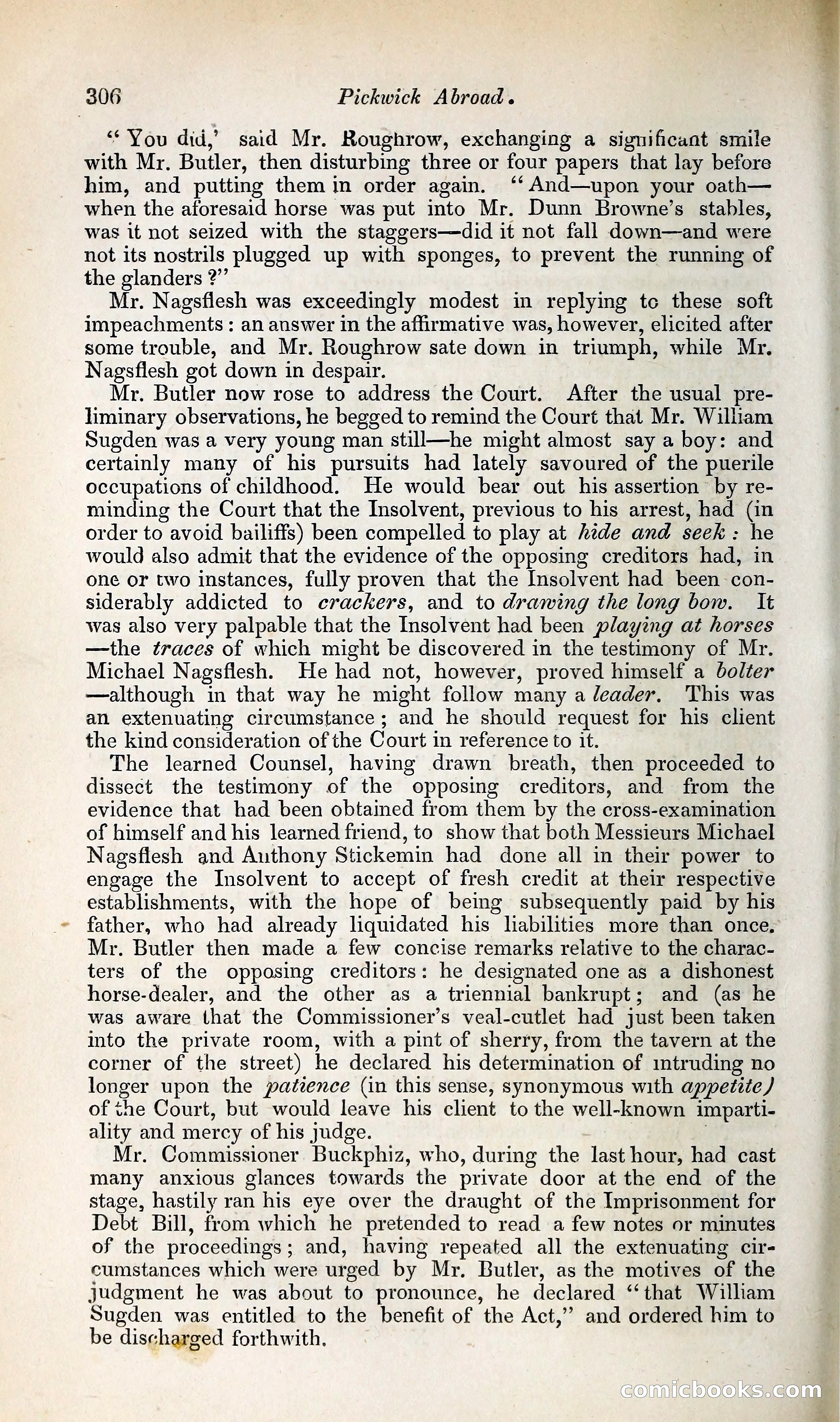
A restored page from Penny Dreadfuls, 1839. Page through the whole issue in the reader above.
📄 Transcribed text from this page (OCR, searchable)
Machine-transcribed from the original scan — historical spelling and the odd misread are preserved.
306 Pickwick Abroad. ‘You did,’ said Mr. Roughrow, exchanging a significant smile with Mr. Butler, then disturbing three or four papers that lay before him, and putting them in order again. ‘‘And—upon your oath— when the aforesaid horse was put into Mr. Dunn Browne’s stables, was it not seized with the staggers—did it not fall down—and were not its nostrils plugged up with sponges, to prevent the running of the glanders ?”’ Mr. Nagsflesh was exceedingly modest in replying tc these soft impeachments : an answer im the affirmative was, however, elicited after some trouble, and Mr. Roughrow sate down in triumph, while Mr. Nagsflesh got down in despair. Mr. Butler now rose to address the Court. After the usual pre- liminary observations, he begged to remind the Court that Mr. William Sugden was a very young man still—he might almost say a boy: and certainly many of his pursuits had lately savoured of the puerile occupations of childhood. He would bear out his assertion by re- minding the Court that the Insolvent, previous to his arrest, had (in order to avoid bailiffs) been compelled to play at hede and seek: he would also admit that the evidence of the opposing creditors had, in one or two instances, fully proven that the Insolvent had been con- siderably addicted to crackers, and to draning the long bow. It was also very palpable that the Insolvent had been playing at horses —the traces of which might be discovered in the testimony of Mr. Michael Nagsflesh. He had not, however, proved himself a bolter —although in that way he might follow many a leader. This was an extenuating circumstance; and he should request for his client the kind consideration of the Court in reference to it. The learned Counsel, having drawn breath, then proceeded to dissect the testimony of the opposing creditors, and from the evidence that had been obtained from them by the cross-examination of himself and his learned friend, to show that both Messieurs Michael Nagsfiesh and Authony Stickemin had done all in their power to engage the Insolvent to accept of fresh credit at their respective establishments, with the hope of being subsequently paid by his father, who had already liquidated his liabilities more than once. Mr. Butler then made a few concise remarks relative to the charac- ters of the opposing creditors: he designated one as a dishonest horse-dealer, and the other as a triennial bankrupt; and (as he was aware that the Commissioner’s veal-cutlet had just been taken into the private room, with a pint of sherry, from the tavern at the corner of the street) he declared his determination of intruding no longer upon the patience (in this sense, synonymous with appetite) of the Court, but would leave his client to the well-known imparti- ality and mercy of his judge. | | Mr. Commissioner Buckphiz, who, during the last hour, had cast many anxious glances towards the private door at the end of the stage, hastily ran his eye over the draught of the Imprisonment for Debt Bill, from which he pretended to read a few notes or minutes of the proceedings; and, having repeated all the extenuating cir- cumstances which were urged by Mr. Butler, as the motives of the judgment he was about to pronounce, he declared ‘‘that William Sugden was entitled to the benefit of the Act,’’ and ordered him to be discharged forthwith. Eomichbooks.co m