
Penny Dreadfuls, 1839 · page 346 of 400
Pickwick Abroad: or, The Tour in France — page 346: what you’re looking at
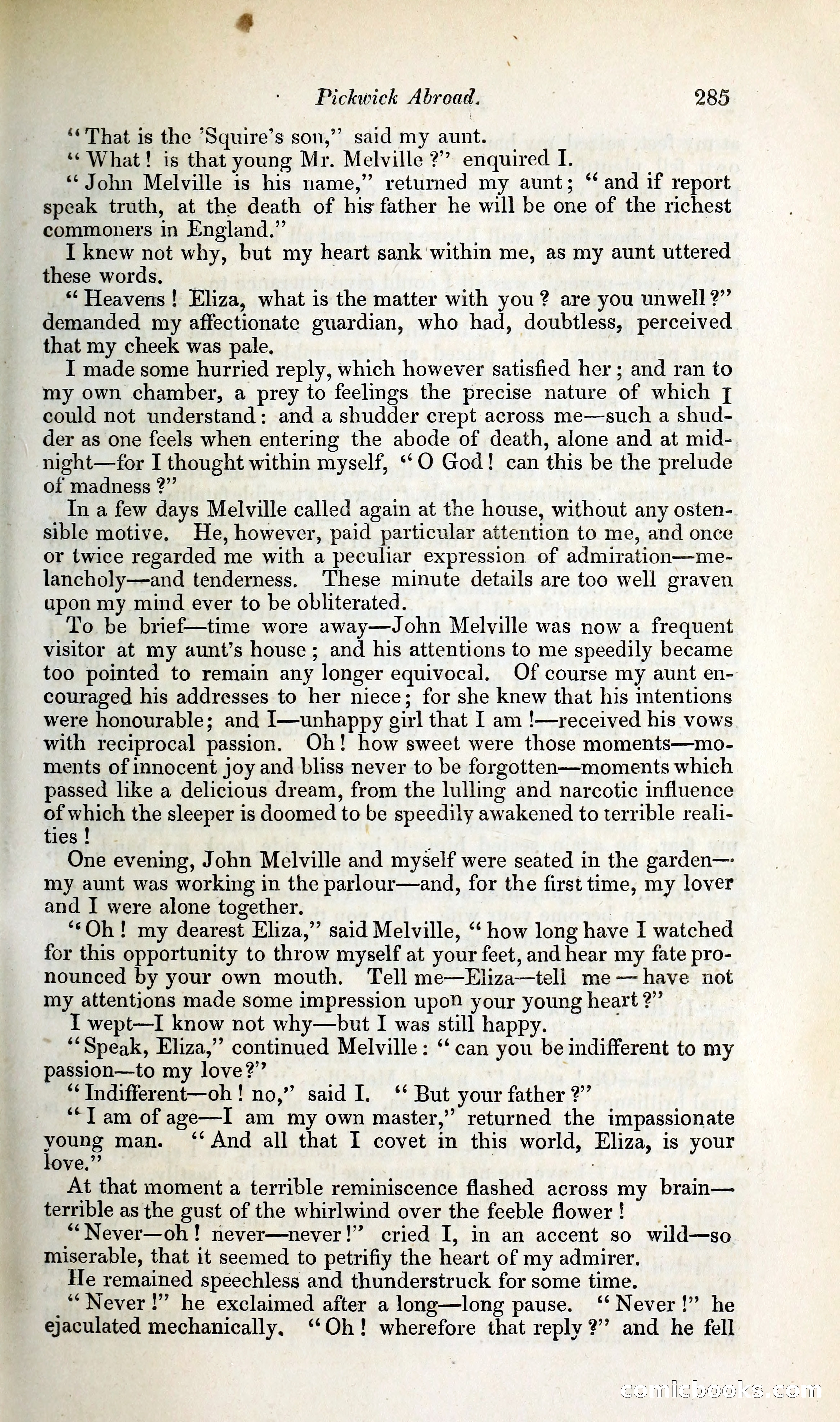
A restored page from Penny Dreadfuls, 1839. Page through the whole issue in the reader above.
📄 Transcribed text from this page (OCR, searchable)
Machine-transcribed from the original scan — historical spelling and the odd misread are preserved.
Pickwick A broad : 285 ‘‘That is the “Squire’s son,”’ said my aunt. ‘What! is that young Mr. Melville 2?” enquired I. “ John Melville is his name,” returned my aunt; “ and if report speak truth, at the death of his father he will be one of the richest commoners in England.” : I knew not why, but my heart sank'within me, as my aunt uttered these words. | | “‘ Heavens ! Eliza, what is the matter with you? are you unwell ?” demanded my affectionate guardian, who had, doubtless, perceived that my cheek was pale. I made some hurried reply, which however satisfied her ; and ran to my own chamber, a prey to feelings the precise nature of which [| could not understand: and a shudder crept across me—such a shud- der as one feels when entering the abode of death, alone and at mid- night—for I thought within myself, “OQ God! can this be the prelude of madness ?”’ In a few days Melville called again at the house, without any osten- sible motive, He, however, paid particular attention to me, and once or twice regarded me with a peculiar expression of admiration—me- lancholy—and tenderness. ‘These minute details are too well graven upon my mind ever to be obliterated. To be brief—time wore away—John Melville was now a frequent visitor at my aunt’s house; and his attentions to me speedily became too pointed to remain any longer equivocal. Of course my aunt en- couraged his addresses to her niece; for she knew that his intentions were honourable; and I—unhappy girl that I am !—received his vows with reciprocal passion. Oh! how sweet were those moments—mo- ments of innocent joy and bliss never to be forgotten—moments which passed like a delicious dream, from the lulling and narcotic influence of which the sleeper is doomed to be speedily awakened to terrible reali- ties ! One evening, John Melville and myself were seated in the garden—: my aunt was working in the parlour—and, for the first time, my lover and I were alone together. : ““Oh! my dearest Eliza,” said Melville, ‘‘ how long have I watched for this opportunity to throw myself at your feet, and hear my fate pro- nounced by your own mouth. Tell me—Eliza—teli me— have not my attentions made some impression upon your young heart ?” I wept—I know not why—but I was still happy. . “Speak, Eliza,”’ continued Melville: “‘ can you be indifferent to my passion—to my love?” } ** Indifferent—oh! no,” said I. ‘‘ But your father 2” *“I am of age—I am my own master,” returned the impassionate gs man. ‘* And all that I covet in this world, Eliza, is your ve.” : At that moment a terrible reminiscence flashed across my brain— terrible as the gust of the whirlwind over the feeble flower! ** Never—oh! never—never!” cried I, in an accent so wild—so miserable, that it seemed to petrifiy the heart of my admirer. He remained speechless and thunderstruck for some time. “Never!” he exclaimed after a long—long pause. ‘‘ Never!” he ejaculated mechanically, ‘“‘Oh! wherefore that reply 2?” and he fell CORNICLO© cS (C(O)