
Penny Dreadfuls, 1839 · page 356 of 400
Pickwick Abroad: or, The Tour in France — page 356: what you’re looking at
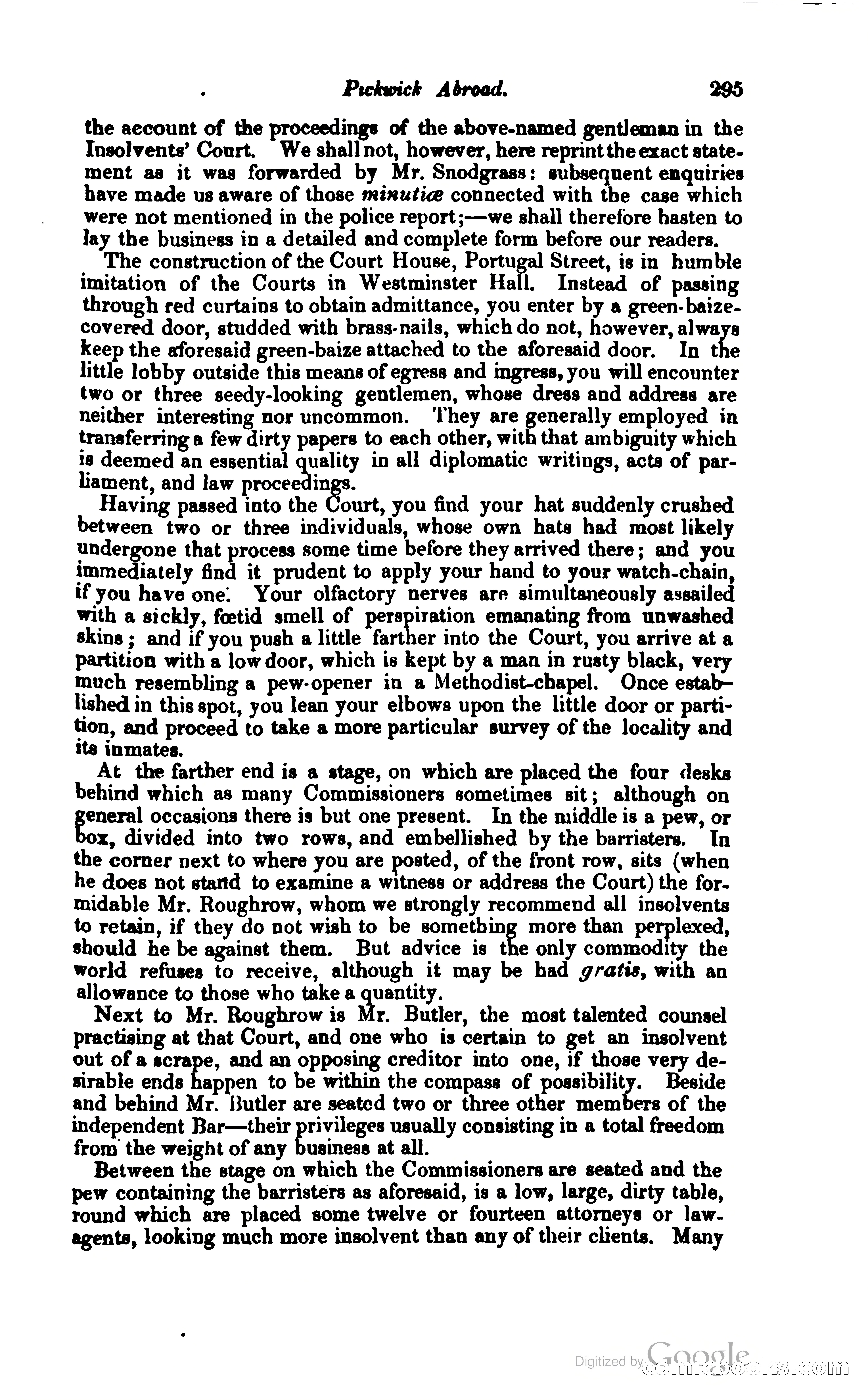
A restored page from Penny Dreadfuls, 1839. Page through the whole issue in the reader above.
📄 Transcribed text from this page (OCR, searchable)
Machine-transcribed from the original scan — historical spelling and the odd misread are preserved.
Pickwick Abroad. 295 the aecount of the proceedings of the above-named gentleman in the Insolvents’ Court. We shall not, however, here reprint the exact state- ment as it was forwarded by Mr. Snodgrass: subsequent enquiries have made us aware of those minutie connected with the case which were not mentioned in the police report ;—we shall therefore hasten to lay the business in a detailed and complete form before our readers. The construction of the Court House, Portugal Street, is in humble imitation of the Courts in Westminster Hall. Instead of passing through red curtains to obtain admittance, you enter by a green- baize- covered door, studded with brass-nails, which do not, however, always keep the aforesaid green-baize attached to the aforesaid door. In the little lobby outside this means of egress and ingress, you will encounter two or three seedy-looking gentlemen, whose dress and address are neither interesting nor uncommon. ‘hey are generally employed in transferring a few dirty papers to each other, with that ambiguity which 18 deemed an essential quality in all diplomatic writings, acts of par- liament, and law proce ngs. Having passed into the Court, you find your hat suddenly crushed between two or three individuals, whose own hats had most likely undergone that process some time before they arrived there; and you immediately find it prudent to apply your hand to your watch-chain, if you have one. Your olfactory nerves are simultaneously assailed with a sickly, foetid smell of perspiration emanating from unwashed skins ; and if you push a little farther into the Court, you arrive at a partition with a low door, which is kept by a man in rusty black, very much resembling a pew-opener in a Methodist-chapel. Once estab- lished in this spot, you lean your elbows upon the little door or parti- tion, and proceed to take a more particular survey of the locality and its inmates. At the farther end is a stage, on which are placed the four desks behind which as many Commissioners sometimes sit; although on eneral occasions there is but one present. In the middle is a pew, or x, divided into two rows, and embellished by the barristers. In the corner next to where you are posted, of the front row, sits (when he does not stand to examine a witness or address the Court) the for- midable Mr. Roughrow, whom we strongly recommend all insolvents to retain, if they do not wish to be something more than perplexed, should he be against them. But advice is the only commodity the world refuses to receive, although it may be had gratis, with an allowance to those who take a quantity. Next to Mr. Roughrow is Mr. Butler, the most talented counsel practising at that Court, and one who is certain to get an insolvent out of a scrape, and an opposing creditor into one, if those very de- sirable ends happen to be within the compass of possibility. Beside and behind Mr. Butler are seated two or three other members of the independent Bar—their privileges usually consisting in a total freedom from the weight of any business at all. Between the stage on which the Commissioners are seated and the pew containing the barristers as aforesaid, is a low, large, dirty table, round which are placed some twelve or fourteen attorneys or law- agents, looking much more insolvent than any of their clients. Many q) COL DGe (c@