
Penny Dreadfuls, 1839 · page 353 of 400
Pickwick Abroad: or, The Tour in France — page 353: what you’re looking at
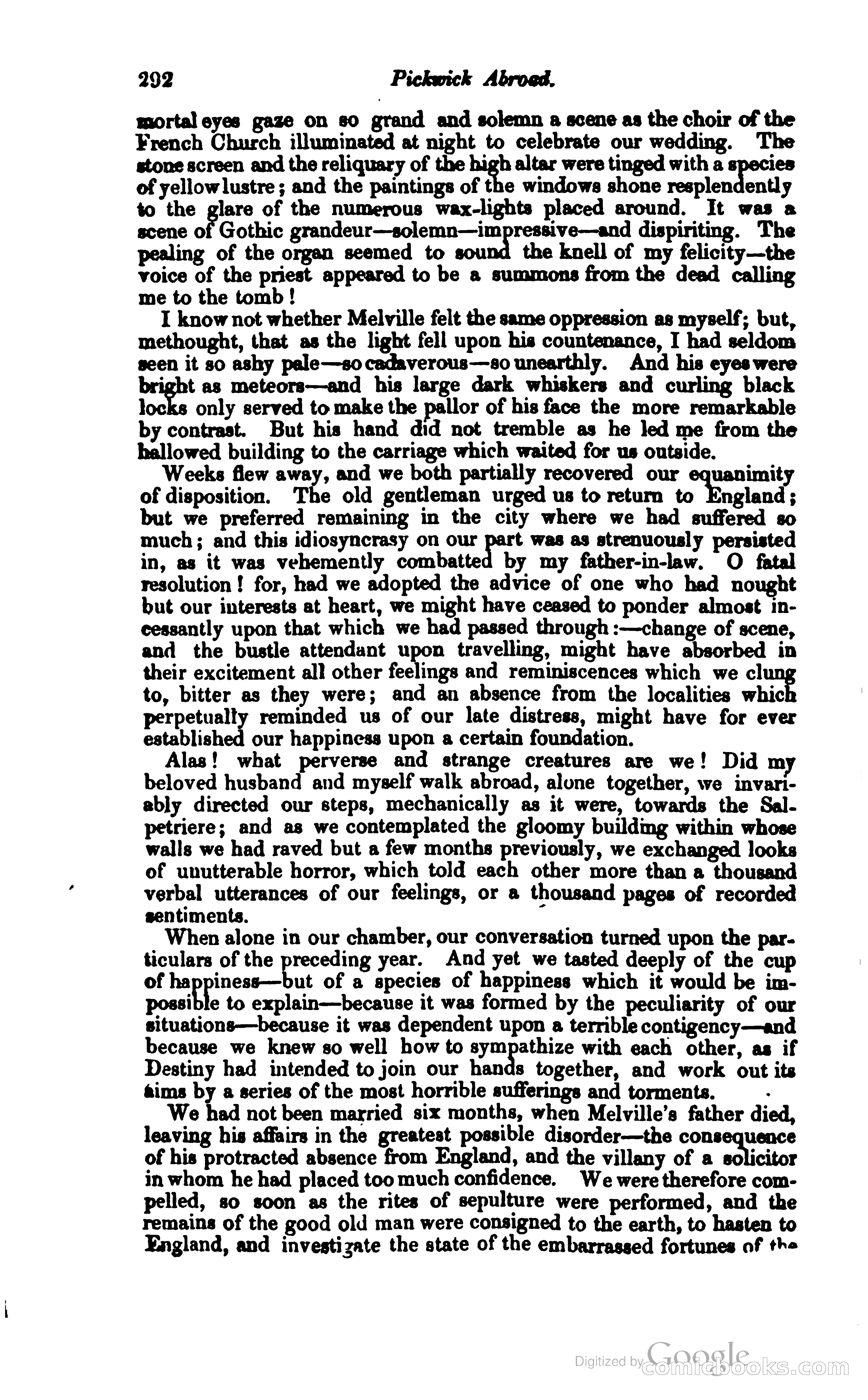
A restored page from Penny Dreadfuls, 1839. Page through the whole issue in the reader above.
📄 Transcribed text from this page (OCR, searchable)
Machine-transcribed from the original scan — historical spelling and the odd misread are preserved.
292 Pickwick Abroed. mortal eyes gaze On so grand and solemn a scene as the choir of the French Church illuminated at night to celebrate our wedding. The stone screen and the reliquary of the high altar were tinged with a les of yellow lustre ; and the paintings of the windows shone resplendently to the glare of the numerous wax-lights placed around. It was a scene of Gothic grandeur—solemn—impressive—and dispiriting. The pealing of the organ seemed to sound the knell of my felicity—the voice of the priest appeared to be a summons from the dead calling me to the tomb! I know not whether Melville felt the same oppression as myself; but, methought, that as the light fell upon his countenance, I had seldom seen it so ashy pale—socadaverous—so unearthly. And his eyes were bright as meteors—and his large dark whiskers and curling black locks only served to make the pallor of his face the more remarkable by contrast. But his hand did not tremble as he led me from the hallowed building to the carriage which waited for us outside. Weeks flew away, and we both partially recovered our equanimity of disposition. The old gentleman urged us to return to England; but we preferred remaining in the city where we had suffered so much; and this idiosyncrasy on our part was as strenuously persisted in, as it was vehemently combatted by my father-in-law. O fatal resolution | for, had we adopted the advice of one who had nought but our interests at heart, we might have ceased to ponder almost in- cessantly upon that which we had passed through :—change of scene, and the bustle attendant upon travelling, might have absorbed in their excitement all other feelings and reminiscences which we cl to, bitter as they were; and an absence from the localities whic perpetually reminded us of our late distress, might have for ever established our happiness upon a certain foundation. Alas! what perverse and strange creatures are we! Did my beloved husband and myself walk abroad, alone together, we invari- ably directed our steps, mechanically as it were, towards the Sal- petriere; and as we contemplated the gloomy buildmg within whose walls we had raved but a few months previously, we exchanged looks of unutterable horror, which told each other more than a thousand verbal utterances of our feelings, or a thousand pages of recorded sentiments. When alone in our chamber, our conversation turned upon the par- ticulars of the preceding year. And yet we tasted deeply of the cup of happiness—but of a species of happiness which it would be im- possible to explain—because it was formed by the peculiarity of our situations—because it was dependent upon a terrible contigency—and because we knew so well how to sympathize with each other, as if Destiny had intended to join our hands together, and work out its aims by a series of the most horrible sufferings and torments. We had not been married six months, when Melville’s father di leaving his affairs in the greatest possible disorder—the consequence of his protracted absence from England, and the villany of a solicitor in whom he had placed too much confidence. We were therefore com- pelled, so soon as the rites of sepulture were performed, and the remains of the good old man were consigned to the earth, to hasten to England, and investizate the state of the embarrassed fortunes of the COL q) 1 SKOKO|KS.EO