
Penny Dreadfuls, 1800 · page 331 of 400
Pickwick Abroad: A Companion to the Pickwick Papers — page 331: what you’re looking at
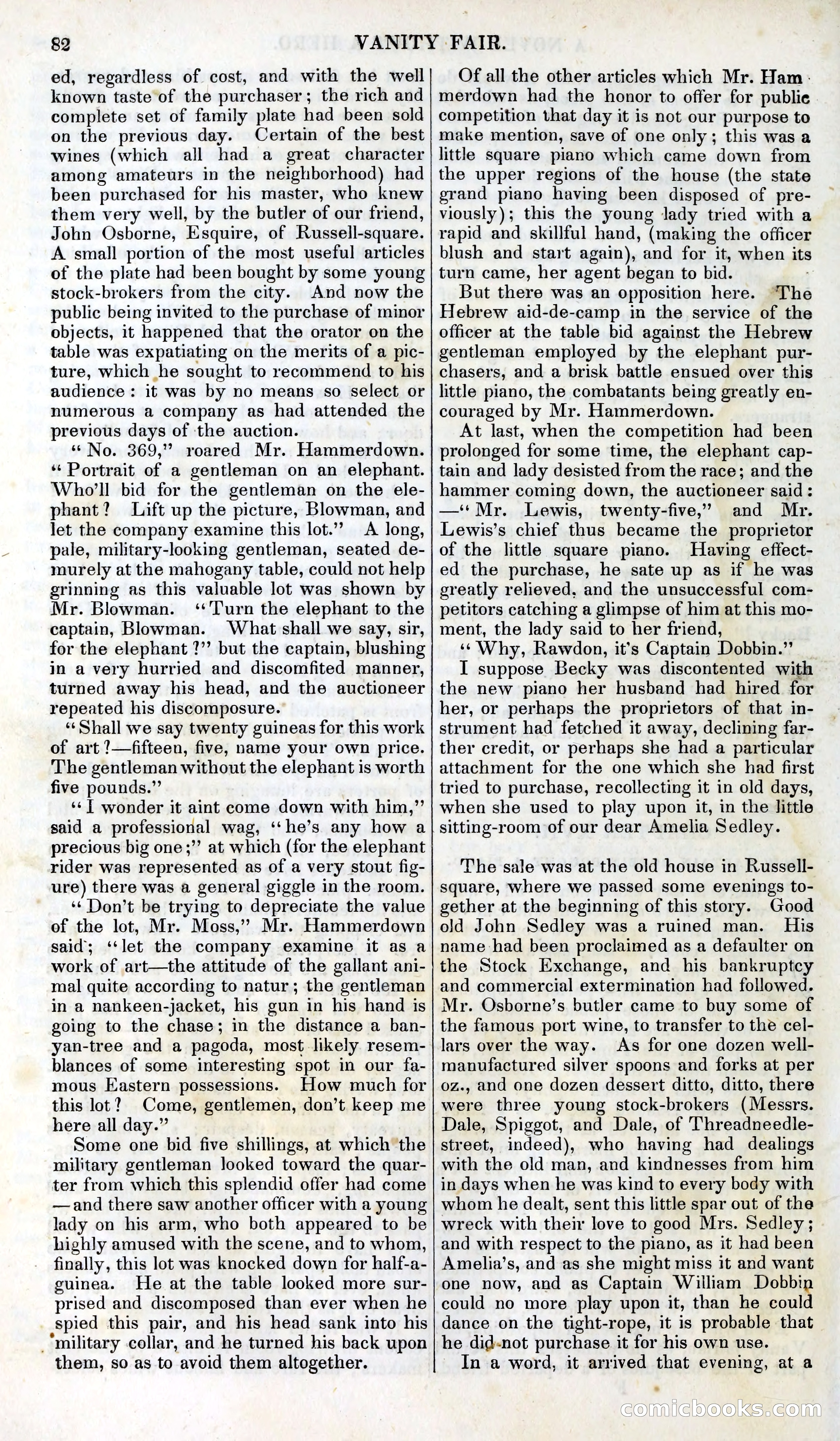
A restored page from Penny Dreadfuls, 1800. Page through the whole issue in the reader above.
📄 Transcribed text from this page (OCR, searchable)
Machine-transcribed from the original scan — historical spelling and the odd misread are preserved.
82 ed, regardless of cost, and with the well known taste of the purchaser; the rich and complete set of family plate had been sold on the previous day. Certain of the best wines (which all had a great character among amateurs in the neighborhood) had been purchased for his master, who knew them very well, by the butler of our friend, John Osborne, Esquire, of Russell-square. A small portion of the most useful articles of the plate had been bought by some young stock-brokers from the city. And now the public being invited to the purchase of minor objects, it happened that the orator on the table was expatiating on the merits of a pic- ture, which he sought to recommend to his audience : it was by no means so select or numerous a company as had attended the previous days of the auction. ‘ No. 369,” roared Mr. Hammerdown. ‘Portrait of a gentleman on an elephant. Who’ll bid for the gentleman on the ele- phant? Lift up the picture, Blowman, and let the company examine this lot.’”’? A long, pale, military-looking gentleman, seated de- | murely at the mahogany table, could not help grinning as this valuable lot was shown by Mr. Blowman. ‘‘l'urn the elephant to the captain, Blowman. What shall we say, sir, for the elephant ?”’ but the captain, blushing in a very hurried and discomfited manner, turned away his head, and the auctioneer repeated his discomposure. ‘Shall we say twenty guineas for this work of art ?—fifteen, five, name your own price. The gentleman without the elephant is worth five pounds.”’ ‘¢ | wonder it aint come down with him,”’ said a professional wag, ‘‘he’s any how a precious big one;”’ at which (for the elephant rider was represented as of a very stout fig- ure) there was a general giggle in the room. ‘¢ Don’t be trying to depreciate the value of the lot, Mr. Moss,” Mr. Hammerdown said; ‘‘let the company examine it as a work of art—the attitude of the gallant ani- mal quite according to natur; the gentleman in a nankeen-jacket, his gun in his hand is going to the chase; in the distance a ban- yan-tree and a pagoda, most likely resem- blances of some interesting spot in our fa- mous Eastern possessions. How much for this lot? Come, gentlemen, don’t keep me here all day.” Some one bid five shillings, at which the military gentleman looked toward the quar- ter from which this splendid offer had come —and there saw another officer with a young lady on his arm, who both appeared to be highly amused with the scene, and to whom, finally, this lot was knocked down for half-a- guinea. He at the table looked more sur- prised and discomposed than ever when he ‘spied this pair, and his head sank into his ‘military collar, and he turned his back upon them, so as to avoid them altogether. VANITY FAIR. Of all the other articles which Mr. Ham. merdown had the honor to offer for publie competition that day it is not our purpose to make mention, save of one only; this was a little square piano which came down from the upper regions of the house (the state grand piano having been disposed of pre- viously); this the young lady tried with a rapid and skillful hand, (making the officer blush and start again), and for it, when its turn came, her agent began to bid. But there was an opposition here. The Hebrew aid-de-camp in the service of the officer at the table bid against the Hebrew gentleman employed by the elephant pur- chasers, and a brisk battle ensued over this little piano, the combatants being greatly en- couraged by Mr. Hammerdown. At last, when the competition had been prolonged for some time, the elephant cap- tain and lady desisted from the race; and the hammer coming down, the auctioneer said: —‘‘+ Mr. Lewis, twenty-five,’ and Mr. Lewis’s chief thus became the proprietor of the little square piano. Having effect- ed the purchase, he sate up as if he was greatly relieved, and the unsuccessful com- petitors catching a glimpse of him at this mo- ment, the lady said to her friend, ‘Why, Rawdon, it’s Captain Dobbin.” I suppose Becky was discontented with the new piano her husband had hired for her, or perhaps the proprietors of that in- strument had fetched it away, declining far- ther credit, or perhaps she had a particular attachment for the one which she had first tried to purchase, recollecting it in old days, when she used to play upon it, in the little sitting-room of our dear Amelia Sedley. The sale was at the old house in Russell- square, where we passed some evenings to- gether at the beginning of this story. Good old John Sedley was a ruined man. His name had been proclaimed as a defaulter on the Stock Exchange, and his bankruptcy and commercial extermination had followed. Mr. Osborne’s butler came to buy some of the famous port wine, to transfer to the cel- lars over the way. As for one dozen well- manufactured silver spoons and forks at per oz., and one dozen dessert ditto, ditto, there were three young stock-brokers (Messrs. Dale, Spiggot, and Dale, of Threadneedle- street, indeed), who having had dealings with the old man, and kindnesses from him in days when he was kind to every body with whom he dealt, sent this little spar out of the wreck with their love to good Mrs. Sedley ; and with respect to the piano, as it had been Amelia’s, and as she might miss it and want one now, and as Captain William preein could no more play upon it, than he coul dance on the tight-rope, it is probable that he did-not purchase it for his own use. In a word, it arrived that evening, at a COMMIE OCW) <SnGOimn