
Penny Dreadfuls, 1800 · page 258 of 400
Pickwick Abroad: A Companion to the Pickwick Papers — page 258: what you’re looking at
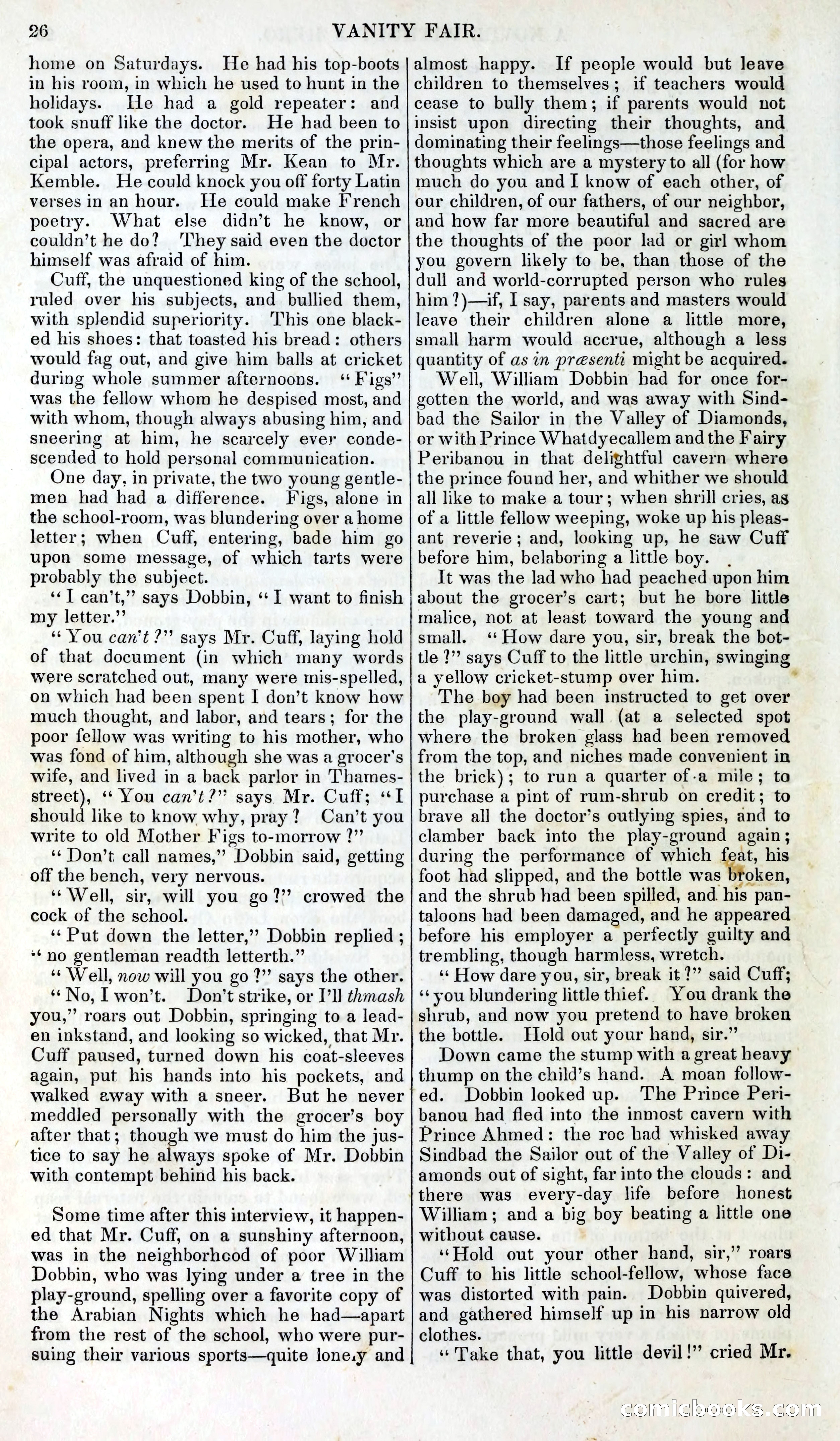
A restored page from Penny Dreadfuls, 1800. Page through the whole issue in the reader above.
📄 Transcribed text from this page (OCR, searchable)
Machine-transcribed from the original scan — historical spelling and the odd misread are preserved.
26 home on Saturdays. He had his top-boots in his room, in which he used to hunt in the holidays. He had a gold repeater: and took snuff like the doctor. He had been to the opera, and knew the merits of the prin- cipal actors, preferring Mr. Kean to Mr. Kemble. He could knock you off forty Latin verses in an hour. He could make French poetry. What else didn’t he know, or couldn’t he do? ‘They said even the doctor himself was afraid of him. Cuff, the unquestioned king of the school, ruled over his subjects, and bullied them, with splendid superiority. This one black- ed his shoes: that toasted his bread: others would fag out, and give him balls at cricket during whole summer afternoons. ‘ Figs’ was the fellow whom he despised most, and with whom, though always abusing him, and sneering at him, he scarcely ever conde- scended to hold personal communication. One day, in private, the two young gentle- men had had a difference. Figs, alone in the school-room, was blundering over a home letter; when Cuff, entering, bade him go upon some message, of which tarts were probably the subject. ‘‘] can’t,” says Dobbin, “I want to finish my letter.”’ “You can’t?” says Mr. Cuff, laying hold of that document (in which many words were scratched out, many were mis-spelled, on which had been spent I don’t know how much thought, and labor, and tears; for the poor fellow was writing to his mother, who was fond of him, although she was a grocer’s wife, and lived in a back parlor in Thames- street), ‘‘ You can’t?” says Mr. Cuff; “I should like to know why, pray? Can’t you write to old Mother Figs to-morrow 2?” ‘ Don’t call names,” Dobbin said, getting off the bench, very nervous. ‘Well, sir, will you go?’’ crowed the cock of the school. ‘¢ Put down the letter,’’ Dobbin replied ; **no gentleman readth letterth.” ‘¢ Well, now will you go ?”’ says the other. ‘No, I won’t. Don’t strike, or I'l] thmash you,”’ roars out Dobbin, springing to a lead- en inkstand, and looking so wicked, that Mr. Cuff paused, turned down his coat-sleeves again, put his hands into his pockets, and walked away with a sneer. But he never meddled personally with the grocer’s boy _ after that; though we must do him the jus- tice to say he always spoke of Mr. Dobbin with contempt behind his back. Some time after this interview, it happen- ed that Mr. Cuff, on a sunshiny afternoon, was in the neighborhcod of poor William Dobbin, who was lying under a tree in the play-ground, spelling over a favorite copy of the Arabian Nights which he had—apart from the rest of the school, who were pur- suing their various sports—quite lone.y and VANITY FAIR. almost happy. If people would but leave children to themselves; if teachers would cease to bully them; if parents would not insist upon directing their thoughts, and dominating their feelings—those feelings and thoughts which are a mystery to all (for how much do you and I know of each other, of our children, of our fathers, of our neighbor, and how far more beautiful and sacred are the thoughts of the poor lad or girl whom you govern likely to be, than those of the dull and world-corrupted person who rules him ?)—if, I say, parents and masters would leave their children alone a little more, small harm would accrue, although a less quantity of as in presenti might be acquired. Well, William Dobbin had for once for- gotten the world, and was away with Sind- bad the Sailor in the Valley of Diamonds, or with Prince Whatdyecallem and the Fairy Peribanou in that delightful cavern where the prince found her, and whither we should all like to make a tour; when shrill cries, as of a little fellow weeping, woke up his pleas- ant reverie; and, looking up, he saw Cuff before him, belaboring a little boy. . It was the lad who had peached upon him about the grocer’s cart; but he bore little malice, not at least toward the young and small. ‘* How dare you, sir, break the bot- tle ?” says Cuff to the little urchin, swinging ” a yellow cricket-stump over him. The boy had been instructed to get over the play-ground wall (at a selected spot where the broken glass had been removed from the top, and niches made convenient in the brick); to run a quarter of-a mile; ta purchase a pint of rum-shrub on credit; to brave all the doctor’s outlying spies, and to clamber back into the play-ground again; during the performance of which feat, his foot had slipped, and the bottle was broken, and the shrub had been spilled, and. his pan- taloons had been damaged, and he appeared before his employer a perfectly guilty and trembling, though harmless, wretch. ‘¢ How dare you, sir, break it?” said Cuff; ‘¢you blundering little thief. You drank the shrub, and now you pretend to have broken the bottle. Hold out your hand, sir.” Down came the stump with a great heavy thump on the child’s hand. A moan follow- ed. Dobbin looked up. The Prince Peri- banou had fled into the inmost cavern with Prince Ahmed: the roc had whisked away Sindbad the Sailor out of the Valley of Di- amonds out of sight, far into the clouds: and there was every-day life before honest William ; and a big boy beating a little one without cause. ‘Hold out your other hand, sir,” roars Cuff to his little school-fellow, whose face was distorted with pain. Dobbin quivered, and gathered himself up in his narrow old clothes. “Take that, you little devil!’ cried Mr. GOmMmiGcdoo <SGO