
Penny Dreadfuls, 1800 · page 253 of 400
Pickwick Abroad: A Companion to the Pickwick Papers — page 253: what you’re looking at
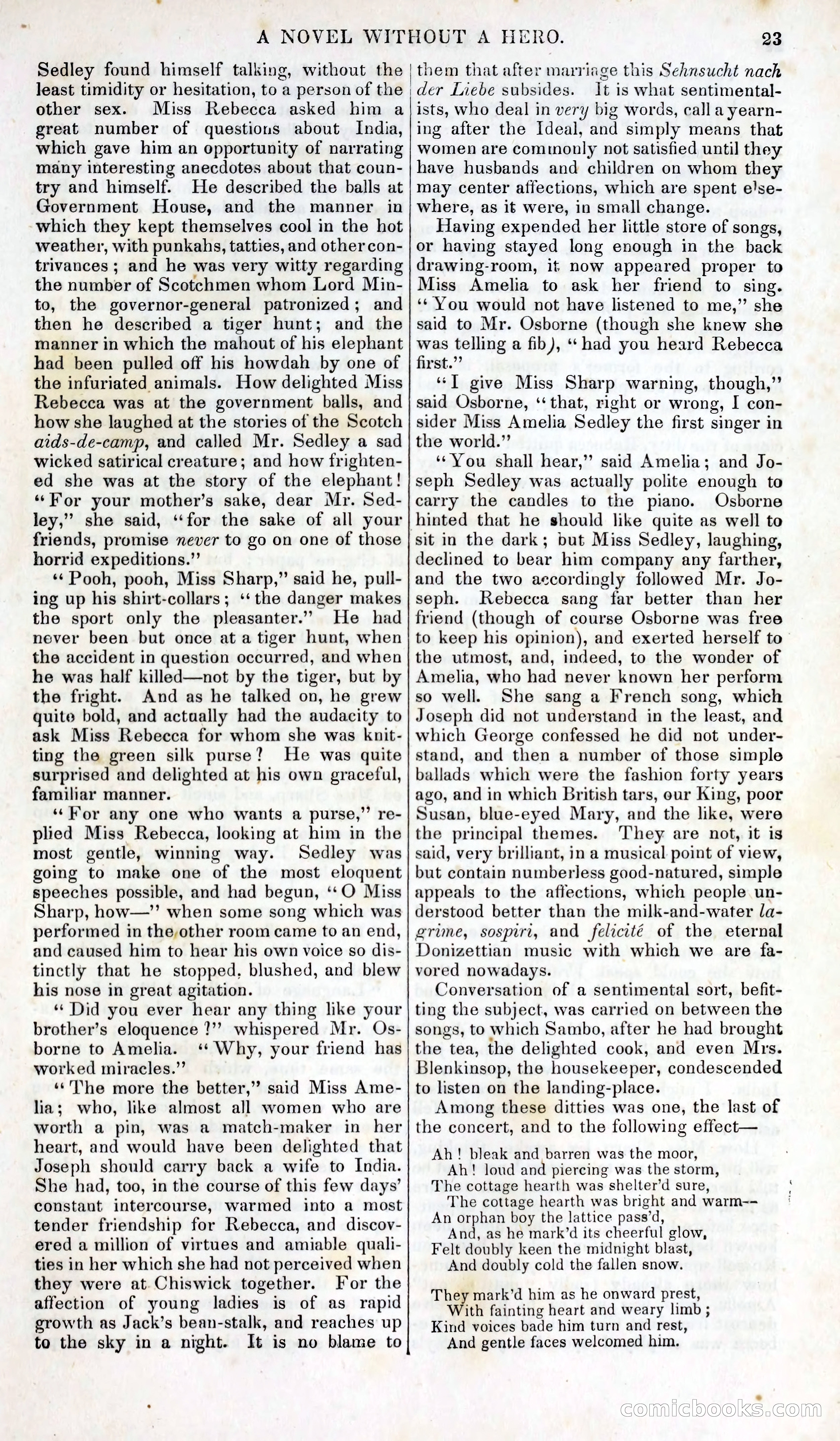
A restored page from Penny Dreadfuls, 1800. Page through the whole issue in the reader above.
📄 Transcribed text from this page (OCR, searchable)
Machine-transcribed from the original scan — historical spelling and the odd misread are preserved.
A NOVEL WITHOUT A HERO. Sedley found himself talking, without the least timidity or hesitation, to a person of the other sex. Miss Rebecca asked him a great number of questions about India, which gave him an opportunity of narrating many interesting anecdotes about that coun- try and himself. He described the balls at Government House, and the manner in which they kept themselves cool in the hot weather, with punkahs, tatties, and other con- trivances ; and he was very witty regarding the number of Scotchmen whom Lord Min- to, the governor-general patronized; and then he described a tiger hunt; and the manner in which the mahout of his elephant had been pulled off his howdah by one of the infuriated animals. How delighted Miss Rebecca was at the government balls, and how she laughed at the stories of the Scotch aids-de-camp, and called Mr. Sedley a sad wicked satirical creature; and how frighten- ed she was at the story of the elephant! ‘For your mother’s sake, dear Mr. Sed- ley,” she said, “for the sake of all your friends, promise never to go on one of those horrid expeditions.”’ ‘¢ Pooh, pooh, Miss Sharp,” said he, pull- ing up his shirt-collars; ‘‘ the danger makes the sport only the pleasanter.”’ He had never been but once at a tiger hunt, when the accident in question occurred, and when he was half killed—not by the tiger, but by the fright. And as he talked on, he grew quite bold, and actually had the audacity to ask Miss Rebecca for whom she was knit- ting the green silk purse? He was quite surprised and delighted at his own graceful, familiar manner. ‘For any one who wants a purse,” re- plied Miss Rebecca, looking at him in the most gentle, winning way. Sedley was going to make one of the most eloquent speeches possible, and had begun, ‘‘O Miss Sharp, how—’’ when some song which was performed in the,other room came to an end, and caused him to hear his own voice so dis- tinctly that he stopped, blushed, and blew his nose in great agitation. ‘ Did you ever hear any thing like your brother’s eloquence ?”’? whispered Mr. Os- borne to Amelia. ‘ Why, your friend has worked miracles.” ‘he more the better,” said Miss Ame- lia; who, like almost all women who are worth a pin, was a match-maker in her heart, and would have been delighted that Joseph should carry back a wife to India. She had, too, in the course of this few days’ constant intercourse, warmed into a most tender friendship for Rebecca, and discov- ered a million of virtues and amiable quali- ties in her which she had not perceived when they were at. Chiswick together. For the affection of young ladies is of as rapid srowth as Jack’s bean-stalk, and reaches up to the sky in a night. It is no blame to | 23 them that after marriage this Sehnsucht nach der Liebe subsides. It is what sentimental- ists, who deal in very big words, call a yearn- ing after the Ideal, and simply means that women are commonly not satisfied until they have husbands and children on whom they may center affections, which are spent e!se- where, as it were, in small change. Having expended her little store of songs, or having stayed long enough in the back drawing-room, it now appeared proper to Miss Amelia to ask her friend to sing. ‘¢ You would not have listened to me,” she said to Mr. Osborne (though she knew she was telling a fib), ‘* had you heard Rebecca first.”’ ‘Tl give Miss Sharp warning, though,” said Osborne, ‘that, right or wrong, I con- sider Miss Amelia Sedley the first singer in the world.” ‘You shall hear,” said Amelia; and Jo- seph Sedley was actually polite enough to carry the candles to the piano. Osborne hinted that he should like quite as well to sit in the dark; but Miss Sedley, laughing, declined to bear him company any farther, and the two accordingly followed Mr. Jo- seph. Rebecca sang far better than her friend (though of course Osborne was free to keep his opinion), and exerted herself to the utmost, and, indeed, to the wonder of Amelia, who had never known her perform so well. She sang a French song, which Joseph did not understand in the least, and which George confessed he did not under- stand, and then a number of those simple ballads which were the fashion forty years ago, and in which British tars, eur King, poor Susan, blue-eyed Mary, and the like, were the principal themes. ‘They are not, it is said, very brilliant, in a musical point of view, but contain numberless good-natured, simple appeals to the affections, which people un- derstood better than the milk-and-water la- grime, sospiri, and felicité of the eternal Donizettian music with which we are fa- vored nowadays. Conversation of a sentimental sort, befit- ting the subject, was carried on between the songs, to which Sambo, after he had brought the tea, the delighted cook, and even Mrs. Blenkinsop, the housekeeper, condescended to listen on the landing-place. Among these ditties was one, the last of the concert, and to the following effect— Ah! bleak and barren was the moor, Ah! loud and piercing was the storm, The cottage hearth was shelter’d sure, The cottage hearth was bright and warm-- An orphan boy the lattice pass’d, And, as he mark’d its cheerful glow, Felt doubly keen the midnight blast, And doubly cold the fallen snow. They mark’d him as he onward prest, With fainting heart and weary limb ; Kind voices bade him turn and rest, And gentle faces welcomed him. GO NOOO (CO)