
Penny Dreadfuls, 1800 · page 243 of 400
Pickwick Abroad: A Companion to the Pickwick Papers — page 243: what you’re looking at
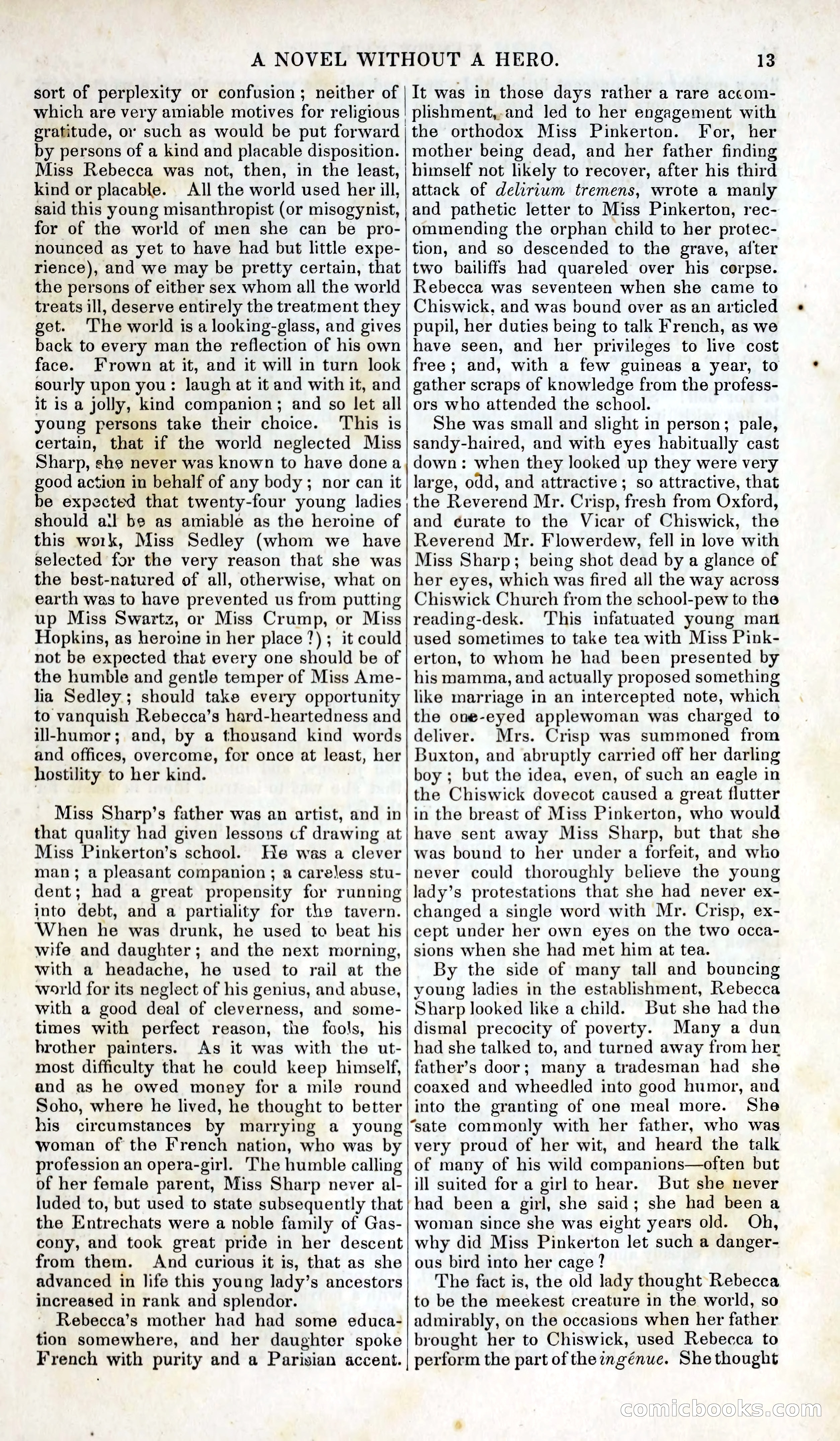
A restored page from Penny Dreadfuls, 1800. Page through the whole issue in the reader above.
📄 Transcribed text from this page (OCR, searchable)
Machine-transcribed from the original scan — historical spelling and the odd misread are preserved.
A NOVEL WITHOUT A HERO. 13 sort of perplexity or confusion; neither of | It was in those days rather a rare accom- which are very amiable motives for religious! plishment,-and led to her engagement with sratitude, or such as would be put forward | by persons of a kind and placable disposition. Miss Rebecca was not, then, in the least, kind or placable. All the world used her ill, said this young misanthropist (or misogynist, for of the world of men she can be pro- nounced as yet to have had but little expe- rience), and we may be pretty certain, that the persons of either sex whom all the world treats ill, deserve entirely the treatment they get. ‘The world is a looking-glass, and gives back to every man the reflection of his own face. Frown at it, and it will in turn look sourly upon you: laugh at it and with it, and it is a jolly, kind companion; and so let all young persons take their choice. ‘This is certain, that if the world neglected Miss Sharp, she never was known to have donea good action in behalf of any body; nor can it be expected that twenty-four young ladies should ail be as amiable as the heroine of this work, Miss Sedley (whom we have selected for the very reason that she was the best-natured of all, otherwise, what on earth was to have prevented us from putting up Miss Swartz, or Miss Crump, or Miss Hopkins, as heroine in her place?) ; it could not be expected that every one should be of the humble and gentle temper of Miss Ame- lia Sedley ; should take every opportunity to vanquish Rebecca’s hard-heartedness and ill-humor; and, by a thousand kind words and offices, overcome, for once at least, her hostility to her kind. Miss Sharp’s father was an artist, and in that quality had given lessons cf drawing at Miss Pinkerton’s school. He was a clever man; a pleasant companion; a careless stu- dent; had a great propensity for running into debt, and a partiality for the tavern. When he was drunk, he used to beat his wife and daughter; and the next morning, with a headache, he used to rail at the world for its neglect of his genius, and abuse, with a good deal of cleverness, and some- times with perfect reason, the fools, his brother painters. As it was with the ut- most difficulty that he could keep himself, and as he owed money for a mile round Soho, where he lived, he thought to better his circumstances by marrying a young woman of the French nation, who was by profession an opera-girl. The humble calling of her female parent, Miss Sharp never al- luded to, but used to state subsequently that the Entrechats were a noble family of Gas- cony, and took great pride in her descent from them. And curious it is, that as she advanced in life this young lady’s ancestors increased in rank and splendor. Rebecca’s mother had had some educa- tion somewhere, and her daughter spoke French with purity and a Parisian accent. the orthodox Miss Pinkerton. For, her mother being dead, and her father finding himself not likely to recover, after his third attack of delirium tremens, wrote a manly and pathetic letter to Miss Pinkerton, rec- ommending the orphan child to her protec- tion, and so descended to the grave, after two bailiffs had quareled over his corpse. Rebecca was seventeen when she came to Chiswick, and was bound over as an articled pupil, her duties being to talk French, as we have seen, and her privileges to live cost free; and, with a few guineas a year, to gather scraps of knowledge from the profess- ors who attended the school. She was small and slight in person; pale, sandy-haired, and with eyes habitually cast down: when they looked up they were very large, odd, and attractive; so attractive, that the Reverend Mr. Crisp, fresh from Oxford, and éurate to the Vicar of Chiswick, the Reverend Mr. Flowerdew, fell in love with Miss Sharp; being shot dead by a glance of her eyes, which was fired all the way across Chiswick Church from the school-pew to the reading-desk. This infatuated young man used sometimes to take tea with Miss Pink- erton, to whom he had been presented by his mamma, and actually proposed something like marriage in an intercepted note, which the one-eyed applewoman was charged to deliver. Mrs. Crisp was summoned from Buxton, and abruptly carried off her darling boy ; but the idea, even, of such an eagle in the Chiswick dovecot caused a great flutter in the breast of Miss Pinkerton, who would have sent away Miss Sharp, but that she was bound to her under a forfeit, and who never could thoroughly believe the young lady’s protestations that she had never ex- changed a single word with Mr. Crisp, ex- cept under her own eyes on the two occa- sions when she had met him at tea. By the side of many tall and bouncing voung ladies in the establishment, Rebecca Sharp looked like a child. But she had the dismal precocity of poverty. Many a dun had she talked to, and turned away from her father’s door; many a tradesman had she coaxed and wheedled into good humor, and into the granting of one meal more. She ‘sate commonly with her father, who was very proud of her wit, and heard the talk of many of his wild companions—often but ill suited for a girl to hear. But she never had been a girl, she said; she had been a woman since she was eight years old. Oh, why did Miss Pinkerton let such a danger- ous bird into her cage? The fact is, the old lady thought Rebecca to be the meekest creature in the world, so admirably, on the occasions when her father brought her to Chiswick, used Rebecca to perform the part of the ingénue. She thought CONIC OOO S (CO)