
Penny Dreadfuls, 1800 · page 184 of 400
Pickwick Abroad: A Companion to the Pickwick Papers — page 184: what you’re looking at
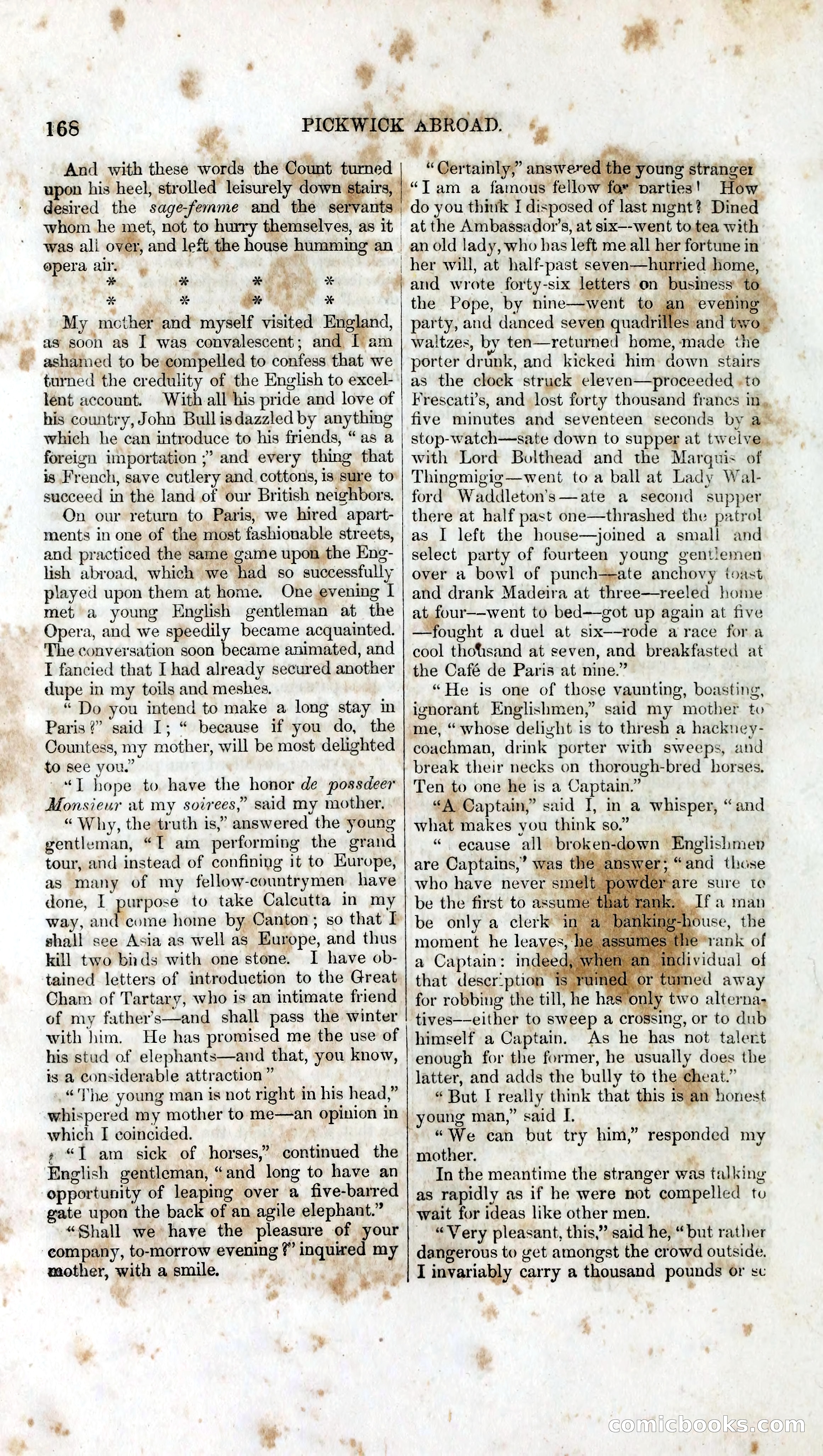
A restored page from Penny Dreadfuls, 1800. Page through the whole issue in the reader above.
📄 Transcribed text from this page (OCR, searchable)
Machine-transcribed from the original scan — historical spelling and the odd misread are preserved.
ie -eompa . ‘ x 166 “ ff, a And with these words the Count turned upon his heel, strolled leisurely down stairs, desired the sage-femme and the servants whom he a not to hurry themselves, as it was ali over, and left the house humming an opera al ae My mcther and myself visited England, as soon as I was convalescent; and I am ashamed to be compelled to confess that we turned the exelity of the Enelish to excel- lent account. With all his pride and love of his country, John Bullisdazzled by anything which he can introduce to his friends, “as a foreign importation ;’ and every thing that is French, save cutlery and cottons, is sure to’ succeed in the land of our British neighbors. On our return to Paris, we hired apart- ments in one of the most fashionable streets, and practiced the same game upon the Eng- lish abroad, which we had so successfully played upon them at home. One evening I met a young English gentleman at the Opera, and we speedily became acquainted. The converxsation soon became animated, and I fancied that I had already secured another dupe in my toils and meshes, “Do you intend to make a long stay mn Paris?” said I; “ because if you do, the Countess, my mother, will be most delighted to see you.” “IT hope to have the honor de possdeer Monsieur at my soirees,” said my mother. “Why, the truth is,” answered the young gentleman, “I am performing the grand tour, and instead of confining it to Europe, as many of my fellow-countrymen have done, I goths tu take Calcutta in my way, anc shall see Asia as well as Europe, and thus kill two binds with one stone. I have ob- tained letters of introduction to the Great Cham of Tartary, who is an intimate friend of my father’s—and shall pass the winter with him. He has promised me the use of his stud of elephants—and that, you know, is a considerable attraction ” “The young man is not right in his head,” whispered my mother to me—an opinion in which I coincided. | » “I am sick of horses,” continued the English gentleman, “and long to have an opportunity of leaping over a five-barred gate upon the back of an agile elephant.” “Shall we have the pleasure of your a ny, to-morrow evening ?” inquired my » * 4 . tee. , Pile eo « mother, with a smile. ‘come home by. Canton; so that I PICKWICK ABROAD. - | | arried home, and wrote forty-six letters on business’ " 4 “Gertainly,” answered f le yo ung frene “Tam a famous fellow fae parties! Ww do you thiuk I disposed of last nignt ? Dined at the Ambassador’s, at six—-went to. tea with an old lady, who has left me all her fortune in her will, at half-past seven—hu1 . 7a the Pope, by nine—went to an evening party, and danced seven quadrilles and two. waltzes, by ten—returned home, made the porter drunk, and kicked him down stairs as the clock struck eleven—proceeded .to Frescati’s, and lost forty thousand frances in, five minutes and seventeen seconds by a. stop-watch—sate down to supper at twelve. with Lord Bolthead and the Marguis of Thingmigig—went toa ball at Lady Wal- ford Waddleton’s—ate a second supper there at half past one—thrashed the patrol as I left the house—joined a small and select party of fourteen young gentlemen over a bowl of punch—ate anchovy toast and drank Madeira at three—reeled home at. four-—-went to bed—got up again at five —fought a duel at six—-rode a race fora cool thofisand at seven, and breakfasted at the Café de Paris at nine.” “He is one of those vaunting, boasting, ignorant Englishmen,” said my mother to me, “whose deliyht is to thresh a hackney- coachman, drink porter with sweeps, and break their necks on thorough-bred borses, Ten to one he is a Captain.” “A Captain,” said I, in a whisper, “and what makes you think so.” “ ecause all broken-down Englishmen are Captains,’ was the answer; “and thuse who have never smelt powder are sure to be the first to assume that rank. Ifa man be only a clerk in a banking-house, the moment he leaves, he assumes the*rank of a Captain: indeed, when an 1 dividual of that deser!ption Is | Lor tumed away for robbing the till, he hasonly two alterna: tives—-either to sweep a crossing, or to dub himself a Captain. As he has not talent enough for the former, he usually does the latter, and adds the bully to the cheat.” “ But I really think that this im honest young man,” said I. “We can but try him,” responded my mother. , In the meantime the stranger was talking as rapidly as if he were not compelled tu wait for ideas like other men. _ “Very pleasant, this,” said he, “but rather dangerous to get amongst the crowd outside. I invariably carry a thousand pounds or sc CORNIECLOOKSsE@ im