
Penny Dreadfuls, 1800 · page 169 of 400
Pickwick Abroad: A Companion to the Pickwick Papers — page 169: what you’re looking at
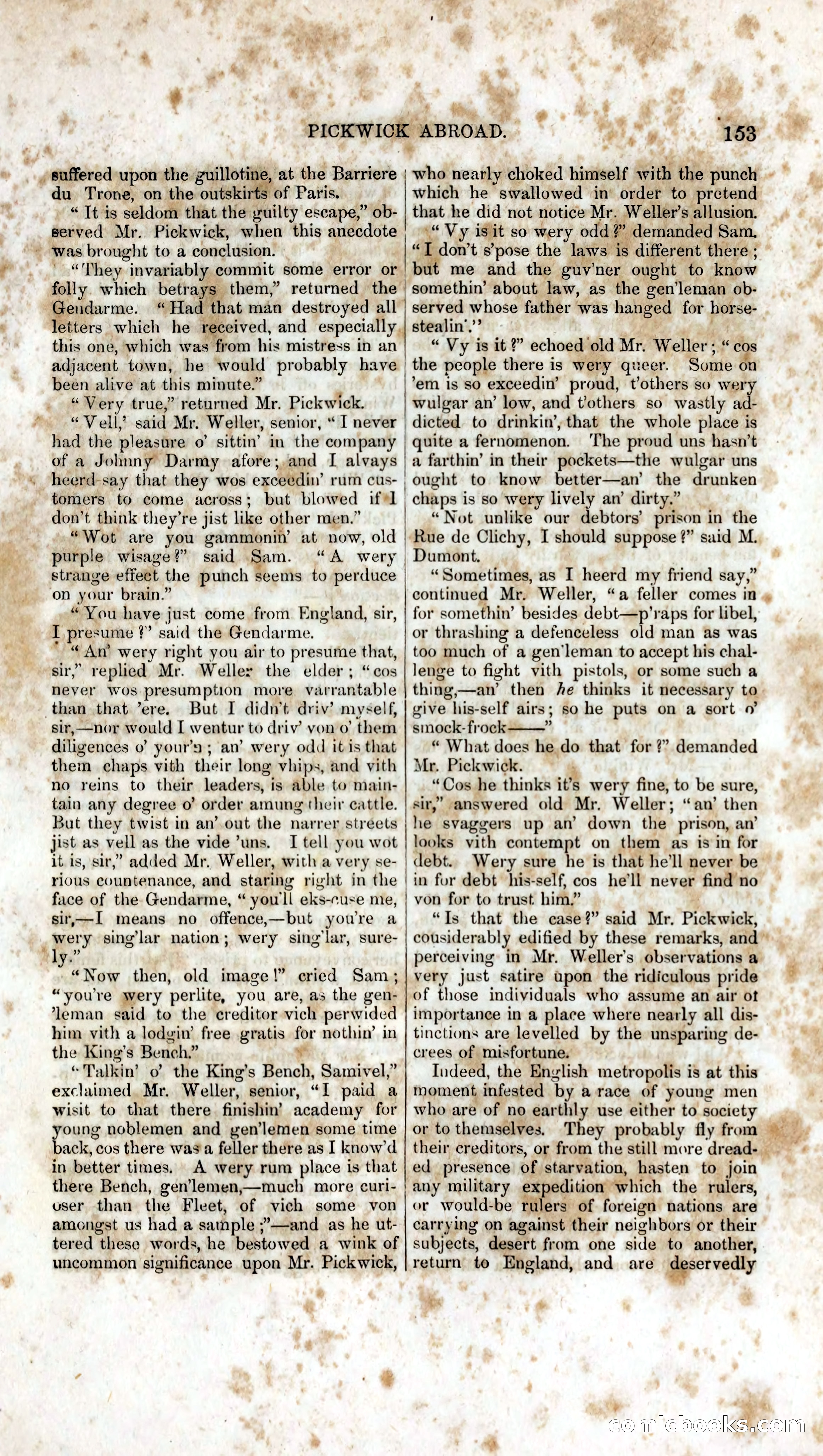
A restored page from Penny Dreadfuls, 1800. Page through the whole issue in the reader above.
📄 Transcribed text from this page (OCR, searchable)
Machine-transcribed from the original scan — historical spelling and the odd misread are preserved.
~« heerd-say that they wos exceedin’ rum cus- ay 7 as ” ad A a : - y re ) oon” | me . . ‘ a? , | P . eS agit oy ak ¥: PICKWICK ABROAD. ee 9 153 oY ; bi) : i, ’ 4 _- Sark, a +. ¥. suffered upon the guillotine, at the Barriere | who nearly choked himself with the punch - ;. du Trone, on the outskirts of Paris. - “Tt is seldom that the guilty escape,” ob- served Mr. Pickwick, when this anecdote © (was brought to a conclusion. — _ “They invariably commit some error or folly. which betrays them,” returned the Gendarme. “Had th : etters which he received, and especially. this one, which was from his mistress in an adjacent town, he would probably have been alive at this minute.” _ “Very true,” returned Mr. Pickwick. “Vell, said Mr. Weller, senior, “ I never had the pleasure o’ sittin’ in the company of a Johnny Darmy afore; and I alvays * ; tomers to come across; but blowed if don’t think they’re jist like other men.” -.*Wot are you gammonin’ at now, old | purple wisage?” said .- “A wery strange effect the punch seems to perduce on your brain.” “You have just come from England, sir, I presume ?” said the Gendarme. “““ An’ wery right you air to presume that, sir, replied Mr. Weller the elder; “cos neyer wos presumption more varrantable than that ’ere. But I didn’t driv’ myself, sir,—nor would I wentur to driv’ von o’ them diligences o’ your's; an’ wery odd itis that them chaps vith their long vhips, and vith no reins to their leaders, is able to main- tain any degree o’ order amung their cattle. But they twist in an’.out the narrer streets jist as vell as the vide ’uns. I tell you wot it is, sir,” added Mr. Weller, with a very se- rious countenance, and staring right in the face of the Gendarme, “ you'll eks-cuse me, sir,—I means no offence,—but youre a fey sing’lar nation; wery sing’lar, sure- \ » ie Now then, old image!” cried Sam; “you're wery perlite, you are, as the gen- ‘leman said to the creditor vich perwided him vith a lodgin’ free gratis for nothin’ in the King’s Bench.” ¥ “ Talkin’ o the King’s Bench, Samivel,” exclaimed Mr. Weller, senior, “I paid a wisit to that there finishin’ academy for young noblemen and gen’lemen some time back, cos there wasa feller there as I know'd in better times. A wery rum place is that there Bench, gen’lemen,—much more curi- user than the Fleet, of vich some von amongst us had a satnple ;’"—and as he ut- tered these words, he bestowed a wink of uncommon significance upon Mr. Pickwick, 2 which he swallowed in order to pretend that he did not notice Mr. Weller’s allusion. I Vy isiit so wery odd” demanded Sam. “T don’t s’pose the laws » different there ; but me and the guy’ner ought to know somethin’ about law, as the gen’leman ob- ‘| served whose father was hanged for horse- stealin’.”” Ee, nl dee “ Vy is it 2” echoed old Mr. Weller; “ . the people there is wery queer. Some « ‘em is so exceedin’ proud, t’others so we wulgar an’ low, and tothers so wastly ad- dicted to drinkin’,that the whole place is quite a fernomenon. The proud uns hasn't a farthin’ in their pockets—the wulgar uns ought to know better—an’ the drunken chaps is so wery lively an’ dirty.” _ “Not unlike our debtors’ prison in the Rue de Clichy, I should suppose ?” said M. Dumont. “Sometimes, as I heerd my friend say,” continued Mr. Weller, “a feller comes in for somethin’ besides debt—p’raps for libel, or thrashing a defenceless old man as was too much of a gen'leman to accept his chal- lenge to fight vith pistols, or some such a thing,—an’ then Ae thinks it necessary to. give his-self airs; so he puts on a sort 0’ smock-frock——” “ What does he do that for ?”? demanded Mr. Pickwick. “Cos he thinks its wery fine, to be sure, : sir,” answered old Mr. Weller; ‘an’ then he svaggers up an’ down the prison, an’ looks vith contempt on them as is in for debt. Wery sure he is that he'll never be in fur debt his-self, cos he'll never find no von for to trust him,” “Ts that the case?” said Mr. Pickwick, cousiderably edified by these remarks, and” _ perceiving in Mr. Weller’s observations a very just satire upon the ridiculous pride of those individuals who assume an air ot importance in a place where nearly all dis- tinctions are levelled by the unsparing de- ' crees of misfortune. Indeed, the English metropolis is at this moment infested by a race of young men who are of no earthly use either to society | or to themselves. They probably fly from | their creditors, or from the still more dread- ed presence of starvation, hasten to join | any military expedition which the rulers, or would-be rulers of foreign nations are carrying on against their neighbors or their subjects, desert from one side to another, return to England, and are iggrct vedly 7 ie lLOOOLK COM Z ”