
Penny Dreadfuls, 1800 · page 129 of 400
Pickwick Abroad: A Companion to the Pickwick Papers — page 129: what you’re looking at
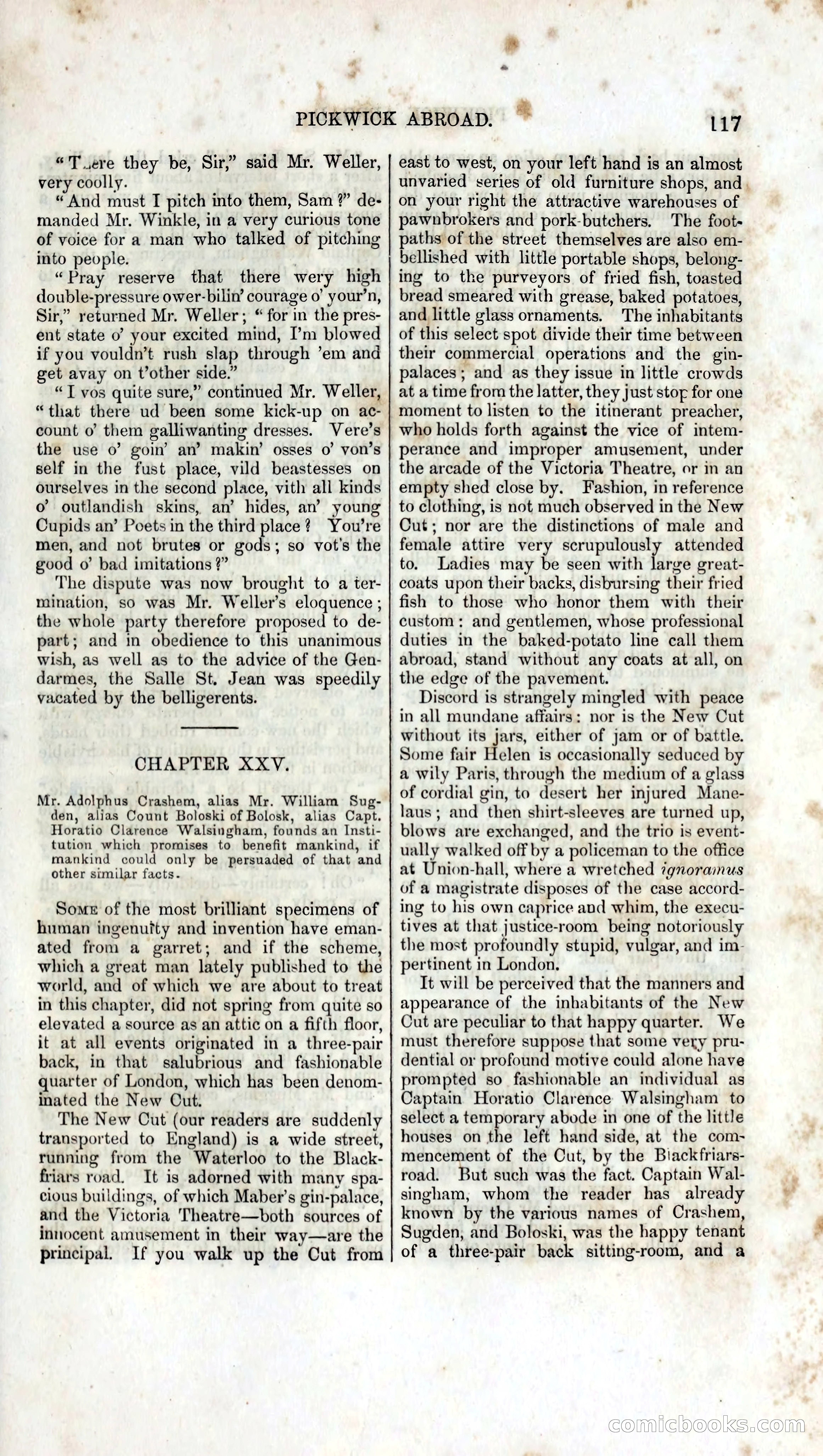
A restored page from Penny Dreadfuls, 1800. Page through the whole issue in the reader above.
📄 Transcribed text from this page (OCR, searchable)
Machine-transcribed from the original scan — historical spelling and the odd misread are preserved.
PICKWICK ABROAD. “Tere they be, Sir,” said Mr. Weller, very coolly. “And must I pitch into them, Sam ?” de- manded Mr. Winkle, in a very curious tone of voice for a man who talked of pitching into people. , “Pray reserve that there wery high double-pressure ower-bilin’ courage o’ your’n, Sir,” returned Mr. Weller; “ for in the pres- ent state o’ your excited mind, I’m blowed if you vouldn’t rush slap through ’em and get avay on t’other side.” “T vos quite sure,” continued Mr. Weller, “that there ud been some kick-up on ac- count o’ them galliwanting dresses. Vere’s the use 0’ goin’ an’ makin’ osses 0’ von’s self in the fust place, vild beastesses on ourselves in the second place, vith all kinds o outlandish skins, an’ hides, an’ young Cupids an’ Poets in the third place? You’re men, and not brutes or gods; so vot's the good o’ bad imitations ?” The dispute was now brought to a ter- mination, so was Mr. Weller’s eloquence ; the whole party therefore proposed to de- part; and in obedience to this unanimous wish, as well as to the advice of the Gen- darmes, the Salle St. Jean was speedily vacated by the belligerents. CHAPTER XXYV. Mr. Adolphus Crashem, alias Mr. William Sug- den, alias Count Boloski of Bolosk, alias Capt. Horatio Clarence Walsingham, founds an Insti- tution which promises to benefit mankind, if mankind could only be persuaded of that and other similar facts. Some of the most brilliant specimens of human ingenufty and invention have eman- ated from a garret; and if the scheme, which a great man lately published to the world, and of which we are about to treat in this chapter, did not spring from quite so elevated a source as an attic on a fifth floor, it at all events originated in a three-pair back, in that salubrious and fashionable quarter of London, which has been denom- inated the New Cut. The New Cut (our readers are suddenly transported to England) is a wide street, running from the Waterloo to the Black- friars road. It is adorned with many spa- cious buildings, of which Maber’s gin-palace, and the Victoria Theatre—both sources of innocent amusement in their way—are the principal. If you walk up the Cut from a ? 117 east to west, on your left hand is an almost unvaried series of old furniture shops, and, on your right the attractive warehouses of pawnbrokers and pork-butchers. The foot- paths of the street themselves are also em- bellished with little portable shops, belong- ing to the purveyors of fried fish, toasted bread smeared with grease, baked potatoes, and little glass ornaments. The inhabitants of this select spot divide their time between their commercial operations and the gin- palaces; and as they issue in little crowds at a time from the latter, they Just stor for one moment to listen to the itinerant preacher, who holds forth against the vice of intem- perance and improper amusement, under the arcade of the Victoria Theatre, or in an empty shed close by. Fashion, in reference to clothing, is not much observed in the New Cut; nor are the distinctions of male and female attire very scrupulously attended to. Ladies may be seen with Ataee great- coats upon their backs, disbursing their fried fish to those who honor them with their custom; and gentlemen, whose professional duties in the baked-potato line call them abroad, stand without any coats at all, on the edge of the pavement. Discord is strangely mingled with peace in all mundane affairs: nor is the New Cut without its jars, either of jam or of battle. Some fair Helen is occasionally seduced by a wily Paris, through the medium of a glass of cordial gin, to desert her injured Mane- laus ; and then shirt-sleeves are turned up, blows are exchanged, and the trio is event- ually walked off by a policeman to the office at Union-hall, where a wretched ignoramus of a magistrate disposes of the case accord- ing to his own caprice and whim, the execu- tives at that justice-room being notoriously the most profoundly stupid, vulgar, and im- pertinent in London. It will be perceived that the manners and appearance of the inhabitants of the New Cut are peculiar to that happy quarter. We must therefore suppose that some very pru- dential or profound motive could alone have prompted so fashionable an individual as Captain Horatio Clarence Walsingham to select a temporary abode in one of the little houses on the left hand side, at the com- mencement of the Cut, by the Biackfriars- road. But such was the fact. Captain Wal- singham, whom the reader has already known by the various names of Crashem, Sugden, and Boloski, was the happy tenant of a three-pair back sitting-room, and a * +? LOO (C©@) S (CO)