
Penny Dreadfuls, 1800 · page 124 of 400
Pickwick Abroad: A Companion to the Pickwick Papers — page 124: what you’re looking at
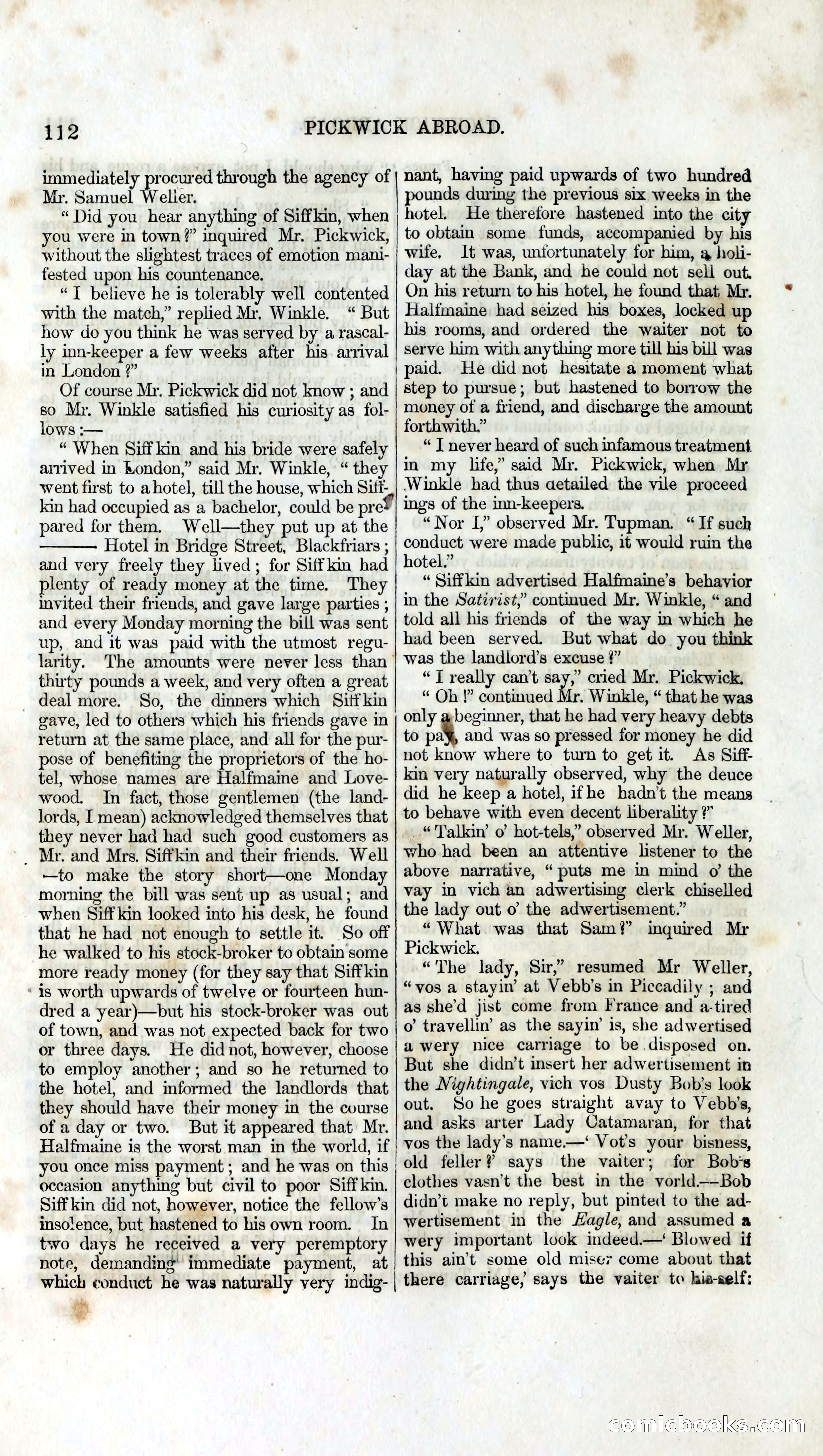
A restored page from Penny Dreadfuls, 1800. Page through the whole issue in the reader above.
📄 Transcribed text from this page (OCR, searchable)
Machine-transcribed from the original scan — historical spelling and the odd misread are preserved.
112 PICKWICK ABROAD. immediately procured through the agency of | nant, having paid upwards of two hundred Mr. Samuel Welier. “Did you hear anything of Siffkin, when you were in town?” inquired Mr. Pickwick, without the slightest traces of emotion mani- fested upon his countenance. “T believe he is tolerably well contented with the match,” replied Mr, Winkle. “ But how do you think he was served by a rascal- ly inn-keeper a few weeks after his arrival in London ?” Of course Mr. Pickwick did not know ; and so Mr. Winkle satisfied his curiosity as fol- lows :— “When Siffkin and his bride were safely arrived in kondon,” said Mr. Winkle, “ they went first to a hotel, till the house, which Siff- unds during the previous six weeks in the hotel. He therefore hastened into the city to obtam some funds, accompanied by his wife, It was, unfortunately for him, g holi- day at the Bank, and he could not sell out. On his return to his hotel, he found that Mr. Halfmaine had seized his boxes, locked up his rooms, and ordered the waiter not to serve him with anything more till his bill was paid. He did not hesitate a moment what step to pursue; but hastened to borrow the money of a friend, and discharge the amount forthwith.” “ T never heard of such infamous treatment in my life,” said Mr. Pickwick, when Mr Winkle had thus detailed the vile proceed kin had occupied as a bachelor, could be pre®| ings of the inn-keepers. pared for them. Well—they put up at the Hotel in Bridge Street, Blackfriars ; and very freely they lived; for Siffkin had plenty of ready money at the time. They invited their friends, and gave large parties ; and every Monday morning the bill was sent up, and it was paid with the utmost regu- larity. The amounts were never less than thirty pounds a week, and very often a great - deal more. So, the dinners which Sitfkin gave, led to others which his friends gave in return at the same place, and all for the pur- pose of benefiting the proprietors of the ho- tel, whose names are Halfmaine and Love- wood. In fact, those gentlemen (the land- lords, I mean) acknowledged themselves that they never had had such good customers as - Mr. and Mrs. Siffkin and their friends. Well —to make the story short—one Monday morning the bill was sent up as usual; and when Siff kin looked into his desk, he found that he had not enough to settle it. So off he walked to his stock-broker to obtain some more ready money (for they say that Siffkin 1s worth upwards of twelve or fourteen hun- dred a year)—but his stock-broker was out of town, and was not expected back for two or three days. He did not, however, choose to employ another; and so he retumed to the hotel, and informed the landlords that they should have their money im the course of a day or two. But it appeared that Mr. Halfmaine is the worst man in the world, if you once miss payment; and he was on this occasion anything but civil to poor Siff kin. Siff kin did not, however, notice the fellow’s insolence, but hastened to his own room. In two days he received a very peremptory note, demanding’ immediate payment, at which eonduct he was naturally very indig- ia “Nor I,” observed Mr. Tupman. “If such conduct were made public, it would ruin the hotel.” “ Siffkin advertised Halfmaine’s behavior in the Satirist,’ contimued Mr. Winkle, “ and told all his friends of the way in which he had been served. But what do you think 1 was the landlord’s excuse ?” “T really can't say,” cried Mr. Pickwick. “ Oh |!” continued Mr. Winkle, “ that he was only @ beginner, that he had very heavy debts to pa¥, and was so pressed for money he did not know where to twn to get it. As Siff kin very naturally observed, why the deuce did he keep a hotel, ifhe hadn't the means to behave with even decent liberality ?” “Talkin o’ hot-tels,” observed Mr. Weller, who had been an attentive listener to the above narrative, “puts me mm mind o’ the vay in vich an adwertising clerk chiselled the lady out o the adwertisement.” “What was that Sam?” imquired Mr Pickwick. “The lady, Sir,’ resumed Mr Weller, “vos a stayin’ at Vebb’s in Piccadily ; and as she’d jist come from France and a-tired o’ travellin’ as the sayin is, she adwertised awery nice carriage to be disposed on. But she didn’t insert her adwertisement in the Nightingale, vich vos Dusty Bob’s look out. So he goes straight avay to Vebb’s, and asks arter Lady Catamaran, for that vos the lady’s name.—‘ Vot’s your bisness, old feller? says the vaiter; for Bob’s clothes vasn't the best in the vorld——Bob didn’t make no reply, but pinted to the ad- wertisement in the Hagle, and assumed a wery important look indeed.— Blowed if this ain't some old mise7 come about that there carriage, says the vaiter to hie-self: EO) 10))O) (9) (C(O)