
Penny Dreadfuls, 1800 · page 106 of 400
Pickwick Abroad: A Companion to the Pickwick Papers — page 106: what you’re looking at
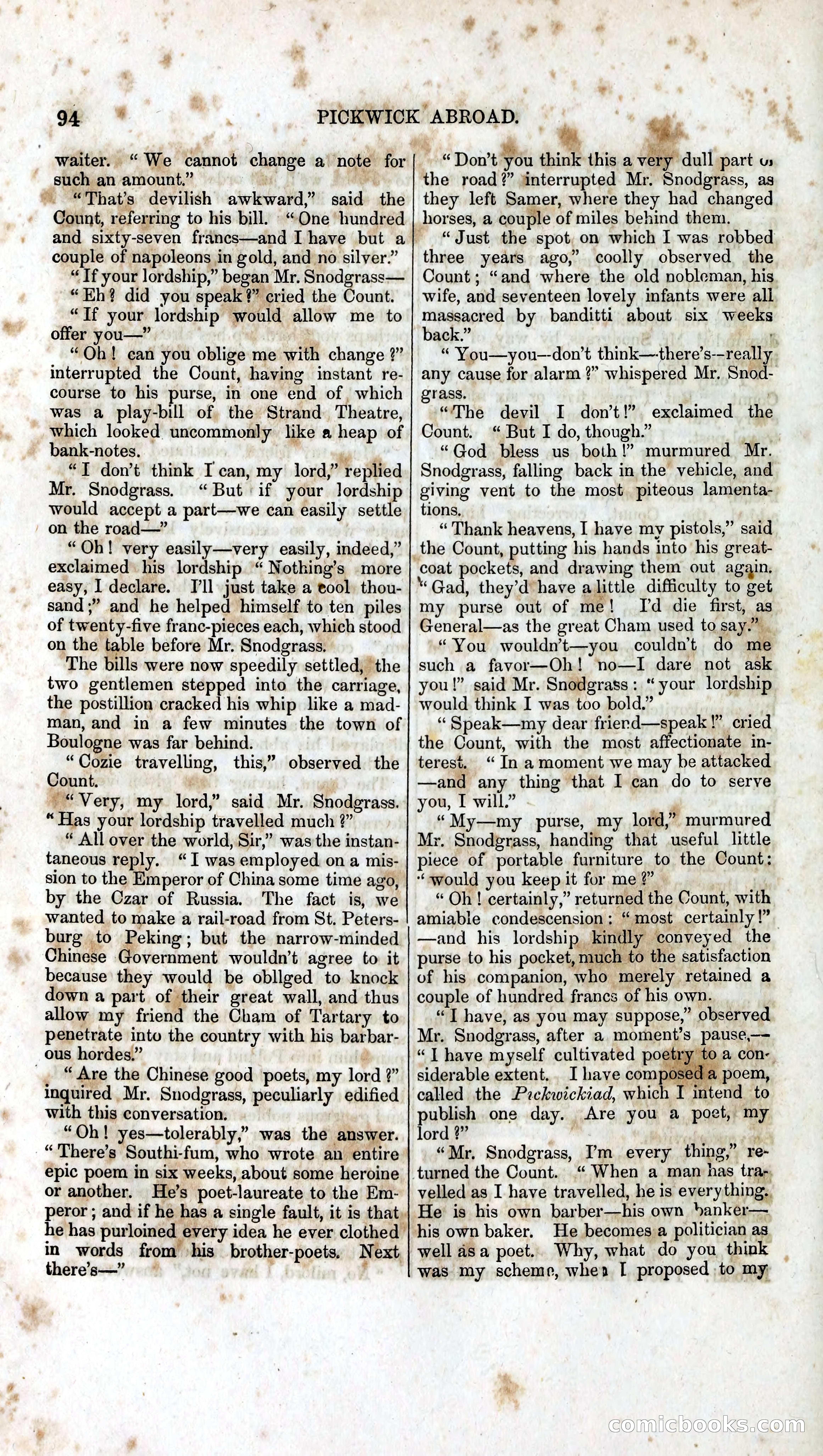
A restored page from Penny Dreadfuls, 1800. Page through the whole issue in the reader above.
📄 Transcribed text from this page (OCR, searchable)
Machine-transcribed from the original scan — historical spelling and the odd misread are preserved.
94 © 7. PICKWICK ABROAD. waiter. “We cannot change a' note for | such an amount.” | | -. “That's devilish awkward,” said the Count, referring to his bill. “One hundred and sixty-seven francs—and I have but a] couple of napoleons in gold, and no silver.” “Tf your lordship,” began Mr. Snodgrass— “Eh? did you speak?” cried the Count. “If your lordship would allow me to offer you—” Ef “Oh! can you oblige me with change ?” interrupted the Count, having instant re- course to his purse, in one end of, which was a play-bill of the Strand. Theatre, which looked uncommonly like a heap of bank-notes. , wy | “TI don’t think I can, my lord,” replied Mr. Snodgrass. “But if your lordship would accept a part—we can easily settle on the road—” “Oh! very easily—very easily, indeed,” exclaimed his lordship “ Nothing’s more easy, I declare. I'll just take a tool, thou- sand;” and he helped himself to ten piles of twenty-five franc-pieces each, which stood on the table before Mr. Snodgrass. The bills were now speedily settled, the two gentlemen stepped into the carriage, the postillion cracked his whip like a mad- man, and in a few minutes the town of Boulogne was far behind. “Cozie travelling, this,” observed the Count. PY. “Very, my lord,” said Mr. Snodgrass. “Has your lordship travelled much ?” “ All over the world, Sir,” was the instan- taneous reply. “I was employed ona mis- sion to the Emperor of China some time ago, by the Czar of Russia. The fact is, we wanted to make a rail-road from St. Peters- burg to Peking; but the narrow-minded Chinese Government wouldn’t agree to it because they would be obliged to knock down a part of their great wall, and thus allow my friend the Cham of Tartary to penetrate into the country with his barbar- ous hordes.’ : " _ “Are the Chinese good poets, my lord ?” inquired Mr. Snodgrass, peculiarly edified with this conversation. “Oh! yes—tolerably,” was the answer. “There’s Southi-fum, who wrote an entire epic poem in six weeks, about some heroine or another. He’s poet-laureate to the Em- peror ; and if he has a single fault, it is that, he has purloined every idea he ever clothed in words from ‘his brother-poets. Next there’s—” i “ Don’t you think this a very dull part us the road?” interrupted Mr. Snodgrass, as they left Samer, where they had changed horses, a couple of miles behind them. “Just the spot, on which I was robbed three years ago,’ coolly observed the Count; “and where the old nobleman, his wife, and seventeen lovely imfants were all massacred by banditti about six weeks back.” | re “ You—you—-don’t think—there’s--really any cause for alarm ?” whispered Mr. Snod- grass. , “The devil I don’t!” exclaimed the Count. “ But I do, though.” “God bless us both!” murmured Mr. Snodgrass, falling back in the vehicle, and giving vent to the most piteous lamenta- tions, “ Thank heavens, I have my pistols,” said the Count, putting his hands into his great- coat pockets, and drawing them out again, “Gad, they’d have alittle difficulty to get my purse out of me! Id die first, as General—as the great Cham used to say.” | “You wouldn’t—you couldn't do me such a favor—Oh! no—I dare not ask you!” said Mr. Snodgrass: “your lordship would think I was too bold.” “ Speak—my dear frienrd—speak !” cried the Count, with the most affectionate in- terest. “In amoment we may be attacked —and any thing that I can do to serve you, [ will.” ‘ “My—my purse, my lord,” murmured Mr. Snodgrass, handing that useful little piece of portable furniture to the Count: ‘would you keep it for me ?” “Oh! certainly,” returned the Count, with amiable condescension; “ most certainly!” —and his lordship kindly conveyed the purse to his pocket, much to the satisfaction of his companion, who merely retained a couple of hundred francs of his own. “T have, as you may suppose,” observed Mr. Snodgrass, after a moment’s pause,—— “T have myself cultivated poetry to a con-. siderable extent. I have composed a poem, called the Prckwickiad, which I intend to publish one day. Are you a poet, my lord ?” A aah “Mr, Snodgrass, I’m every thing,’ ’ re~- turned the Count. “ When a man has tras, velled as I have travelled, he is everything. He is his own barber—his own »banker— his own baker. He becomes.a politician as well asa poet.. Why, what do you think was my scheme, whea I proposed to my: @) (CONN I NOO/KS.~EO