
Penny Dreadfuls, 1890 · page 9 of 31
Old Cap. Collier Library No. 379: The Lawyer Detective — page 9: what you’re looking at
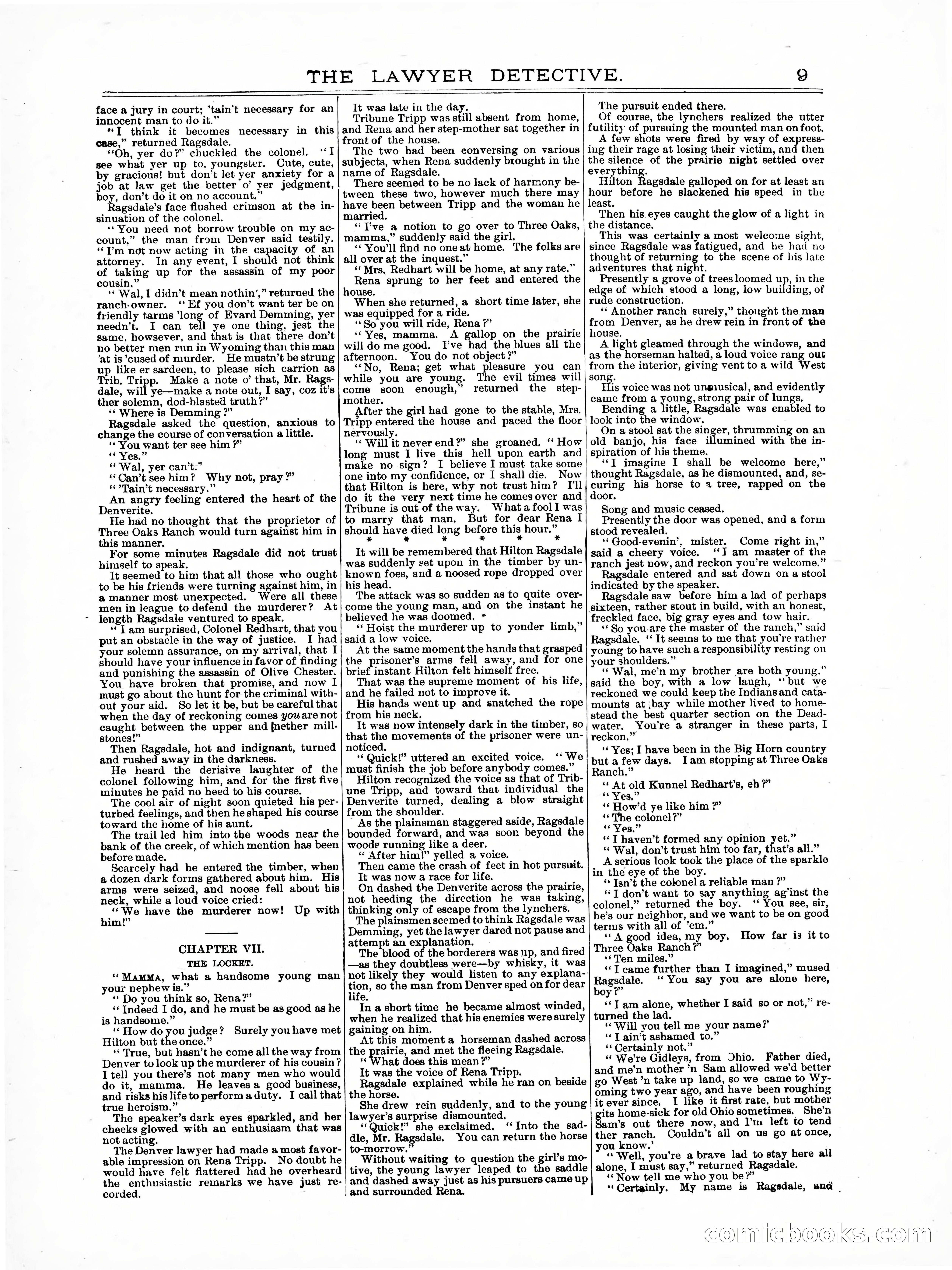
A restored page from Penny Dreadfuls, 1890. Page through the whole issue in the reader above.
📄 Transcribed text from this page (OCR, searchable)
Machine-transcribed from the original scan — historical spelling and the odd misread are preserved.
ey face a jury in court; ’tain’t necessary for an innocent man to do it.” “TIT think it becomes necessary in this case,” returned Ragsdale. “Oh, yer do?” chuckled the colonel. ‘‘I see what yer up to, youngster. Cute, cute, by gracious! but don’t let yer anxiety for a job at law get the better o’ yer jedgment, boy, don’t do it on no account.” Ragsdale’s face flushed crimson at the in- sinuation of the colonel. ‘*You need not borrow trouble on my ac- count,” the man from Denver said testily. ‘‘T’m not now acting in the capacity of an attorney. In any event, I should not think of taking up for the assassin of my poor cousin,” ‘‘ Wal, I didn’t mean nothin’,” returned the ranch-owner. ‘‘ Ef you don’t want ter be on friendly tarms ‘long of Evard Demming, yer needn’t. I can tell ye one thing, jest the same, howsever, and that is that there don’t no better men run in Wyoming than this man 'at is’cused of murder. He mustn’t be strung up like er sardeen, to please sich carrion as Trib. Tripp. Make a note o’ that, Mr. Rags- dale, wall yeamales a note out, I say, coz it’s ther solemn, dod-blasted truth?” ‘* Where is Demming ?” Ragsdale asked the question, anxious to change the course of conversation a little. ‘‘-You want ter see him ?” ‘* Yes.” ‘‘'Wal, yer can’t.” ‘“Can’t see him? Why not, pray?” ‘°>Tain’t necessary.” An angry feeling entered the heart of the Denverite. He had no thought that the proprietor of Three Oaks Ranch would turn against him in this manner. For some minutes Ragsdale did not trust himself to speak. It seemed to him that all those who ought to be his friends were turning against him, in @ manner most unexpected. Were all these men in league to defend the murderer? At length Ragsdale ventured to speak. ‘“T am surprised, Colonel Redhart, that you put an obstacle in the way of justice. I had your solemn assurance, on my arrival, that I should have your influence in favor of finding and punishing the assassin of Olive Chester. You have broken that promise, and now I must go about the hunt for the criminal with- out your aid. So let it be, but be careful that when the day of reckoning comes youare not caught between the upper and [nether mill- stones!” Then Ragsdale, hot and indignant, turned and rushed away in the darkness. He heard the derisive laughter of the colonel following him, and for the first five minutes he paid no heed to his course. The cool air of night soon quieted his per- turbed feelings, and then he shaped his course toward the home of his aunt. The trail led him into the woods near the bank of the creek, of which mention has been before made. Scarcely had he entered the timber, when a dozen dark forms gathered about him. His arms were seized, and noose fell about his neck, while a loud voice cried: " ‘‘We have the murderer now! Up with im!” —— CHAPTER VII. THE LOCKET. ‘*Mamma, what a handsome young man your nephew is.” ‘‘Do you think so, Rena?” ‘Indeed I do, and he must be as good as he is handsome.” ‘‘ How do you judge? Surely you have met Hilton but the once.” ‘“True, but hasn’t he come all the way from Denver to look up the murderer of his cousin? I tell you there’s not many men who would do it, mamma. He leaves a good business, and risks his life to performaduty. I call that true heroism.” The speaker’s dark eyes sparkled, and her cheeks glowed with an enthusiasm that was not acting. The Denver lawyer had made a most favor- able impression on Rena Tripp. No doubt he would have felt flattered had he overheard the enthusiastic remarks we have just re- corded. THE LAWYER DETECTIVE. It was late in the day. Tribune Tripp was still absent from home, and Rena and her step-mother sat together in front of the house. The two had been conversing on various subjects, when Rena suddenly brought in the name of Ragsdale. There seemed to be no lack of harmony be- tween these two, however much there may have been between Tripp and the woman he married. ‘‘T’ve a notion to go over to Three Oaks, mamma,” suddenly said the girl. ‘You'll find no oneat home. The folks are all over at the inquest.” ‘Mrs. Redhart will be home, at any rate.” Rena sprung to her feet and entered the house. When she returned, a short time later, she was equipped for a ride. ‘‘So you will ride, Rena ?” ‘‘Yes, mamma. A gallop on the prairie will do me good. I’ve had the blues all the afternoon. You do not object?” ‘No, Rena; get what pleasure you can while you are young. The evil times will come soon enough,” returned the step- mother. After the girl had gone to the stable, Mrs. Tripp entered the house and paced the floor nervously. ‘¢ Will it never end?” she groaned. ‘“‘ How long must I live this hell upon earth and make no sign? I believe I must take some one into my confidence, or I shall die. Now that Hilton is here, why not trust him? [Pll do it the very next time he comes over and Tribune is out of the way. WhatafoolI was to marry that man. But for dear Rena I should have died long before this hour.” * * It will be remembered that Hilton Ragsdale was suddenly set upon in the timber by un- known foes, and a noosed rope dropped over his head. The attack was so sudden as to quite over- come the young man, and on the instant he believed he was doomed. ° ‘‘ Hoist the murderer up to yonder limb,” said a low voice. At the same moment the hands that grasped the prisoner’s arms fell away, and for one brief instant Hilton felt himself free. That was the supreme moment of his life, and he failed not to improve it. His hands went up and snatched the rope from his neck. It was now intensely dark in the timber, so that the movements of the prisoner were un- noticed. ‘“‘ Quick!” uttered an excited voice. ‘‘ We must finish the job before anybody comes.” Hilton recognized the voice as that of Trib- une Tripp, and toward that individual the Denverite turned, dealing a blow straight from the shoulder. ’ As the plainsman staggered aside, Ragsdale bounded forward, and was soon beyond the woods running like a deer. ‘‘ After him!” yelled a voice. Then came the crash of feet in hot pursuit. It was now a race for life. On dashed the Denverite across the prairie, not heeding the direction he was taking, thinking only of escape from the lynchers. The plainsmen seemed to think Ragsdale was Demming, yet the lawyer dared not pause and attempt an explanation. The blood of the borderers was up, and fired —as they doubtless were—by whisky, it was not likely they would listen to any explana- ent so the man from Denver sped on for dear ife. In a short time he became almost winded, when he realized that his enemies were surely gaining on him. At this moment a horseman dashed across the prairie, and met the fleeing Ragsdale. ‘What does this mean ?” It was the voice of Rena Tripp. Ragsdale explained while he ran on beside the horse. She drew rein suddenly, and to the young lawyer’s surprise dismounted. “Quick!” she exclaimed. ‘Into the sad- dle, Mr. Ragsdale. You can return the horse to-morrow.” Without waiting to question the girl’s mo- tive, the young lawyer leaped to the saddle and dashed away just as his pursuers came up and surrounded Rena. but a few days. Ranch.” 9 The pursuit ended there. Of course, the lynchers realized the utter futility: of pursuing the mounted man on foot. _ A few shots were fired by way of express- ing their rage at losing their victim, and then the silence of the prairie night settled over everything. Hilton Ragsdale galloped on for at least an hour before he slackened his speed in the least. Then his eyes caught the glow of a light in the distance. This was certainly a most welcome sight, since Ragsdale was fatigued, and he had no thought of returning to the scene of his late adventures that night. Presently a grove of trees loomed up, in the edge of which stood a long, low building, of rude construction. ‘* Another ranch eurely,” thought the man from Denver, as he drew rein in front of the house. A light gleamed through the windows, and as the horseman halted, a loud voice rang out from the interior, giving vent to a wild West song. His voice was not unausica], and evidently came from a young, strong pair of lungs, Bending a little, Ragsdale was enabled to look into the window. On a stool sat the singer, thrumming on an old banjo, his face illumined with the in- spiration of his theme. ‘‘T imagine I shall be welcome here,” thought Ragsdale, as he dismounted, and, se- unre his horse to 2 tree, rapped on the oor. Song and music ceased. Presently the door was opened, and a form stood revealed. ‘‘Good-evenin’, mister. Come right in,” said a cheery voice. ‘‘] am master of the ranch jest now, and reckon you’re welcome.” Ragsdale entered and sat down on a stool indicated by the speaker. Ragsdale saw before him a lad of perhaps sixteen, rather stout in build, with an honest, freckled face, big gray eyes and tow hair. ‘‘So you.are the master of the ranch,” said Ragsdale. ‘‘ It seems to me that you're rather young to have such a responsibility resting on your shoulders.” ‘‘ Wal, me’n my brother are both young,” said the boy, with a low laugh, ‘‘but we reckoned we could keep the Indiansand cata- mounts at bay while mother lived to home- stead the best quarter section on the Dead- water. You're a stranger in these parts, I reckon.” ‘‘ Yes; I have been in the Big Horn country Iam stopping at Three Oaks ‘¢ At old Kunnel Redhart’s, eh?” ‘¢ How'd ye like him ?” ‘‘ The colonel?” 6c Yes.” ‘¢T haven’t formed any opinion yet.” ‘‘ Wal, don’t trust him too far, that’s all.” A serious look took the place of the sparkle in the eye of the boy. ‘+ Ign’t the colonel a reliable man ?” ‘JT don’t want to say anything ag’inst the colonel,” returned the boy. ‘‘ You see, sir, he’s our neighbor, and we want to be on good terms with all of ’em.” ‘* A good idea, my boy. Three Oaks Ranch ?” ‘¢Ten miles.” ‘‘T came further than I imagined,” mused Ragsdale. ‘‘You say you are alone here, boy ?”’ ‘©T am alone, whether I said so or not,” re- turned the lad. ‘Will you tell me your name?” ‘‘T ain't ashamed to.” ‘¢ Certainly not.” ‘‘ We're Gidleys, from Ohio. Father died, and me’n mother ’n Sam allowed we'd better go West ’n take up land, so we came to Wy- oming two year ago, and have been roughing it ever since, I like it first rate, but mother its home-sick for old Ohio sometimes. She’n m’s out there now, and I’w left to tend ther ranch. Couldn’t all on us go at once, you know.’ “Well, you’re a brave lad to stay here all alone, I must say,” returned Ragsdale. ‘‘ Now tell me who you be?” How far i3 it to ‘Certainly. My name is Ragsdale, and — COA ClOOO© SS