
Penny Dreadfuls, 1890 · page 7 of 31
Old Cap. Collier Library No. 379: The Lawyer Detective — page 7: what you’re looking at
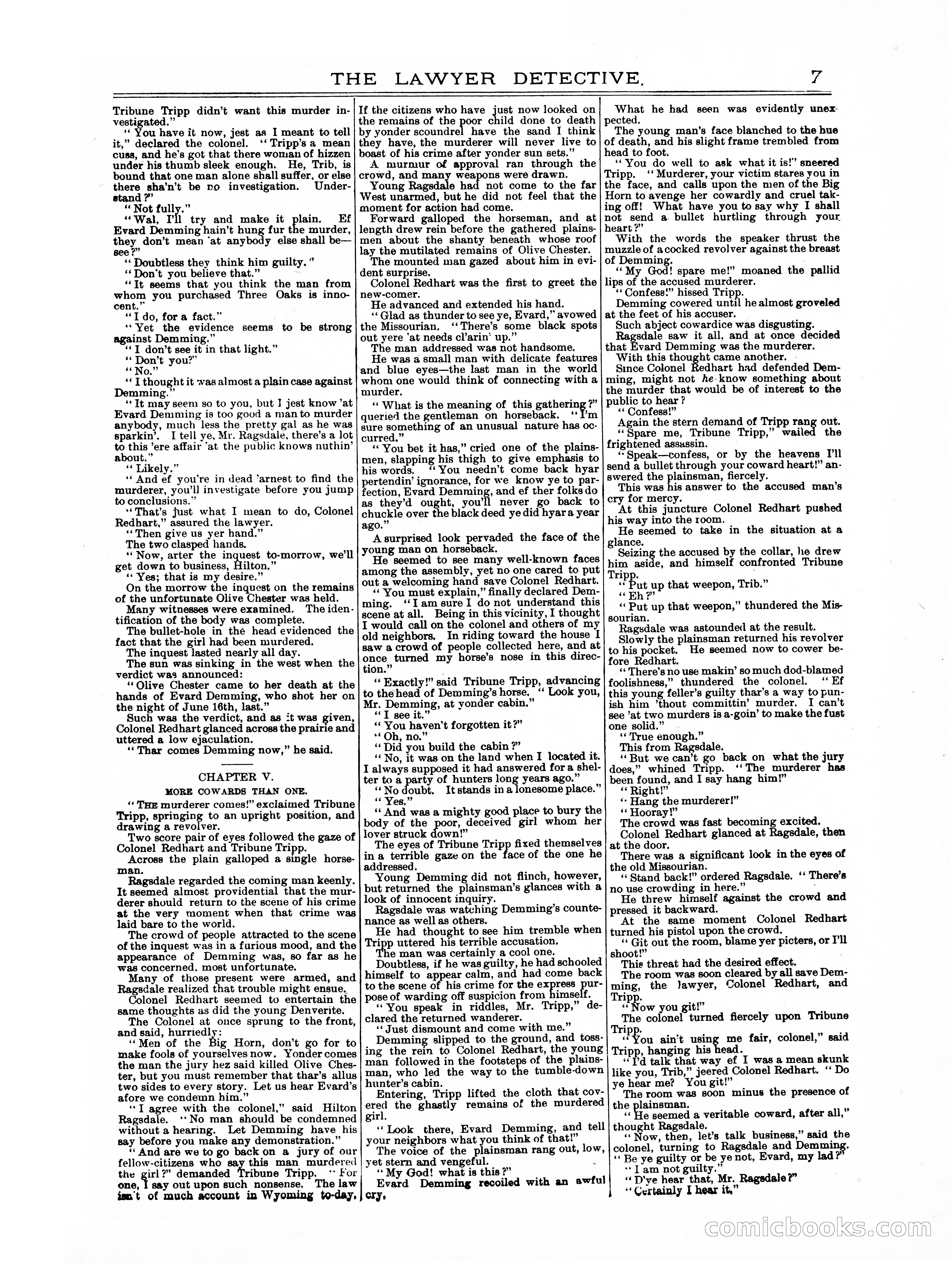
A restored page from Penny Dreadfuls, 1890. Page through the whole issue in the reader above.
📄 Transcribed text from this page (OCR, searchable)
Machine-transcribed from the original scan — historical spelling and the odd misread are preserved.
THE LAWYER DETECTIVE, vid Tribune Tripp didn’t want this murder in- vestigated.” ‘‘ You have it now, jest as I meant to tell it,” declared the colonel. ‘‘ Tripp’s a mean cuss, and he’s got that there woman of hizzen under his thumb sleek enough. He, Trib, is bound that one man alone shall suffer, or else there sha’n’t be no investigation. Under- stand ?’ “Not fully.” “Wal, ri try and make it plain. Ef Evard Demming hain’t hung fur the murder, pig! don’t mean ‘at anybody else shall be— see ?” ‘‘ Doubtless they think him guilty.” ‘Don't you believe that.” ‘“‘It seems that you think the man from whom you purchased Three Oaks is inno- cent.” “‘T do, fora fact.” ‘‘Yet the evidence seems to be strong inst Demming.” ‘‘I don’t see it in that light.” ‘Don’t you?” 66 No.” “‘T thought it was almost a plain case against Demming.”’ ‘‘It may seem so to you, but I jest know ’at Evard Demming is too good a man to murder anybody, much less the pretty gal as he was sparkin’. I tell ye, Mr. Ragsdale, there’s a lot to this ’ere affair ‘at the public knows nuthin’ about.” ‘‘ Likely.” ‘‘ And ef you're in dead ‘arnest to find the murderer, you'll investigate before you jump to conclusions.” ‘‘That’s just what I mean to do, Colonel Redhart,” assured the lawyer. ‘Then give us yer hand.” The two clasped hands, ‘Now, arter the inquest to-morrow, we'll get down to business, Hilton.” ‘Yes; that is my desire.” On the morrow the inquest on the remains of the unfortunate Olive Chester was held. Many witnesses were examined. The iden- tification of the body was complete. The bullet-hole in thé head evidenced the fact that the girl had been murdered. The inquest lasted nearly all day. The sun was sinking in the west when the verdict was announced: ‘‘Olive Chester came to her death at the hands of Evard Demming, who shot her on the night of June 16th, last.” Such was the verdict, and as :t was given, Colonel Redhart glanced across the prairie and uttered a low ejaculation. ‘‘Thar comes Demming now,” he said. CHAPTER V. MORE COWARDS THAN ONE, ‘‘ THE murderer comes!” exclaimed Tribune Tripp, springing to an upright position, and drawing a revolver. Two score pair of eyes followed the gaze of Colonel Redhart and Tribune Tripp. Across the plain galloped a single horse- man. Ragsdale regarded the coming man keenly. It seemed almost providential that the mur- derer should return to the scene of his crime at the very moment when that crime was laid bare to the world. The crowd of people attracted to the scene of the inquest was in a furious mood, and the appearance of Demming was, so far as he was concerned. most unfortunate. Many of those present were armed, and Ragsdale realized that trouble might ensue. Colonel Redhart seemed to entertain the same thoughts as did the young Denverite. The Colonel at once sprung to the front, and said, hurriedly: ‘‘Men of the Big Horn, don’t go for to make fools of yourselves now. Yonder comes the man the jury hez said killed Olive Ches- ter, but you must remember that thar’s allus two sides to every story. Let us hear Evard’s afore we condemn him.” ‘*T agree with the colonel,” said Hilton Ragsdale. ‘*No man should be condemned without a hearing. Let Demming have his say before you make any demonstration.” ‘‘ And are we to go back on a jury of our fellow-citizens who say this man murdered the girl?” demanded Tribune Tripp. °* For cael say out upon such nonsense. The law isn't of much account in Wyoming to-day, If the citizens who have just now looked on the remains of the poor child done to death by yonder scoundrel have the sand I think they have, the murderer will never live to boast of his crime after yonder sun sets.” A murmur of approval ran through the crowd, and many weapons were drawn. Young Ragsdale had not come to the far West unarmed, but he did not feel that the moment for action had come. Forward galloped the horseman, and at length drew rein before the gathered plains- men about the shanty beneath whose roof lay the mutilated remains of Olive Chester. The mounted man gazed about him in evi- dent surprise. Colonel Redhart was the first to greet the new-comer. He advanced and extended his hand. ‘‘Glad as thunder to see ye, Evard,” avowed the Missourian, ‘‘There’s some black spots out yere ‘at needs cl’arin’ up.” The man addressed was not handsome. He was a small man with delicate features and blue eyes—the last man in the world whom one would think of connecting with a murder, ‘‘ What is the meaning of this gathering ?” queried the gentleman on horseback. ‘I’m sure something of an unusual nature has oc- curred.” ‘“-You bet it has,” cried one of the plains- men, slapping his thigh to give emphasis to his words. ‘You needn’t come back hyar pertendin’ ignorance, for we know ye to par- fection, Evard Demming, and ef ther folks do as they'd ought, youll never go back to chuckle over the black deed ye did hyara year ago.” A surprised look pervaded the face of the young man on horseback. He seemed to see many well-known faces among the assembly, yet no one cared to put out a welcoming hand save Colonel Redhart. ‘You must explain,” finally declared Dem- ming. ‘‘IamsurelI do not understand this scene at all. Being in this vicinity, I thought I would call on the colonel and others of my old neighbors, In riding toward the house I saw a crowd of people collected here, and at once turned my horse’s nose in this direc- tion.” . ‘‘ Exactly!” said Tribune Tripp, advancing to the head of Demming’s horse. ‘‘ Look you, Mr. Demming, at yonder cabin.” ““T see it.” ‘You haven't forgotten it?” ** Oh, no.” ‘‘Did you build the cabin ?” ‘‘ No, it was on the land when I located it. I always supposed it had answered for a shel- ter to a party of hunters long years ago.” ‘‘No doubt. Itstands in a lonesome place.” 66 Yes. ” ‘‘ And was a mighty good place to bury the body of the r, deceived girl whom her lover struck down!” The eyes of Tribune Tripp fixed themselves in a terrible gaze on the face of the one he addressed. Young Demming did not flinch, however, but returned the plainsman’s glances with a look of innocent inquiry. Ragsdale was watching Demming’s counte- nance as well as others. He had thought to see him tremble when Tripp uttered his terrible accusation. he man was certainly a cool one. Doubtless, if he was guilty, he had schooled himself to appear calm, and had come back to the scene of his crime for the express pur- pose of warding off suspicion from himself. ‘‘ You speak in riddles, Mr. Tripp,” de- clared the returned wanderer. ‘“‘ Just dismount and come with me.” Demming slipped to the ground, and toss- ing the rein to Colonel Redhart, the young man followed in the footsteps of the plains- man, who led the way to the tumble-down hunter’s cabin. Entering, Tripp lifted the cloth that cov- ered the ghastly remains of the murdered girl, ‘‘Look there, Evard Demming, and tell your neighbors what you think of that!” The voice of the plainsman rang out, low, yet stern and vengeful. ; ‘*My God! what is this ?” Evard Demming recoiled with an awful cry, What he had seen was evidently unex- pected. The young man’s face blanched to the hue of death, and his slight frame trembled from head to foot. ‘“*You do well to ask what it is!” sneered Tripp. ‘‘ Murderer, your victim stares you in the face, and calls upon the men of the Big Horn to avenge her cowardly and cruel tak- ing off! What have you to say why I shall not send a. bullet hurtling through your heart ?” With the words the speaker thrust the muzzle of acocked revolver against the breast of Demming. ‘‘My God! spare me!” moaned the pallid lips of the accused murderer. ‘‘Confess:” hissed Tripp. Demming cowered until he almost groveled at the feet of his accuser. Such abject cowardice was disgusting. Ragsdale saw it all, and at once decided that Evard Demming was the murderer. With this thought came another. - Since Colonel Redhart had defended Dem- ming, might not he-know something about the murder that would be of interest to the public to hear? ‘‘ Confess!” Again the stern demand of Tripp rang out. ‘‘Spare me, Tribune Tripp,” wail the frightened assussin. ‘“Speak—confess, or by the heavens I'll send a bullet through your coward heart!” an- swered the plainsman, fiercely. This was his answer to the accused man’s cry for mercy. At this juncture Colonel Redhart pushed his way into the room. He seemed to take in the situation at a glance. Seizing the accused by the collar, he drew him aside, and himself confronted Tribune Tripp. ‘“Put up that weepon, Trib.” 66 Eh ?”? ‘‘Put up that weepon,” thundered the Mis- sourian. Ragsdale was astounded at the result. Slowly the plainsman returned his revolver to his pocket. He seemed now to cower be- fore Redhart. ‘‘ There’s no usé makin’ so much dod-blamed foolishness,” thundered the colonel. ‘‘ Ef this young feller’s guilty thar’s a way to pun- ish him ’thout committin’ murder. I can’t see ’at two murders is a-goin’ to make the fust one solid.” ‘True enough.” This from Ragsdale. ‘‘But we can’t go back on what the jury does,” whined Tripp. ‘‘The murderer has been found, and I say hang him!” ‘“ Right!” ‘- Hang the murderer!” ‘‘ Hooray!” The crowd was fast becoming excited. Colonel Redhart glanced at Ragsdale, then at the door. There was a significant look in the eyes of the old Missourian. ‘‘ Stand back!” ordered Ragsdale. ‘‘ There’s no use crowding in here.” He threw himself against the crowd and pressed it backward. At the same moment Colonel Redhart turned his pistol upon the crowd. ‘‘ Git out the room, blame yer picters, or I'll shoot!” 7 This threat had the desired effect. The room was soon cleared by all save Dem- ming, the lawyer, Colonel Redhart, and Tripp. = Now you git!” ; The colonel turned fiercely upon Tribune Tripp. ‘“You ain't using me fair, colonel,” said Tripp, hanging his head. ‘“T’'d talk that way ef I was a mean skunk like you, Trib,” jeered Colonel Redhart. ‘‘ Do ye hear me? You git!” The room was soon minus the presence of the plainsman. ‘«‘ He seemed a veritable coward, after all,” thought Ragsdale. ‘‘ Now, then, let’s talk business,” said the colonel, turning to Ragsdale and Demming. ‘Be ye guilty or be ye not, Evard, my lad? ‘Tam not guilty.” ‘“‘D’ye hear that, Mr. Ragsdale?” ‘Certainly I hear it,” COA @ NOOKS